
By October, the garden center starts looking different. The summer displays have thinned out. In their place are stacks of frost blankets, bags of mulch, rolls of burlap, tree wraps, bulb planters and soil-testing kits. There are hoses meant for deep watering, little thermometers for checking the soil, and structures designed to keep vegetables growing when the weather outside has stopped cooperating.
It is easy to walk in for one thing and leave wondering whether you have somehow forgotten nine others. That was the feeling one gardener had on an October trip to the garden center. She had gone in with a straightforward plan: get the garden ready for winter. Then she started looking at the shelves.
She thought about the trees in her yard. The perennial bed. The vegetables that were still producing. The one young tree she had planted that spring. She remembered that last winter had brought one particularly cold spell, but also several stretches of mild weather. Did she need a frost blanket? Probably not for everything. What about burlap? Maybe for one exposed evergreen. Mulch? She already had a pile of leaves.
The more she looked, the less useful the question “What winter garden products should I buy?” seemed.
A better question was emerging:
What problem is actually coming to my garden this winter?
That distinction matters because there is no single American winter garden. A gardener in Minnesota may be preparing for frozen soil and snow cover while someone in coastal California is planting vegetables. A homeowner in Colorado may need to think about dry winter air and young trees, while someone in the Pacific Northwest may be dealing with prolonged rain instead of deep freezes. In parts of the Southeast, fall is still a productive gardening season.
The products on the seasonal shelves aren’t necessarily unnecessary. They are simply designed for particular problems. And once you identify the problem first, the shopping list gets considerably shorter.
Start with the garden, not the shelf
Fall garden preparation is often presented as one long checklist: mulch, wrap, cover, water, test, protect. In reality, the right winterization depends on three things: what you grow, where you grow it and what your weather is likely to do.
The research behind these recommendations shows just how different the October-to-December Garden can look from one part of the country to another. Northern regions shift toward physical protection from freezing temperatures, wind and wildlife, while warmer areas may still be actively planting cool-season crops.
So before buying anything, walk the garden. Look at the plants that are still growing, anything newly planted, young trees, exposed evergreens and containers. Then ask what went wrong last winter—or what nearly went wrong. That is usually more useful than a seasonal display telling you what to buy.
If an early freeze is the problem, a frost blanket may make sense
The first real freeze is often when gardeners discover that their garden isn’t quite finished with summer. There may still be peppers hanging on the plants. A few tomatoes may be stubbornly ripening. Fall greens may be growing well enough that it seems wasteful to let one cold night end the season.
This is where floating row covers and frost blankets can earn their space. These fabrics can create a small buffer around plants by reducing heat loss and protecting foliage from wind. University of Wisconsin Extension notes that the degree of protection depends on the weight of the fabric, with heavier covers providing substantially more frost protection. But that doesn’t mean every plant needs to be wrapped when the forecast drops.
If the garden contains fully dormant, cold-hardy perennials that are finished for the season, there may be nothing to protect. The product is more useful when there is something you are actually trying to keep growing. That might be a vegetable garden in the Midwest, a raised bed of fall greens, or a container plant that is more vulnerable than the same species growing in the ground.
One detail matters: the cover needs to protect the plant without becoming a sealed plastic tent. Row covers are designed to allow air, light and water through. If fabric is supported over foliage, it can also reduce abrasion and prevent wet snow from sitting directly on the plants.
And don’t confuse lightweight insect netting with a genuine frost-protection fabric. If the garden is already going dormant, however, there may be nothing to buy.
If the soil keeps freezing and thawing, think about mulch
Mulch is one of those garden products that seems almost impossible to avoid in October. Bags appear everywhere. But winter mulch has a different job in the garden. In cold regions, its value is largely about moderating soil temperature and reducing the repeated freezing and thawing that can heave shallow-rooted plants and newly established plants out of the ground.
That makes coarse organic material such as clean straw, pine needles or suitable shredded bark useful around vulnerable plants. Extension guidance identifies vulnerable perennials, bulbs and other plants as situations where winter mulch can be useful.
The timing matters. Putting a thick insulating layer over warm soil simply because the calendar says October can be counterproductive in colder climates. In colder regions where winter mulch is used this way, Extension guidance recommends waiting until the soil has begun to freeze before applying winter protection.
And there is an easier question to ask before buying a bag: Do you already have the material?
A garden with plenty of clean fallen leaves may already have a useful source of organic cover. University Extension guidance also points gardeners toward leaves and other organic material as valuable winter protection.
One thing you don’t want is a pile of mulch pressed against a tree trunk. Think donut, not volcano. The trunk should remain clear while the surrounding root zone receives protection.
If your garden is in a warm, frost-free region, meanwhile, the whole winter-mulch question may be far less important.
If snow brings rabbits and voles, protect the young trees
This is one of the less glamorous winter problems—and one of the easiest to overlook. A young tree can look perfectly healthy going into December and badly damaged when the snow disappears. The problem is not necessarily the cold itself.
Under snow, voles can move around beneath the cover while feeding on bark near the base of young trees. Rabbits can also reach higher portions of the trunk and branches when snow raises the effective ground level. A quarter-inch hardware-cloth guard can make sense when there is a known wildlife problem, particularly around young fruit and ornamental trees in snowy regions.
University of New Hampshire Extension supports small-mesh hardware cloth as a physical barrier against vole damage and recommends burying the lower portion so animals cannot simply tunnel underneath. The important part is matching the guard to the winter you actually get.
A short plastic spiral guard may look perfectly adequate in October. It becomes less convincing when the snow reaches the height of a rabbit’s dinner table. If you live somewhere with little or no sustained snow and have never seen rodent damage, this may be a product you can leave on the shelf.
And if you do install one, remember to check it later. A guard that stays tight against a growing trunk can become its own problem.
If the sun damages young tree trunks, the answer isn’t warmth
This is probably the least intuitive product on the list.
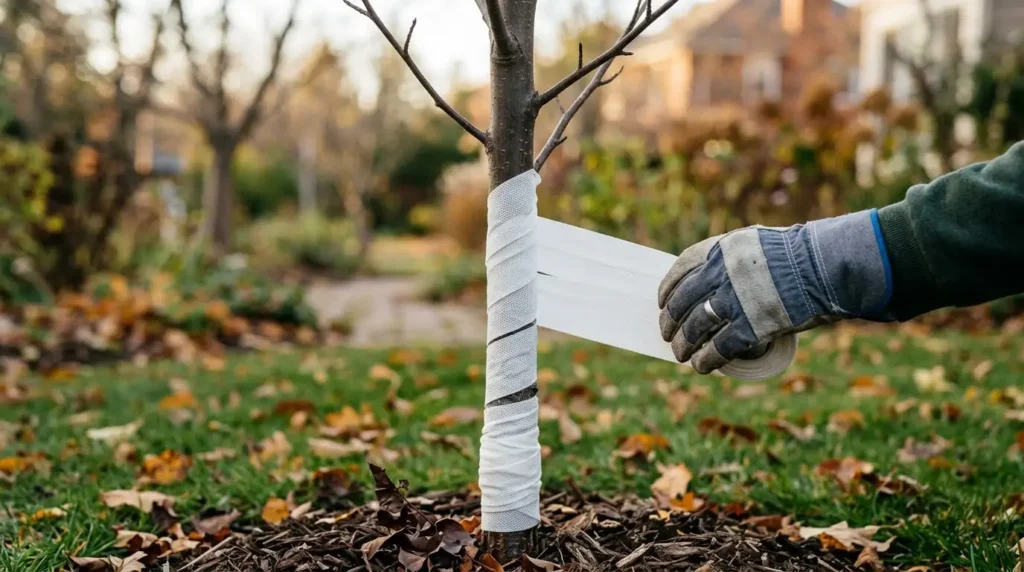
White tree wrap isn’t really a winter coat.
Its job is to reflect sunlight. Young, thin-barked trees can be vulnerable to winter sunscald, particularly on south- and southwest-facing portions of the trunk. On bright winter days, bark can warm in the sun and then cool rapidly when temperatures drop. That repeated temperature swing can injure the tissue beneath the bark. White reflective wrap helps reduce that solar heating.
Extension guidance from Utah State University specifically recommends white protective wraps for susceptible young trees and emphasizes removing them in spring. This can be particularly relevant in colder parts of the Midwest, Great Plains, Northeast and Intermountain West. It is much less compelling for a mature, thick-barked tree sitting in a sheltered location.
And don’t improvise with a dark material because it happens to be sitting in the garage. The whole point is reflectivity.
If an evergreen keeps turning brown, look at the wind before buying a spray
Evergreen foliage creates a different winter problem. A deciduous tree drops its leaves and largely shuts down its exposed foliage for the season. An evergreen keeps its needles or leaves and continues losing moisture even when the surrounding soil is frozen. Add dry winter wind and bright sun, and you can end up with brown foliage by spring. This is winter burn, and it is particularly relevant to exposed evergreens and newly established plants.
A burlap wind screen can help by reducing direct exposure to winter winds. Notice the word screen. The useful design is not necessarily a shrub wrapped tightly like a parcel. Penn State Extension recommends placing stakes around the plant and attaching burlap to create a barrier on the wind-exposed sides while leaving the top open.
That distinction matters because tightly wrapping foliage can put additional weight on branches during snow or freezing rain. A sheltered evergreen beside a building may need nothing. An exposed boxwood hedge facing winter winds may be another story.
And before buying a spray marketed as an anti-desiccant, consider whether a physical windbreak is the more appropriate solution for the site. Extension recommendations vary by plant and product, so chemical treatments should be selected and applied according to the label and local guidance rather than treated as a universal winter fix.
If the garden struggled last year, test the soil instead of guessing
Not every useful fall garden purchase is something you spread, wrap or drape. Sometimes the most useful thing you can buy is a soil test.
Fall is a particularly practical time to test garden soil because the growing season is winding down and there is time to act on the results before spring. A laboratory soil test can provide information about pH and nutrient levels and, where appropriate, recommendations for lime or sulfur. University of Wisconsin Extension specifically recommends fall testing for gardens, perennial beds, lawns and fruit-growing areas.
That is much more useful than adding lime simply because someone at the garden center told you your soil probably needs it. If a bed has been performing well and was tested recently, another test may not be necessary. If you have a new vegetable garden, unexplained poor growth or soil that hasn’t been tested in years, this is one of the purchases that can prevent several less useful purchases later.
In other words, the soil test doesn’t solve the garden problem. It helps you stop guessing about it.
If you had a pest problem, dormant oil may have a place—but not by default
This is where a shopping trip can become unnecessarily complicated. A bottle labeled dormant oil can sound like a standard part of winter garden preparation. It isn’t. Horticultural oils can be used against certain pests, including some overwintering scale and mite stages, but the timing and appropriate plants vary. University of Wisconsin Extension emphasizes that oils need to be properly timed and applied according to the specific product label and pest situation.
So start with the pest. Did you actually have scale, mite eggs, or a recurring orchard problem that warrants treatment? If the answer is no, there may be no reason to spray anything simply because winter has arrived. This is particularly important because applying horticultural oil at the wrong growth stage or under unsuitable weather conditions can injure plants.
The broader point is the same: dormant oils make more sense when there is a known pest problem than as a routine winter treatment. For a homeowner without that history, sanitation, observation and a plan for spring scouting may be the better investment.
If the irrigation system is shut down, don’t assume the trees are done drinking
This one depends heavily on geography. In a wet fall, a garden may have plenty of water. In a dry inland climate, shutting off irrigation can leave recently planted trees heading into winter with a surprisingly dry root zone. Colorado State University Extension recommends watering trees, shrubs and other plants during prolonged dry fall and winter periods in Colorado, particularly when there is no snow cover, and recommends watering when air and soil temperatures are above 40°F.
That makes a good hose or slow-watering attachment useful for some gardeners—not because every tree needs a special winter watering system, but because some landscapes genuinely dry out. Newly planted trees deserve particular attention, while a mature tree in a naturally moist landscape is a very different situation.
And if you do water with a hose late in the season, disconnect and drain it afterward. Frozen outdoor plumbing is a much less pleasant garden problem to discover in January.
If you’re planting bulbs, check the soil instead of the calendar
Fall bulb displays create a strange psychological pressure. The bulbs arrive at the store, sitting there as if they obviously need to go into the ground immediately. Not necessarily.
Spring-flowering bulbs need time to establish roots before winter, but planting into warm soil can encourage unwanted early growth. University of New Hampshire Extension notes that bulbs planted too early in warm conditions can send up foliage prematurely. This is where a soilthermometer can be useful for gardeners who want a more precise answer than a calendar date. But even here, the product may be optional.
If you’re planting a handful of tulips, you probably don’t need a specialized bulb planter either. A normal trowel and a little patience can do the job. A soil thermometer can be useful for gardeners planting spring bulbs or fall garlic, while a dedicated mechanical bulb planter is more of a convenience than a necessity. That is a good example of the difference between useful and necessary.
If you want to keep harvesting, a cold frame is a different kind of purchase
A cold frame or low tunnel is not really a winter-protection product for every garden. It is a commitment to keep gardening. That distinction matters. If your vegetable garden ends with the first hard freeze, you don’t need a structure designed to extend the season.
But if you are growing spinach, kale, mâche, leeks or other cold-tolerant crops and want to keep harvesting through colder weather, a cold frame or low tunnel can change what is possible. University of Wisconsin Extension describes cold frames and tunnels as useful season-extension structures for crops such as lettuce, radishes and spinach, while emphasizing the need for ventilation during warm periods.
The structure also changes the workload. A protected garden still needs watching. A sunny winter day can make an enclosed structure much warmer than the air outside, so ventilation matters. A gardener who buys a cold frame and then treats it like a sealed box may create a new problem instead of solving the old one.
For an ornamental garden, skip it. For someone determined to harvest greens in January, it may be one of the few purchases on this list that genuinely earns its footprint.
And then there are the gardens that don’t need much winter protection at all
This is the part seasonal displays don’t always make obvious. Some gardens are already adapted to the winter they are about to experience. Native perennials that are hardy to the local climate may need very little intervention. Standing stems and leaf litter can provide habitat and natural protection.
In the Pacific Northwest, prolonged winter rain can matter more than deep freezing. In California and parts of the Southwest, October through December can be a productive cool-season gardening period rather than a shutdown. In the Southeast and Gulf Coast, gardeners may still be planting leafy greens and other cool-season crops while northern gardeners are worrying about frozen ground.
So a gardener in Georgia does not need to copy a Minnesota gardener’s winter checklist. Nor should someone in Oregon assume a dry Colorado winter will behave like theirs.
The same product can go from useful to unnecessary simply by crossing a state line.
Before you buy anything, make this five-question walk around the garden
By now, the seasonal shelves probably look a little different.
Instead of asking which products are recommended for winter, look at each potential problem separately.
What is vulnerable?
A young tree, a container plant, a tender vegetable, an exposed evergreen and a dormant native perennial have very different needs.
What problem is actually coming? Frost, freeze-thaw cycles, wind, drought, rodents under snow, sunscald or a known pest problem?
Does my climate make that problem likely?
A product designed for frozen soil isn’t automatically useful in a mild coastal climate.
Do I already have a solution?
Leaves can provide mulch. A sheltered planting location can reduce wind exposure. A hand trowel can plant bulbs. Existing rainfall may eliminate the need for supplemental watering.
And only then: do I actually need to buy something?
That was the question waiting at the garden center. The gardener had gone in expecting winter preparation to mean adding things to the garden. Instead, she started removing things from the imaginary shopping list.
The frost blanket stayed on the shelf because most of the plants she was worried about were already finished for the season. The expensive bagged mulch stayed behind because she had plenty of usable leaves. The tree wrap made sense for the young, thin-barked tree in the open part of the yard. The burlap made sense for one exposed evergreen, but not for everything. The soil test was worth doing because the vegetable bed had been struggling and hadn’t been tested recently.
That was enough.
Winter preparation, she realized, wasn’t really a shopping category. It was a diagnosis.
Across the United States, the right preparation can range from covering vegetables before a freeze to protecting a young tree from rabbits, watering a newly planted tree during a dry Colorado winter, or simply leaving a well-adapted perennial garden alone.
The smartest fall garden purchase may sometimes be the one you don’t make. Before you put anything in the cart, walk outside and look at the garden you actually have. Then ask what winter is likely to do to it. That answer is usually a much better shopping list.