
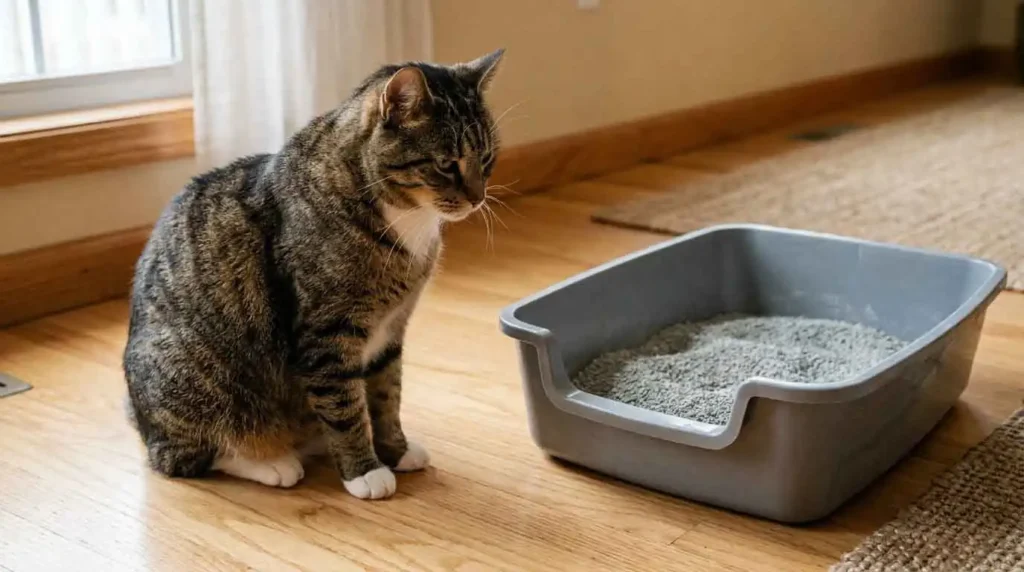
The first sign was easy for Claire to explain away. Maggie, her seven-year-old domestic shorthair, had always been predictable about the litter box. She would wander downstairs, step into the same familiar box and be done in a few minutes.
Then, one September morning, Claire found a small wet spot on the floor—right outside the box. Nothing else seemed wrong. Maggie was eating, she was affectionate, and she was moving around the house. Claire cleaned the floor and the box and assumed it was a one-off.
A few days later, it happened again.
So, Claire did what many cat owners would do. She cleaned the box more frequently, paid closer attention to the litter and wondered whether Maggie had somehow decided she didn’t like the box anymore.
But then Claire noticed something that had nothing, at first glance, to do with litter. Maggie had stopped jumping onto the window perch.
She still went to the window. She would sit underneath it, looking up at the familiar spot. But instead of making the easy leap she’d made for years, she hesitated.
That was when the two behaviors began to look like one problem. Not a bad cat, and not a dirty litter box, but a cat who might be finding it harder to get around her own house.
The litter-box problem that didn’t look like a litter-box problem
A cat that suddenly urinates or defecates outside the litter box should not automatically be assumed to have arthritis.
Urinary disease, kidney disease, diabetes, thyroid disease, gastrointestinal problems and even stress or litter-box aversion can all contribute to house-soiling. Cornell’s Feline Health Center recommends considering medical causes when a previously reliable cat changes its elimination habits.
Claire doesn’t know that Maggie has osteoarthritis. She doesn’t even know that Maggie has a joint problem. She knows only that something has changed.
And that can be one way mobility problems reveal themselves in cats.
Cats with osteoarthritis do not necessarily limp dramatically. A cat may instead jump less often, hesitate before jumping, groom less, become less active or settle into easier-to-reach resting places. In one prospective study of cats with osteoarthritis, changes in the ability to jump and the height of jumps were among the most frequently observed clinical signs.
That subtlety matters because discomfort in cats can easily look like a change in preference.
The cat who used to sleep on the back of the sofa now sleeps on the seat. The cat who once bounded upstairs now waits, while the cat who always climbed into a high-sided litter box begins leaving urine beside it.
Individually, each change can look insignificant, but together they can tell a different story.
The clues may be scattered around the house
Osteoarthritis is common in cats, particularly as they get older.
A study of 100 client-owned cats aged six and older found radiographic evidence of osteoarthritis in at least one joint in 61% of the cats. The likelihood of osteoarthritis increased with age, and the study also found associations between osteoarthritis and changes including decreased mobility and grooming and inappropriate elimination.
That statistic should not be interpreted to mean that 61% of cats have painful arthritis—or that a litter-box accident proves arthritis. Radiographs and clinical pain are not interchangeable, and a cat can have joint changes without displaying the same degree of clinical impairment as another cat.
Mobility can change before a cat looks obviously sick.
And a seven-year-old cat is not necessarily a senior. Under the AAHA/AAFP feline life-stage guidelines, cats ages seven to 10 are considered mature adults, while the senior stage begins at age 10. Maggie’s age, then, shouldn’t be treated as evidence that she “has arthritis,” but that doesn’t make her mobility changes any less worth noticing.
For Claire, the important question isn’t, Is seven old enough for arthritis? It is, Why has a movement that used to be easy suddenly become less easy?
Start with the litter box—but change the physical demand
If a veterinarian identifies osteoarthritis or another mobility problem, one of the simplest places to begin is the litter box itself. Think about what the cat has to do to use it: find it, approach it, step over the rim, enter, turn around, squat, stand and climb back out.
For a cat with painful or restricted movement, the height of that first step can matter.
Cornell recommends low-sided litter boxes for elderly cats and cats with arthritis or joint problems. International Cat Care likewise recommends trays with at least one low side for cats with mobility difficulties.
The point isn’t to buy the most elaborate box on the market, but to remove an unnecessary obstacle. A low-entry box can be especially useful when a cat has trouble lifting her legs or stepping over a tall wall. A roomy box also gives her space to turn without having to twist awkwardly; International Cat Care recommends a tray roughly one and a half times the cat’s body length, while emphasizing individual preferences.
An uncovered box may also be easier for some mobility-limited cats than a design that requires climbing through a small opening. But there is no need to declare every covered box unacceptable. The cat’s comfort, preferences and ability to enter and exit safely matter most.
And if the existing box is otherwise working, the first solution may be as straightforward as providing an easier-entry alternative rather than replacing every box in the house.
Then look at the floor
This is the part of the house owners often overlook. Imagine a cat whose joints hurt, then look at the route from her favorite sleeping spot to the litter box. Is there a stretch of slippery hardwood? Does she have to cross a polished tile floor or climb stairs? Maybe she has to make a sharp turn around furniture, or the box is at the opposite end of the house from where she spends most of her day.
For a healthy, agile cat, these details may be irrelevant, but for a cat whose mobility has changed, they can add up.
Veterinary guidance for cats with osteoarthritis recommends improving traction with nonslip rugs or runners and making important resources easier to reach. That does not mean carpeting the entire house. A securely anchored runner along a slippery route may be enough. So may a nonslip mat around the litter box.
The runner needs to be securely anchored. A loose rug that slides underneath a cat can create a new hazard rather than solving the old one.
The same principle applies to stairs.
If a litter box is downstairs and a cat now spends most of her time upstairs, adding another accessible box may be more useful than expecting her to make the trip several times a day. International Cat Care and veterinary guidance from VCA both recommend making toileting resources readily accessible to cats with mobility problems, including considering boxes on different floors.
The house becomes part of the plan—not because rearranging furniture cures arthritis, but because reducing physical demands can make daily life easier.
Don’t take away the perch. Change the route to it.
Maggie’s window perch is where Claire finally sees the pattern. Maggie still wants to be there; she just doesn’t seem willing—or able—to make the same jump. Cats don’t stop valuing their favorite places simply because reaching them has become harder.
Veterinary guidance for cats with osteoarthritis recommends using stable steps, ramps or intermediate surfaces to help cats reach favored furniture and elevated locations. A low ottoman beside the sofa may turn one difficult leap into two easy steps. A stable ramp can reduce the demand of getting onto a favorite window platform, while a lower bed placed in the same sunny location may give a cat another option without taking away her ability to climb if she still wants to.
The goal isn’t to tell a cat, You’re old now; stay on the floor. It’s to give her choices.
If a cat tree has become difficult to navigate, an owner might add a secure intermediate platform rather than immediately throwing it away. If a window perch is too high, a lower perch in the same window may preserve what the cat actually likes—the sunlight, the view, the familiar smell—without requiring the same jump.
The environmental approach is about making normal behavior easier, not eliminating normal behavior.
Fall may reveal a change without causing it
The timing of Maggie’s problem is tempting to explain. It is September, the evenings are cooler, the hardwood floor feels colder in the morning, and Maggie has started sleeping in a warmer corner.
But this is where the science requires some restraint.
There is not strong evidence establishing that the arrival of autumn itself causes feline osteoarthritis to flare. Veterinary guidance does recommend keeping cats with osteoarthritis warm and dry, and notes that cold or damp conditions may worsen stiffness or discomfort.
Cats with osteoarthritis may seek out warm or sunny resting places, but these observations do not establish a direct seasonal cause-and-effect relationship.
So autumn is better understood as a useful observation point: the temperature changes, windows open and close, and cats choose different sleeping places. Floors feel different, too, and daily routines shift.
And those changes can make a previously subtle mobility problem easier for an owner to notice. If Maggie suddenly spends every afternoon curled up in the warmest patch of sunlight, that is worth noticing.
It is not, by itself, proof of arthritis.
Make warm places easy to reach
If a cat is seeking warmth, start with simple environmental changes. Move a favorite bed away from drafts, put soft bedding in a naturally warm, easily accessible spot, and consider whether the cat has to climb stairs or jump onto furniture to reach it.
A heated pad should not be treated as an automatic solution.
VCA warns that heating pads can cause burns, particularly in pets who are elderly, arthritic or otherwise less able to move away from the heat while sleeping.
For most households, blankets, beds and sensible placement are easier to manage safely.
Again, don’t start with What product should I buy? Instead, ask: Where does my cat want to rest, and how much effort does it take her to get there?
Watch for the pattern, not just the accident
The most useful thing Claire can do is observe Maggie’s routine: Does she hesitate before jumping or take the stairs more slowly? Does she spend more time sleeping or groom less thoroughly? Does she seem stiff when getting up, or has she moved her sleeping spot to a lower location? Does she approach the litter box but appear reluctant to climb inside?
These are the kinds of changes veterinary sources associate with feline mobility problems and osteoarthritis.
A short video can also be useful to a veterinarian if the behavior is intermittent. A cat who moves normally at the clinic may behave differently at home, where the owner can observe the actual route she takes through the house.
But observation should lead to evaluation—not self-diagnosis.
A new litter-box problem deserves a medical explanation
This is the part that should come before any shopping list: if a previously reliable cat suddenly starts urinating or defecating outside the box, arrange a veterinary examination. Arthritis is only one possibility.
Urinary tract disease can cause painful or urgent urination. Kidney disease, diabetes and hyperthyroidism can change drinking and urination. Constipation and other gastrointestinal problems can make elimination painful. Neurologic problems can affect movement and toileting. Stress, household changes, litter preferences and conflict with another cat can also alter litter-box behavior.
Some signs need faster action.
A cat that repeatedly strains to urinate, produces little or no urine, or becomes increasingly distressed may have a urinary obstruction, which is an emergency requiring immediate veterinary care.
That is why a low-entry litter box is a home-accessibility measure, not a substitute for diagnosis.
The house can change before the cat does
Eventually, Claire’s changes around the house are not dramatic. There is a lower-entry litter box, a nonslip runner where Maggie used to cross the slippery floor, an easier intermediate step to her favorite window, and a warm bed she can reach without climbing. None of these changes tells Claire exactly what is wrong with Maggie.
That is the veterinarian’s job.
But the changes do something else: they make Maggie’s ordinary routines less physically demanding while the underlying problem is being investigated.
And that may be the most useful way to think about mobility in cats.
A cat doesn’t experience a house as a collection of products. She experiences it as a series of movements: step over this, walk across that, climb here, jump there, turn around, get comfortable, get back up.
When those movements become harder, the first clue may appear in the most mundane place of all—a little urine beside a litter box.
The solution may begin there. But sometimes, as Claire discovered, the better question isn’t What’s wrong with the litter box? It’s What has become harder for my cat to do to get through her day?