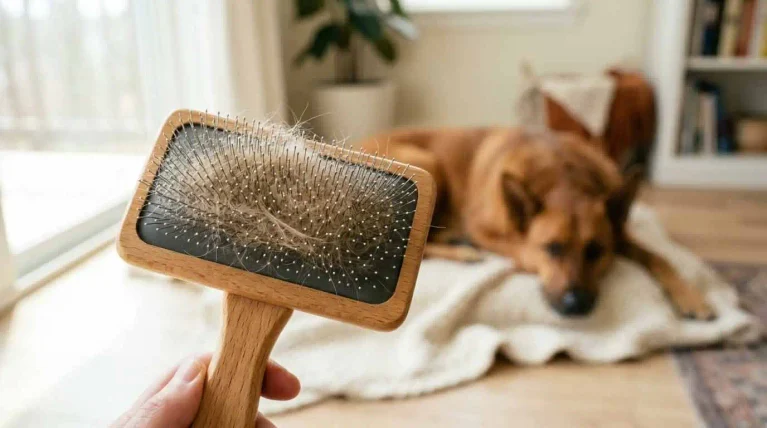
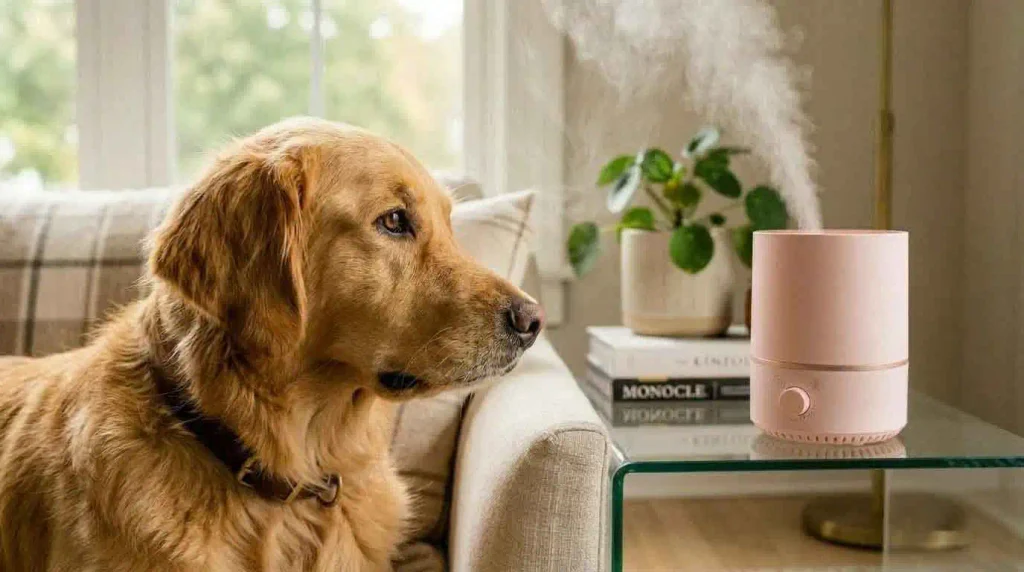
The furnace has been running for a few days. The house feels warmer, but somehow less comfortable. A blanket snaps with static when you pull it from the dryer. The dog’s coat seems a little drier than it did in September. Maybe the cat is grooming more.
Then there is the scratching. It is easy to make the obvious connection: Something is wrong with the dog.
But fall changes more than the calendar; it changes the indoor environment, too. As outdoor temperatures fall and homes are heated, relative humidity can drop, sometimes substantially. Cold outdoor air brought indoors and heated can have much lower relative humidity once warmed, even without anyone deliberately removing moisture from the house.
That does not mean a scratching pet has “dry air.” It means the room is worth looking at, too.
Veterinarians treat itching as a symptom, not a diagnosis. Fleas and other parasites, infections, environmental allergies, food allergies and contact irritants are among the common causes of pruritus in dogs.
So before buying a humidifier, there is one useful question to answer:
What is the humidity in the room right now?
The House Changes Before You Notice It
Winter dryness is not distributed evenly across the United States, and neither is the need for a humidifier.
The physics are straightforward: relative humidity describes how much water vapor is in the air relative to how much that air could hold at its current temperature. When cold air is brought indoors and heated, its relative humidity falls unless moisture is added. The World Health Organization gives a simple illustration: outdoor air at -8°C and 100 percent relative humidity, once heated to 20°C, would have a relative humidity of about 15 percent.
What happens in an actual American home depends on the starting conditions and the building. Insulation, air leakage, ventilation, cooking and bathing, heating equipment and the amount of moisture already present all matter. A tightly built apartment with a lot of cooking and showering may behave very differently from a drafty house in a cold climate.
That is why “turn on the heat, humidity falls below 30 percent” is too broad as a national rule. Some homes will become very dry, while others will not.
EPA’s practical target is more useful than a seasonal assumption: keep indoor relative humidity between 30 and 50 percent. A basic hygrometer can tell you where your home actually sits.
That measurement also explains why regional advice has limits. Cold-weather heating is a bigger part of the indoor-humidity equation in much of the Northeast and Midwest. High, dry Western environments can create a different problem. The Southeast, by contrast, is predominantly humid-subtropical, so some homes may start fall with plenty of moisture already present.
In other words, geography can suggest a question, but the hygrometer answers it.
What Dry Air Can—and Can’t—Explain About Your Pet
There is legitimate veterinary guidance for considering humidification when winter conditions are drying a pet’s skin. VCA’s winter guidance notes that cold, dry conditions can contribute to itching, flaking, scaling and cracking skin and recommends humidifying the home as one possible measure.
But that is not the same as saying a humidifier treats the cause of itching. A dog that suddenly scratches after the heating system comes on may simply have coincidentally developed a flea allergy. Or an existing allergy may be flaring. Infection, mites, contact dermatitis and other skin disorders are also possibilities.
The distinction matters because a humidifier can change the room without changing the disease.
The same caution applies to breathing problems. Coughing, wheezing or increased respiratory effort should not be interpreted as evidence that a pet needs more humidity. Cornell’s guidance on feline asthma notes that several environmental approaches borrowed from human asthma care have not been rigorously tested or proven in cats. A recent veterinary review likewise describes feline asthma as a complex inflammatory airway disease that requires veterinary diagnosis and management. A pet that is persistently itchy, develops sores, hair loss, odor or redness, or shows respiratory symptoms needs a veterinary assessment rather than a trial of household equipment.
The Humidifier You Buy Changes What Goes Into the Air
Humidifiers all add water to indoor air, but they do not all do it the same way. An evaporative humidifier moves room air through a wet wick or filter. Water evaporates from that material and enters the room as water vapor. EPA classifies evaporative units among the portable humidifier types that generally disperse fewer, if any, minerals and microorganisms into the air than ultrasonic and impeller machines.
An ultrasonic humidifier uses high-frequency vibrations to break water into a fine mist. The droplets are not pure water vapor, so whatever is dissolved in the water can travel with those droplets, which is why the mineral content of the fill water matters.
There are also steam vaporizers and warm-mist humidifiers, which heat water to make steam. EPA says steam vaporizer and evaporative humidifiers are not expected to disperse substantial amounts of minerals, although steam devices introduce a burn hazard.
For a pet owner, the important distinction is not which technology sounds more sophisticated but what the machine does to the water before that water enters the room.
What That White Dust From an Ultrasonic Humidifier Actually Is
The white film that appears around an ultrasonic humidifier is one of the more useful clues in this story. It is largely the mineral content of the water.
Ultrasonic humidifiers can disperse minerals from tap water into the air. Those aerosolized particles can later settle on furniture, electronics and floors, producing the familiar pale residue. EPA specifically warns that ultrasonic and impeller humidifiers are efficient at dispersing minerals from tap water and notes that mineral scale can accumulate inside the machine and provide a place for microorganisms to grow.
Peer-reviewed studies make the mechanism clearer. In one bedroom-scale experiment, particle production varied markedly with water quality: harder, higher-mineral water produced more and larger aerosol particles than lower-mineral water. Chemical analysis showed that the emitted particles reflected the mineral composition of the fill water.
Another study found that ultrasonic humidifiers produced aerosols containing minerals from the water and documented substantial differences in particle concentrations depending on water quality.
That does not establish that using an ultrasonic humidifier automatically harms a dog or cat. The evidence is much more limited there. A mouse inhalation study found biological effects from exposure under controlled laboratory conditions, while later work and reviews have emphasized that longer-term human epidemiologic and toxicity evidence remains incomplete. That distinction is worth preserving. The mineral aerosol is real. A specific level of harm to household pets has not been established by comparable clinical studies.
EPA’s solution is relatively uncomplicated: for ultrasonic or impeller humidifiers, use water with low mineral content, preferably distilled water, and clean the machine regularly.
Distilled water changes the equation because it contains far fewer dissolved minerals than ordinary tap water. “Purified” water is not necessarily equivalent; EPA notes that bottled waters labeled spring, artesian or mineral are not necessarily treated to remove minerals.
Evaporative vs. Ultrasonic: What Pet Owners Should Know
For a household where the central concern is minimizing mineral aerosol, an evaporative humidifier has a straightforward advantage: the water passes through a wick instead of being blasted into the room as a mist. That is the reason the uploaded research focused so heavily on evaporative technology, specifically the Canopy Bedside Humidifier, while identifying pet-specific clinical evidence as the weak point.
A real-world example is the Canopy Bedside Humidifier 2.0, which the manufacturer describes as an evaporative system. Its current product information lists a 2.5-liter tank, up to 36 hours of runtime and coverage of rooms up to 500 square feet. Canopy says the unit filters air and water before evaporation, uses a filter that should be replaced every 45 days, and uses UV technology and sensor-controlled airflow as part of its mold-inhibiting design.
Canopy’s pricing can change with promotions and subscription options, so check the current price before buying.
Best for: A household that has actually measured low humidity and prefers an evaporative system designed to avoid visible mist and mineral “white dust.”
What it does well: Its basic technology matches the particular concern raised by ultrasonic mineral dispersal: water evaporates from a filter rather than being atomized as a room aerosol. The water-contact components are also dishwasher-safe, according to the manufacturer.
Where it falls short: It is not maintenance-free. The filter is a recurring expense, and the unit still needs regular cleaning. And there is no veterinary trial establishing that this particular model treats canine itching or feline respiratory disease.
What to know before buying: Canopy markets a UV and airflow system to inhibit mold growth inside the device. That is a manufacturer claim about the humidifier itself, not proof that the machine disinfects the room or prevents respiratory disease. Canopy’s own product documentation makes that distinction.
Who should skip it: A household whose measured humidity is already in a comfortable range, or one with condensation and moisture problems.
An ultrasonic unit is not automatically a bad choice; it can be compact, quiet and effective. But if you choose one, water quality and maintenance become a bigger part of the decision.
What to Look For Before You Buy
Start with the room rather than the pet-product aisle. A cheap hygrometer is more informative than a marketing claim that a humidifier “supports healthy skin.” Measure humidity in the room where the pet spends time, preferably at different points in the day.
If the reading is already around 40 or 45 percent, there may be nothing to fix. If it is consistently very low during heating season, humidification becomes more reasonable. EPA recommends staying between 30 and 50 percent rather than treating “more moisture” as inherently better.
Then consider the technology. With an ultrasonic machine, ask what water the manufacturer recommends and whether you are realistically going to use distilled water or maintain a demineralization system. With an evaporative unit, ask whether you are willing to buy replacement wicks or filters.
Room size matters, too. A humidifier designed for a bedroom cannot necessarily maintain the same humidity throughout an open-plan house, especially when heating and ventilation are moving air between rooms.
The Maintenance Problem Nobody Puts on the Box
This is where the humidifier stops being a gadget and becomes another household chore.
EPA recommends emptying portable humidifiers daily, wiping surfaces dry and cleaning portable units every third day. The agency also warns against allowing standing water to linger and says users should follow the manufacturer’s instructions for cleaning products and replacement materials.
The reason is simple: A water tank is a suitable place for microorganisms to grow if it is neglected. EPA notes that standing-water humidifiers can disperse microorganisms as well as minerals, particularly with ultrasonic and impeller systems.
Canopy makes the physical cleaning somewhat easier by putting its water-contact components in the dishwasher and specifying a 45-day filter replacement interval. But “easier to clean” is not the same as “does not need cleaning.”
There is another failure mode on the opposite side: too much humidity. The same machine that helps a dry room can create condensation on windows, walls or other surfaces if it is run too aggressively. EPA recommends not humidifying above 50 percent and says condensation is a signal to lower the output, change the setting or move the unit.
A humidifier that creates a damp wall is not solving the household’s environmental problem. It is creating a new one.
Who Actually Needs a Humidifier?
A humidifier may make sense if a hygrometer shows persistently low indoor relative humidity during heating season and the household is noticing signs associated with dry conditions. Veterinary guidance from VCA specifically includes home humidification among measures that may help pets dealing with winter-related dry skin.
You may not need one if your indoor humidity already sits comfortably in the 30-to-50-percent range, you live in a humid environment, you already have effective whole-house humidification, or the room has condensation, dampness or another moisture problem. EPA’s advice is to humidify only when conditions require it.
The regional picture is therefore more nuanced than a “dry states versus humid states” map. In the Northeast and Midwest, heating season can create substantial indoor dryness. In the Mountain West and parts of the Southwest, naturally dry conditions can make humidity more relevant. The Southeast’s humid-subtropical climate means some households will have the opposite problem: too much moisture. The Pacific Northwest can be wet outdoors while still having heated, relatively dry indoor rooms.
The room wins the argument.
When a Humidifier Isn’t the Answer
An itchy dog is the clearest example: dry air is one possible contributor, but it is not a diagnosis.
Veterinary references emphasize that pruritus can come from parasites, allergies, infection and other skin conditions. A dog that keeps scratching despite a more comfortable indoor humidity level may need an examination, skin testing or treatment for the actual underlying problem.
The same logic applies to cats with breathing problems. Feline asthma is not something to manage by guessing at room humidity. Cornell specifically notes that environmental strategies borrowed from human asthma care have not necessarily been proven in cats.
And there is one household habit worth eliminating altogether: don’t turn a humidifier into an essential-oil diffuser just because the machine offers that option.
ASPCA warns that essential oils can pose toxicity and respiratory-irritation risks to pets, with cats particularly sensitive to some exposures. Pet Poison Helpline similarly advises caution, especially with active diffusers that emit oil particles into the air.
A scent marketed as relaxing to people is not automatically benign for an animal sharing the room.
The Better Question to Ask This Fall
When the furnace starts and the dog starts scratching, the tempting response is to buy something.
The better first response is to look around.
Did the indoor humidity actually change? What does a hygrometer say? Is the room dry, or is the pet showing signs of a skin problem that has nothing to do with humidity? Is the household already humid enough that adding moisture would create condensation? And if a humidifier makes sense, which technology adds moisture without creating an avoidable mineral-aerosol or maintenance problem?
That is the useful distinction between buying a pet product and solving a household problem.
An evaporative humidifier can be a sensible choice for a genuinely dry room, especially for an owner who wants to avoid the mineral aerosol associated with ultrasonic misting. An ultrasonic humidifier can also be used responsibly, particularly with low-mineral water and careful maintenance. But neither technology should be sold as a treatment for an unexplained itch or respiratory disease. EPA’s guidance is more modest: use humidification when conditions call for it, keep humidity in a reasonable range, use appropriate water and clean the machine.
The goal isn’t to buy another device because fall arrived.
It is to understand what changed in the home, determine whether humidity is actually part of the problem, and then choose a machine whose technology and upkeep make sense for that particular household.
The answer may be a humidifier. It may also be a hygrometer, a veterinarian’s appointment, or nothing at all.