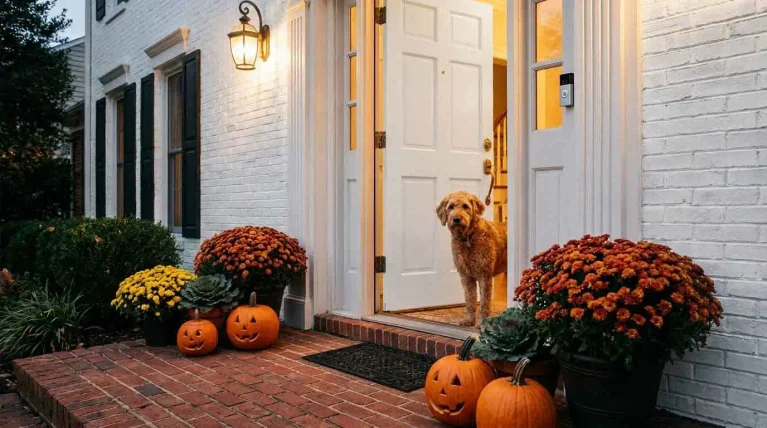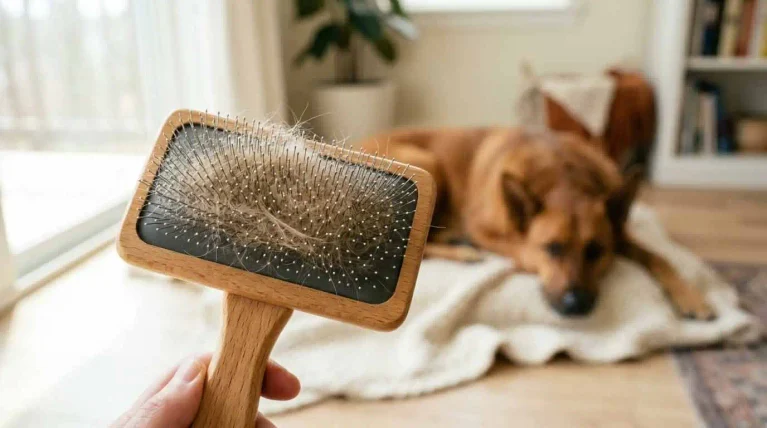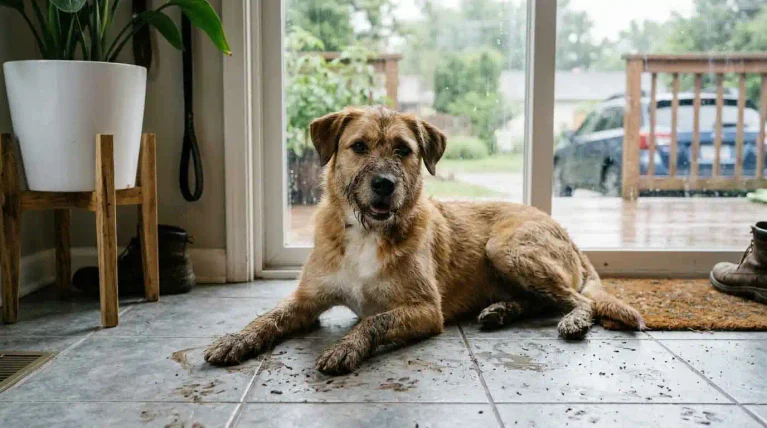
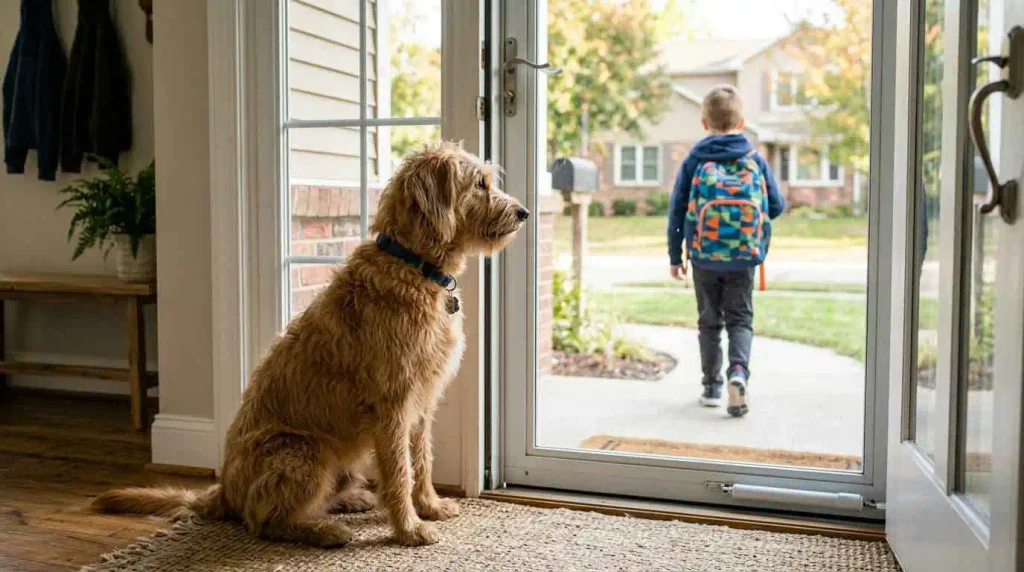
On the first Tuesday of September, Lauren Bennett put on her shoes before she had finished her coffee. That was new. All summer, mornings at Lauren’s house had been loose enough that nobody seemed to know exactly when the day began: her two kids wandered downstairs when they woke up, the back door opened and closed all morning, Scout got a walk when somebody had time for one, and breakfast might happen at 7:30 or 9. Then school started. By 8:15, the backpacks were gone, the car was gone and the house was quiet. Scout noticed.
He had always been a friendly, follow-you-into-the-kitchen kind of dog. But that week he started following Lauren from room to room with unusual determination. He waited beside the front door while she made lunch. He watched her put on her shoes. One morning, after she left, he chewed the corner of a cardboard box that had been sitting harmlessly in the recycling bin for
months.
Lauren’s first thought was the obvious one: He needed more exercise. So she added another loop to their morning walk. It helped for about as long as the walk lasted. Then Scout was back at her heels.
The morning the house changed
September can make a household feel as if somebody flipped a switch.
The change may be dramatic in a family with school-age children: later summer mornings become earlier ones, midday company disappears, and the dog who spent much of the day with people suddenly spends a longer stretch alone. But there doesn’t have to be a school bus involved. A parent may return to an office, a college student may leave for campus, a flexible summer work schedule may disappear, or a family that spent more time outdoors may start spending more hours away from home.
The pet doesn’t know that it is September. It knows that the pattern of the day has changed.
Veterinary guidance from the American Animal Hospital Association specifically recommends shifting feeding, walks, play and quiet time gradually when a household is preparing for the school-year schedule. That doesn’t mean every dog will struggle. Many won’t. And a dog acting differently after a schedule change isn’t automatically anxious, much less diagnosed with separation anxiety. It does mean that the timing of the behavior is worth noticing.
The behavior that made her wonder
For Lauren, the clue was not the chewed cardboard. It was what happened before she left. Scout had begun paying close attention to the small rituals that came before the door opened: shoes, keys, bag, coffee cup, goodbye to the kids. The dog seemed to know what was coming before Lauren reached the front step. That distinction mattered.
A dog that follows you around the house may simply enjoy being near you. A dog that whines may be asking for attention, expressing excitement or responding to stress. Even destructive behavior can have more than one explanation.
The ASPCA notes that whining has several possible causes, including attention-seeking, excitement and anxiety; when whining occurs specifically around departures or absences alongside other distress behaviors, separation-related problems become more relevant.
Context matters, as does what happens after the door closes. A camera can sometimes reveal a very different story from the one an owner imagines. The American Veterinary Society of Animal Behavior recommends video observation when separation anxiety is suspected, because some dogs show substantial distress soon after departure while others may spend most of the absence resting normally.
Lauren didn’t need to diagnose Scout. She just needed to find out what Scout was actually doing.
It wasn’t simply boredom
The extra walk had been Lauren’s first attempt to solve the mystery. It was also a reasonable one: exercise is part of good dog care, and physical activity may help a dog settle.
But Scout’s behavior suggested that exercise wasn’t the whole story. The morning had changed in several ways at once.
Breakfast was earlier, the children disappeared for most of the day, Lauren left at a predictable time instead of working intermittently from home, and there was less movement through the house. Most significantly, Scout’s period without people had become longer.
Research on dogs’ time alone offers a useful clue here. In a longitudinal study of more than 1,800 UK pet dogs, researchers found that individual dogs varied considerably in separation-related behavior, but changes in how much time dogs were left alone were associated with the later appearance of such behavior in some dogs.
That doesn’t prove that a back-to-school schedule causes separation anxiety, but it does make the household change worth taking seriously.
A separate longitudinal study examining dog behavior during the COVID-19 period found that changes in owners’ routines and management were associated with changes in some dog behaviors, while also finding that stress-related changes did not necessarily amount to separation-related problems. That distinction is easy to lose when a chewed shoe is sitting in the middle of the floor.
What a changed routine can do to a pet’s day
Predictability can give animals information about what comes next. That doesn’t mean dogs require every breakfast to happen at precisely 7:03 a.m. It means that repeated patterns can become meaningful parts of daily life: the morning walk, the sound of a school backpack zipper, the person leaving, the quiet period afterward.
When those patterns change, a pet may have to adjust. For some dogs, the adjustment may be barely noticeable. For others, it may show up as increased following, restlessness, vocalization or trouble settling.
The research is strongest when talking about changes in routine and time alone, rather than about an abstract claim that all dogs “need” rigid schedules. Current veterinary guidance nevertheless recommends consistency and predictability as useful components of managing
separation-related distress.
That is why Lauren’s second experiment was less dramatic than her first. She stopped trying to tire Scout out of the problem. Instead, she made the new weekday less surprising.
She began moving breakfast toward its school-year time, kept the morning walk at roughly the same point each day, and built a quiet period into the morning while everyone was still home, rather than having the house go from full-volume family activity to complete silence the instant the door closed.
She wasn’t trying to create a perfect schedule. She was creating a recognizable one.
Making the new routine predictable
If your household is going through the same transition, start with the parts of the day you can actually control: move meals and walks toward their new times rather than changing them all at once. If a midday outing is disappearing, consider whether a dog walker, neighbor or family member can break up an unusually long absence.
AAHA recommends gradual schedule changes and suggests arranging companionship when a pet will otherwise be alone for long stretches.
Then look at the departure itself: keys, shoes, coat, bag, door.
Dogs can learn that these ordinary objects predict what happens next. Veterinary behavior guidance describes practicing those cues without actually leaving as one way of loosening that association in dogs with separation-related distress.
The important word is practice. It is not a magic trick, and a dog already panicking at departures should not simply be left alone for longer and longer periods in the hope that it will “get used to it.” For dogs with genuine separation anxiety, repeatedly reaching a state of panic is not a useful way to teach them to feel comfortable alone. For an otherwise comfortable dog adjusting to a new household rhythm, though, ordinary practice can be as simple as putting on the shoes, picking up the keys and then sitting down again. The goal is not to fool the dog. It is to make the cues less loaded.
When enrichment helps—and what it can’t fix
Lauren also stopped treating toys as emergency equipment. Instead of buying Scout something new every time he seemed restless, she began giving him familiar, appropriate activities at predictable points in the day.
Food puzzles are one option, and the American Veterinary Society of Animal Behavior describes them as a form of enrichment that gives dogs an opportunity to work for food and engage in natural foraging behavior.
Sniffing and searching games can provide another outlet. A safe chew may work for a dog who enjoys chewing. Some dogs like simple food searches around a pet-proofed room.
The point is not to make the empty house so entertaining that the dog forgets everyone left.
Enrichment has a more modest job: give the animal something appropriate to do and improve the quality of the environment.
Research in shelter dogs suggests that different kinds of enrichment can influence stress-related behavior, but that work is context-specific and does not establish enrichment as a treatment for clinical separation anxiety in household pets.
A food puzzle can be a good activity, but it is not a substitute for veterinary behavior care when a dog is panicking.
When “adjustment” is something more serious
This is the point at which labels can get in the way. If a dog is clingier for a few days after the family schedule changes, that doesn’t tell you that the dog has separation anxiety.
Clinical separation-related problems are more concerning when there is a consistent pattern of distress associated with separation: repeated barking or howling, pacing, destructive escape behavior, house soiling, inability to settle, or attempts to injure themselves while trying to get out.
A sudden behavior change also deserves medical consideration. Pain and other health problems can alter behavior, and a veterinarian is in the best position to determine whether something physical is contributing.
If you’re unsure, record what happens when you’re gone. Does the dog settle after a few minutes? Does she eat the enrichment you left? Does he pace continuously? Is destruction concentrated around doors or windows? Does the behavior happen only during absences, or at other times too? That information can be far more useful to a veterinarian than “he seems anxious.”
And if there is self-injury, serious escape behavior, persistent inability to settle, major changes in eating or elimination, or behavior that is escalating rather than easing, don’t wait for the calendar to fix it. AAHA recommends veterinary involvement for severe or persistent separation-related distress, with veterinary behavior consultation when appropriate.
Cats deserve the same attention, although their responses may look different. Veterinary sources note that cats value consistency and predictability too, and changes in household schedules can contribute to stress-related behavior.
What changed for Lauren
By October, Scout was still Scout. He still followed Lauren into the kitchen, appeared at the door when someone picked up a backpack, and preferred company to an empty room.
But the frantic quality of the first weeks had eased. The morning no longer seemed to happen to him. It happened in a pattern he recognized.
Lauren eventually realized that her first instinct had been to ask what was wrong with the dog. The more useful question was what had changed around him. Summer had given Scout one kind of household: doors opening, people drifting in and out, walks at odd hours, children nearby. September gave him another.
Neither routine was inherently better. But the second arrived almost overnight.
Once Lauren saw that, the solution became less about tiring Scout out or correcting him and more about helping him understand the new shape of his day.
For families heading through the same transition, that may be the most useful place to start. Not with the assumption that the dog is being difficult. Not with a diagnosis. Just with a closer look at the calendar, the clock, the front door—and what happens after everyone leaves.