By the time the rain started coming down steadily, the towel was already waiting by the door. Sarah had learned to keep one there.
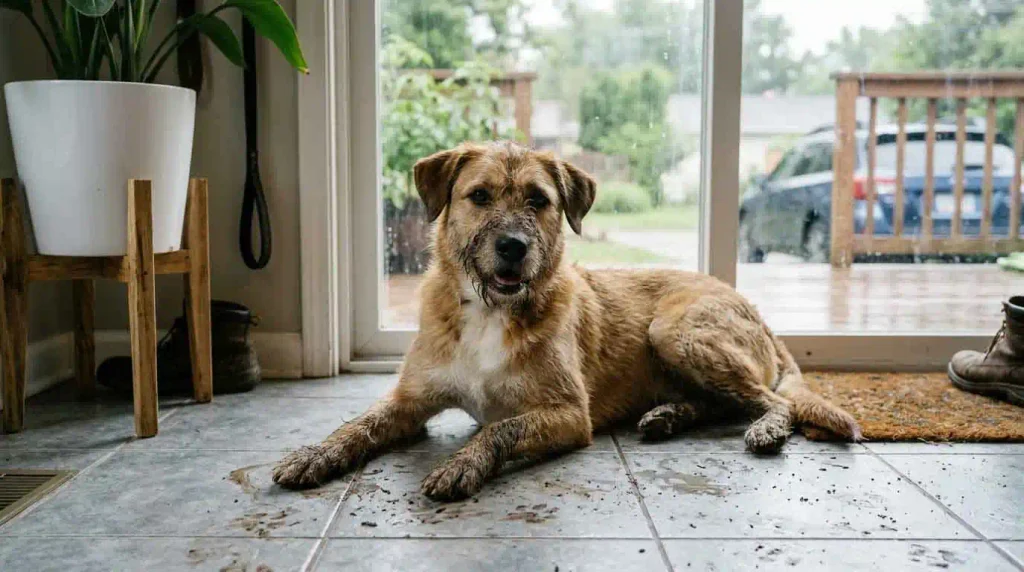
She and her dog, a medium-size mutt named Jasper, had barely made it up the front steps when she could see what was coming: dark paws, wet fur around the ankles, and the particular expression Jasper wore when he knew he was about to be asked to stand still.
“Hang on,” Sarah said, reaching for the towel. Jasper did not hang on.
He stepped onto the entryway floor, shook once, and walked three determined steps toward the kitchen. Four muddy paw prints appeared behind him. The towel was still in Sarah’s hand.
This was how September rain worked in the house. The walk itself was rarely the problem. Jasper loved the rain. Sarah could live with the wet leash, the damp dog smell and the occasional leaf stuck to his belly. It was what happened afterward.
She would wipe his paws at the door, then watch him move just far enough away to leave another little trail. She would mop the obvious spots. An hour later, she would notice a faint brown mark beside the kitchen table. The next time it rained, she would do the whole thing again.
Eventually, the cleanup became part of the walk. The dog went out. The dog came in. The towel came out. The mop came out. Sarah muttered something under her breath. Then the dog shook.
The mat was never really the problem
Sarah had already tried the sensible fixes. There was a doormat outside and another just inside. The towel lived within arm’s reach of the door. She had experimented with wiping Jasper’s paws one at a time, and she had tried getting to him before he could make a break for the kitchen.
Sometimes it worked beautifully. Sometimes Jasper stood patiently while she wiped each paw. Sometimes he gave her one paw, then another, then suddenly decided the procedure was over and trotted away with two still-damp feet.
The mat helped, too. It caught some of what Jasper brought home, but not everything. A mat can only do so much if the dog crosses it once and keeps going.
After a particularly wet walk, Sarah found herself looking at the mat with suspicion. Maybe she needed a better one.
A bigger one. A thicker one. One of those serious-looking mats designed for people who apparently own both a dog and a farmhouse.
But the more she thought about it, the less the mat seemed like the whole answer. She wasn’t dealing with one mess.
She was dealing with several small jobs that happened to involve the same four paws.
There was the water and loose mud that needed to come off before Jasper went farther inside. There was the dirt that still clung between his toes and around his pads. Then there was the dampness left behind after cleaning.
Sarah had been trying to solve all three with a towel.
That was the moment the arrangement of the entryway began to look different.
The problem wasn’t that she needed a better doormat. Her entryway had no system.
Start with capture, not scrubbing
The simplest version of a dog paw cleaning station begins before the paws are cleaned.
The first zone is the landing zone: a piece of absorbent, washable material placed where the dog crosses on the way in.
Its job is modest. It is there to catch some of the moisture, loose mud and outdoor grit before they travel farther into the house.
That distinction matters.
A mat is not the cleaning station. It is the first step in the process.
For a home with a little more room, the capture zone might be a substantial indoor-outdoor mat or washable textile near the door, with enough length for a few steps. In a narrow foyer, it may simply be a runner-sized area immediately inside the entrance. The National Wood Flooring Association recommends breathable rugs inside and outside doorways to help limit tracked grit, salt, chemicals, sand, moisture and other debris on wood floors; it also recommends that rugs be cleaned and thoroughly dried before being returned to the floor.
The practical lesson is less glamorous than shopping for the “best mat for muddy dog paws”: choose something suited to the floor, keep it clean, and give it enough room to do its small job.
And make sure it stays put. A rug that skates across a smooth floor when a wet dog steps on it has defeated the purpose of making the entrance safer.
Then give the paws their own stop
The second zone is where the actual cleaning happens.
This can be surprisingly small.
A low basket or container can hold the supplies: an absorbent towel, a dog-safe wipe for lighter cleanups, or a portable paw cleaner for muddy walks. The point is to have everything together so the owner isn’t standing in the doorway with one wet dog, one towel and no idea where the other towel went.
For light dirt, a damp towel may be enough. For a serious muddy walk, a more thorough rinse or a paw-cleaning tool may make more sense. The American Kennel Club recommends pet-safe wipes for quick cleanup and notes that a warm, soapy washcloth may be more appropriate for heavier messes. It also recommends cleaning between the toes and around the pads when dirt has accumulated there.
It helps to keep the dog in the cleaning area until the job is finished: clean the paws, dry them, then let him go. That last part may be the most useful.
If Jasper gets released after the first paw is wiped, there’s a good chance he’ll assume the job is over. For Sarah, keeping the routine in one place meant she could handle all four paws before Jasper headed farther inside.
This is also why the setup should be convenient for the person using it. If the towels are in a closet down the hall, the wipes are in the kitchen and the paw cleaner is somewhere in the garage, the system will quietly dissolve after about three rainy days.
The final stop: dry, then look
The third zone is quieter.
It is the towel.
After cleaning, the paws need to be dried before Jasper heads into the rest of the house. A fresh, absorbent towel can remove remaining moisture and help keep wet footprints from becoming another problem. The AKC specifically recommends a super-absorbent towel for drying wet paws and notes that thorough drying is part of paw care.
This is also the natural moment for a quick look.
Spread the toes gently enough to see whether a bit of grit is caught between them. Check the pads for an obvious cut, sore spot or foreign material. You’re not conducting a veterinary examination at the front door. You’re just noticing something that looks different from normal.
Veterinary guidance likewise recommends checking a dog’s paws after walks for cuts, bruises and foreign bodies such as splinters or burs. If there is an actual injury, persistent irritation, swelling, discharge, significant licking or another unusual change, that moves beyond routine mud cleanup and is a reason to contact a veterinarian.
For ordinary rainy walks, though, the job is much simpler.
Clean. Dry. Look. Then let the dog go.
What Sarah changed was mostly the order
A week later, it rained again.
Jasper came through the door carrying the usual evidence: wet paws, a little mud, a leaf stuck to one leg.
This time, Sarah didn’t reach for the mop.
He crossed the first mat and stopped.
She cleaned his paws in the small space she’d cleared beside the door. The towel was already there. She dried each foot, glanced between the pads, and released him.
Jasper walked into the kitchen.
There were still a couple of damp marks.
Sarah left them for a minute, then wiped them up.
That was it.
The house wasn’t magically mud-free. Jasper was still a dog who enjoyed puddles. The difference was that most of the mess had been dealt with before he could distribute it across three rooms.
The routine had become easier because there was less improvising.
Three functions can fit almost anywhere
A three-zone dog mudroom setup does not require a mudroom.
In a dedicated entryway, the arrangement can be literal: a capture mat near the threshold, a cleaning station beside it, and a towel or drying spot just beyond.
In a narrow foyer, the zones may overlap. The mat is Zone 1. A small basket beside the wall is Zone 2. The last section of the mat, or a washable towel placed nearby, becomes Zone 3.
In an apartment, the whole station might fit into a few feet beside the door. A washable runner can provide the first surface, while a small container holds towels and dog-safe cleaning supplies. There is no need to create a miniature grooming room.
In a shared entryway, storage may be the limiting factor. A hook for towels and a compact container for the cleaning supplies can keep the routine together without turning the entrance into a permanent pet-care display.
And in a home with almost no storage, the principle still works.
Three functions, not three large physical spaces.
That is the part worth keeping.
A few tempting shortcuts can make the routine worse
Once people start trying to stop dog tracking mud in the house, it is easy to overcorrect.
One common shortcut is simply leaving the paws wet after cleaning. The mess may look gone, but the dog is still walking around with damp feet. Drying is part of the routine, not an optional step. The AKC recommends drying paws thoroughly after washing and notes that wet paws can leave footprints on floors.
Another is grabbing whatever household wipe happens to be nearby.
Convenience is useful, but human cleaning products are not automatically appropriate for dogs. The AKC advises using products formulated specifically for dogs, while veterinary guidance notes that products intended for people can be too harsh for canine skin.
Then there are the rugs themselves.
A wet dog needs a stable surface to stand on. A loose rug on smooth flooring can become its own little hazard, especially when the dog is stepping onto it with wet paws. The National Wood Flooring Association also advises choosing appropriate, breathable rugs and keeping them clean and thoroughly dry rather than allowing moisture to sit against the floor.
Good entryway ideas are often less about buying more things than arranging the things you already need so they work together.
The rain will come back
A few days later, the towel was hanging beside the door again.
Rain tapped against the windows. Jasper waited to be let out, then came back in looking pleased with himself and considerably less pleased with the towel.
Sarah opened the door. Jasper crossed the mat, and she cleaned his paws, dried them, and let him go inside.
There was no chase through the kitchen. No frantic search for a towel. No immediate mop duty.
The routine was familiar now.
That is the point of a mud-lock. Not to make a dog immune to rain, mud or the irresistible puddle at the edge of the sidewalk. Not to create an immaculate entryway that looks as though nobody actually lives there.
The goal is smaller and more useful.
Keep the outdoor mess near the door.
Give it somewhere to go.
And keep a normal muddy walk from becoming a whole-house problem.