By the second week of September, Lauren had stopped wearing her black sweatshirt. It wasn’t a fashion decision. It was a practical one. Her dog, Milo, a broad-chested, tan-and-white shepherd mix with a dense coat, had begun leaving himself behind everywhere. There was fur on the sofa where he slept in the afternoon, fur caught in the stair runner, fur on the kitchen floor that seemed to reappear minutes after she vacuumed.
One morning Lauren found a pale strand stuck to the sleeve of the sweatshirt before she had even left the bedroom.
She pulled it off and looked at Milo. He was lying beside the back door, perfectly content. “Seriously?” Milo opened one eye.
The timing was familiar. The mornings had started to feel a little cooler. The school-year calendar was back on the refrigerator. The air conditioner was still running. Nobody was ready to surrender summer yet.
Lauren vacuumed. She brushed Milo. She vacuumed again.
She used a lint roller on the sofa and picked hair from the stairs with her fingers. Then, by the following evening, the house looked as though Milo had never been brushed at all.
Her working theory was simple: Milo was shedding more, so she needed to clean more.
That seemed reasonable. It was also only half the problem.
The fur was starting before it reached the floor
Dogs shed because hair grows, rests, and is eventually released. The timing and amount vary considerably with genetics, coat type, environment, and the individual dog. Dogs with seasonal shedding patterns can shed more heavily in spring and fall, while others shed more continuously.
Milo belonged to the group that made the distinction obvious.
His coat was double-layered. The coarser outer hairs, often called guard or primary hairs, protect the skin and help repel dirt and moisture. Beneath them is a softer, denser undercoat made of secondary hairs.
That undercoat is the part that can suddenly seem to be everywhere when a dog is going through a seasonal coat change.
At the level of the skin, dog hair grows from compound follicles. A large primary hair can be surrounded by numerous smaller secondary hairs, and hair growth is influenced by several factors, including hormones, nutrition and photoperiod, or the amount of daylight. Changes in season and daylight are among the signals associated with normal shedding.
That helped explain why September had arrived with a furry little alarm clock attached to Milo. It also explained why Lauren’s vacuum was losing the battle. She was dealing with the final stage of the process. The loose hair had already left the dog. The better question was whether she could catch more of it before that happened.
A grooming problem disguised as a cleaning problem
Lauren had been thinking about the house. She needed to think about the coat. That distinction changed what she did next.
Instead of brushing Milo wherever she happened to be sitting, she chose one place for grooming: a small section of the laundry room just inside the garage. The floor was easy to clean. There was enough room for Milo to stand comfortably. A washable mat went down, along with an old towel, a brush and comb suited to his coat, a container for collected fur and a small
vacuum kept nearby.
It wasn’t a grooming salon. It wasn’t even particularly attractive. That was part of the appeal. The point was to create a place where the loose coat had somewhere to go.
For Lauren, the laundry room worked because she could close the door, clean the floor afterward and keep the rest of the house out of the process. Someone else might have a bathroom with a washable floor, a utility room, a garage, or, when weather and the dog’s comfort make it appropriate, a covered outdoor area.
The location matters because brushing doesn’t make the hair disappear. It changes where the hair is released.
And once Lauren started treating grooming as a contained household task rather than something she did casually on the sofa, she noticed another problem with her old routine: she wasn’t always reaching the coat that was shedding.
The right brush depends on the dog underneath it
There is no universal fall-shedding brush because there is no universal dog coat.
A short double coat, such as that of a Labrador Retriever, behaves differently from a medium double coat such as an Australian Shepherd’s, and differently again from the long, dense coat of a Newfoundland or an Arctic-type coat such as a Samoyed’s. Grooming needs also vary among individual dogs.
That makes the question of the best brush for a shedding undercoat a little less straightforward than it first appears.
The better question is: What layer of this particular coat am I trying to reach, and what needs to come out?
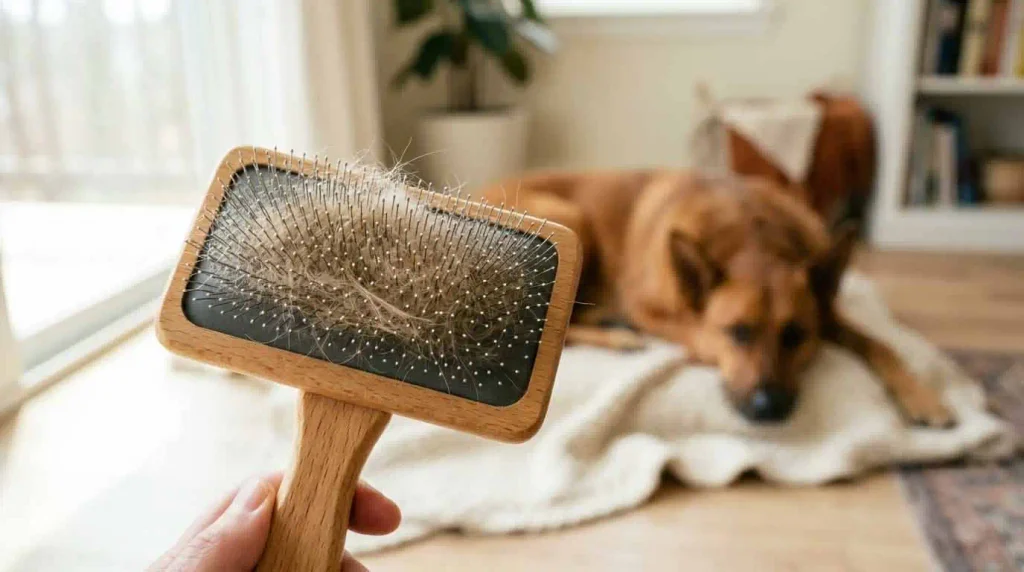
For many longer or double-coated dogs, a slicker brush can help reach and remove loose hair from a dense coat. During heavier shedding, a coat rake or de-shedding tool may be useful for removing loose undercoat. But tools differ, and technique matters. AKC guidance specifically cautions against pressing too hard with shedding tools, particularly those with blades.
Lauren began with the tools she already had and stopped trying to make one brush do every job.
She worked methodically instead of rushing.
The coat was divided into manageable areas. She brushed through the areas where loose undercoat accumulated, paying attention to places that were easy to miss. For a dense coat, line brushing or line-combing means working through sections rather than skimming over the outer surface. That matters because brushing only the visible top layer can leave a considerable
amount of loose undercoat underneath. AKC grooming guidance describes section-by-section line work as a useful technique for thick coats, while emphasizing that coat type should determine the approach.
She also learned the difference between removing loose hair and trying to win a wrestling match with a mat.
If she encountered a tangle that did not yield gently, she stopped. A coat that requires aggressive pulling is no longer a simple shedding session, and severe matting is a reasonable point to involve a professional groomer.
The goal was never to make Milo look newly manufactured.
It was to remove hair that was ready to leave.
The station had three jobs
After a couple of weeks, Lauren’s laundry-room setup had settled into a rhythm. The first job was removal.
Milo went to the station before the loose coat had a chance to distribute itself across the house. The frequency depended on how much he was shedding. During heavier periods, grooming became more frequent; when shedding eased, the schedule did too. There is no useful universal number of sessions because coat type, length and shedding pattern all change the
equation.
The second job was containment. The washable mat caught what fell. The towel kept the work area comfortable and made cleanup easier. The tools stayed in one place. Loose fur went directly into a bin rather than onto upholstery.
The third job was reset. Lauren collected the hair, vacuumed the small area, cleaned the tools as appropriate and put everything back where it belonged.
That last step was surprisingly important. When the brushes were scattered around the house, grooming felt like another chore she had to assemble. When they lived in one place, the next session was already halfway prepared.
The system had become boring. That was good. Boring systems tend to get used.
What “blowing coat” should mean at home
People sometimes talk about a dog “blowing coat”
as though every dog experiences the same dramatic autumn event.
They don’t.
Seasonal shedding is more pronounced in some dogs than others, and dogs living in different environments can have different shedding patterns. Even among double-coated dogs, there is variation.
But for a dog that is visibly releasing a large amount of undercoat, the principle is useful: remove loose coat deliberately and contain it before it becomes household debris.
Some professional grooming setups use high-velocity, or forced-air, dryers to help dislodge loose hair from dense coats. That can be effective, but it isn’t a casual appliance to point at every dog.
A dog should first be comfortable with the equipment. AKC guidance recommends introducing dryers gradually, beginning at a distance and using a low setting, while keeping the airflow away from the face and ears.
Safe equipment, controlled airflow, low heat, and close attention to the dog’s comfort all matter when using a dryer.
For a nervous dog, a dog who has never experienced a dryer, or an owner who isn’t confident using one, professional grooming may be the better choice.
The same restraint applies to eyes and ears. High-velocity air can be startling and uncomfortable, and groomers use protective and safety practices around those sensitive areas.
Lauren didn’t buy a powerful dryer. Her system didn’t need one. A grooming station, Lauren realized, was not a shopping list.
The house still needs a plan
The laundry room did not make the rest of the house immune to dog hair. Milo still slept on the sofa. He still followed Lauren upstairs. A few hairs still appeared on clothing.
Lauren began cleaning the sofa and stairs as maintenance rather than emergency response. A lint brush or similar tool could handle the occasional stray hair on clothing or upholstery. For furniture, rugs and other surfaces, the point was no longer to remove an impossible amount of fur after the fact. It was to reduce the amount that got there in the first place.
She also started paying attention to the home’s routine around filters and other places where household dust and debris collect. There was still a sensible reason to keep ordinary HVAC maintenance on schedule, but the grooming station was solving a much simpler problem.
Most of the hair she was seeing on the sofa had come from Milo.
So she started with Milo.
When shedding stops looking normal
Sometimes heavy shedding needs a closer look.
Normal shedding is different from hair loss.
Bald patches, pronounced thinning, inflamed skin, pustules, significant itching, or a sudden and unusual loss of hair can have causes unrelated to an ordinary seasonal coat change. Veterinary evaluation is appropriate when the pattern looks abnormal rather than simply heavy.
A grooming session is also a useful time to look at the skin instead of treating the coat as one undifferentiated mass. Regular brushing can make it easier to notice sore spots, cuts, mats or other changes that might otherwise stay hidden beneath the hair.
And if a double-coated dog seems to be producing enough fur to make shaving look tempting, pause there.
Shaving is not a shortcut for seasonal shedding. A double coat has protective and insulating functions, and shaving can interfere with the normal relationship between the undercoat and guard hairs as they grow back. AKC guidance generally advises against shaving double-coated dogs simply to reduce shedding or keep them cool.
The coat is doing a job.
The grooming routine should help it do that job, not dismantle it.
By October, the sweater was back
Lauren didn’t win. That wasn’t the point.
Milo still shed. There was still a pale hair on the sofa now and then. One appeared on the black sweatshirt again in early October, and Lauren pulled it off with two fingers before heading out the door.
But the house no longer seemed to be generating Milo from the walls.
The laundry-room mat had become the place where the loose coat collected. The brush lived beside it. The vacuum stayed nearby. On grooming days, Milo stood there while Lauren worked through the coat in
sections, and the fur fell in one contained little weather system instead of drifting down the stairs.
She had spent several weeks trying to clean the evidence. Then she changed the location of the evidence.
Fall dog shedding was never something she could stop. Milo’s coat had its own timetable, influenced by the biology of the hair itself and, for dogs with seasonal patterns, by changes in the environment and daylight. What Lauren could change was the route the loose coat took. A few weeks earlier, that route had been the sofa, the hallway, the stairs, the laundry and, eventually, the vacuum. Now it was the laundry-room mat.
The black sweatshirt still picked up the occasional hair. Lauren decided she could live with one.