
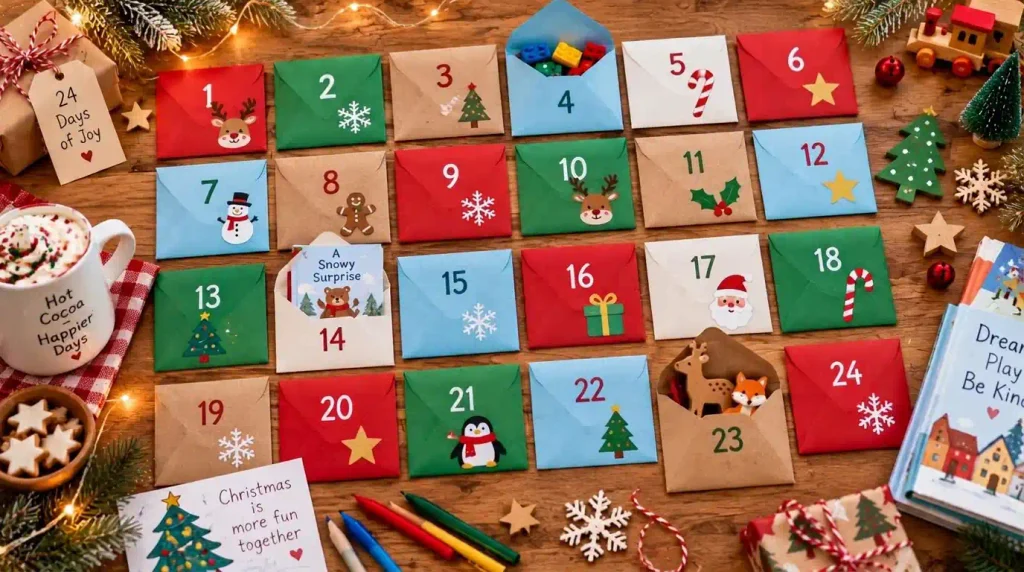
By October, the Advent calendars have started appearing. They show up while you’re buying Halloween candy, scrolling through a retailer’s toy section, or standing in the checkout line with a child who has somehow spotted the one box you weren’t planning to buy.
“Can I have that?”
It looks harmless enough. One little box. Twenty-four doors. Christmas is still weeks away. Then you look closer.
There are LEGO calendars. Disney calendars. Bluey calendars. Cars. Books. Play-Doh. Squishy things. Collectibles. Chocolate. Calendars with tiny toys, tiny books, tiny accessories, and enough tiny pieces to make you wonder where exactly all of this is supposed to live. And suddenly, it feels like a bigger decision.
Because you’re not really buying one Christmas gift. You’re choosing 24 mornings.
That is why the best Advent calendars for kids aren’t necessarily the biggest or most expensive ones. What matters more is whether the calendar fits the child who is going to open it every morning. Will they build with it? Read it? Pretend with it? Collect it? Make something with it?
Or will the excitement wear off somewhere around December 10, leaving you with a pile of tiny plastic things on the kitchen counter? The answer probably has less to do with the box than with the child.
1. It Starts With One Very Small Box
The Advent calendar decision usually begins innocently. You’re not sitting down to conduct research. You’re shopping for something else. Then you see the Christmas displays arriving earlier than seems reasonable, and there it is: a calendar with a familiar character on the front.
Your child likes that character. Problem solved. Except it isn’t.
Once you start looking, the choices multiply. Some calendars are built around construction. Some are miniature playsets. Some give children a new story every day. Others are collections of little figures or accessories that eventually become a larger scene. The prices spread out, too. And this is where the calendar starts to look different.
Twenty-four doors means twenty-four little decisions, twenty-four small surprises and, potentially, twenty-four new things entering the house before Christmas Day even arrives. Your child may adore every one of them. Or they may love the first three and then forget the calendar exists.
That’s the part worth thinking about before clicking “Add to Cart.”
2. Don’t Let the Box Make the Decision
Holiday packaging is very good at making everything look like a wonderful idea. A familiar character helps. Bright colors help. A photograph of a child smiling over a pile of miniature toys definitely helps. But the box doesn’t know your kid.
The child who can spend an hour building a LEGO vehicle may be bored by a calendar built around collecting figures. A child who wants a story at bedtime may get far more from twenty-four tiny books than twenty-four plastic accessories.
And then there is the child who already has a bedroom full of toys. For that child, another collection of little things may not feel like a treat to the adult who has to find somewhere to put them.
The useful question is surprisingly simple: What does this child already love doing?
Building? Reading? Pretending? Collecting? Making things? Start there.
The calendar comes second.
3. Before You Buy, Ask Five Simple Questions
Before you get too seduced by the little doors, there are five things worth asking.
How old is the child? Check the manufacturer’s age recommendation rather than relying on how mature the child seems.
What do they actually enjoy? Not what they enjoyed six months ago. Not what their sibling likes. What do they repeatedly choose when nobody tells them what to play with?
Do they like collecting, building, reading, making or pretending?
Will the contents become something larger? A collection that works with an existing play system can have a very different life after December 24 from a box of unrelated trinkets.
And finally: What do you actually want the 24 days to be?
Twenty-four surprises? Twenty-four stories? Twenty-four activities? Twenty-four little treats?
Try the 24-Day Test
Think about the calendar as if you’re already in December.
Day 1: Is this exciting?
Day 7: Is the child still interested?
Day 15: Are the things being opened actually being used?
Day 24: Did the calendar leave behind something the child will continue playing with or reading?
This isn’t a scientific measurement of children’s enjoyment. Kids are wonderfully unpredictable, and the child who ignores a carefully chosen toy for three days may suddenly decide it’s their favorite thing on earth. It’s simply a way of looking beyond the first morning.
4. The 2026 Advent Calendars Worth Looking At
This year’s choices make the old chocolate-calendar idea look almost quaint. There are calendars for builders, readers, preschoolers, collectors and children who have very strong opinions about Bluey.
Start with the kind of child you’re shopping for.
A note about our links: Oakwood Daily does not participate in an affiliate program for the products featured in this article. We do not earn commissions from purchases made through these links. The links are provided simply so readers can view the products and their current details directly from the manufacturer or publisher.
For the LEGO Kid: LEGO City Advent Calendar 2026
Best for: Kids who genuinely like building and then playing with what they’ve built.
Age: 5+
What’s inside: Twenty-four surprises, including seasonal mini builds and characters such as Santa, Mrs. Claus, three elves, a snowman and a baby reindeer. The box also folds out into a Santa’s workshop playmat. LEGO lists 252 pieces and a $34.99 U.S. price.
Why it stands out: This is one of the easier calendars to imagine surviving beyond December. The daily surprises aren’t necessarily the end of the experience. They can be combined with other LEGO City sets after Christmas.
Watch for: Tiny building pieces are still tiny building pieces. A five-year-old who is easily frustrated by small builds may need some help, particularly during the first few mornings.
For a Child Who Loves LEGO Characters and Stories: LEGO Friends Advent Calendar 2026
Best for: Kids 6 and up who prefer character-driven pretend play as much as construction.
Age: 6+
What’s inside: The 2026 set contains 211 pieces, three minidolls and six mini animal figures, including a seal, pony, weasel, polar bear, penguin and bunny. There are also winter accessories and small story-building elements. LEGO’s U.S. price is $34.99.
Why it stands out: There is more of a story hiding inside this one. The daily reveals can become characters and props rather than simply a succession of objects.
Watch for: The experience works best for a child who actually enjoys building. If the pieces are likely to end up loose in a drawer, the calendar loses some of its appeal.
For the Disney Princess Child: LEGO Disney Princess Advent Calendar 2026
Best for: Disney Princess fans who already enjoy LEGO.
Age: 5+
What’s inside: Twenty-four days of characters and mini builds, including Ariel, Cinderella, Moana and Mulan microdolls, along with Disney animals and other buildable pieces. The calendar contains 290 pieces, and the box converts into a game board for up to eight players. LEGO lists it at $44.99.
Why it stands out: The box itself has a second life as a game board, which is a nice answer to the “what happens after December?” problem.
Watch for: At $44.99, this sits above LEGO’s $34.99 City and Friends calendars. The higher price makes more sense when the child is genuinely interested in both Disney Princess and LEGO rather than simply liking the characters.
For the Star Wars Kid: LEGO Star Wars Advent Calendar 2026
Best for: Kids 6+ who are already firmly in the Star Wars universe.
Age: 6+
What’s inside: The 293-piece calendar includes minifigures and mini builds from The Mandalorian, including The Mandalorian, Moff Gideon, Grogu, Carson Teva and a Jawa, along with seven mini-build vehicles and other accessories. LEGO lists it at $44.99.
Why it stands out: This is a particularly clear example of why the child’s existing interests matter. A child who already plays with LEGO Star Wars has somewhere to put these pieces after Christmas.
Watch for: The value is much less obvious if Star Wars is only a passing interest.
For the Child Who Wants a Story Every Morning: Where’s Waldo? Advent Calendar 24-Book Collection
Best for: Kids who enjoy search-and-find books, jokes and short activities.
Age: 5–9 years
What’s inside: Twenty-four miniature books with search-and-find activities, jokes and facts, plus a press-out Waldo figure to hide on Christmas Eve. The 2026 edition is $29.99 and was published in August.
Why it stands out: This is a very different kind of December clutter. Instead of twenty-four toy pieces, the child gets twenty-four little reading experiences. It also gives parents something they can actually sit down and do with a child.
Watch for: The books are miniature. If you’re imagining twenty-four full-size picture books, this isn’t that.
For Preschoolers: Little Golden Books Advent Calendar
Best for: Younger children who enjoy being read to.
Age: 2–5 years
What’s inside: Twenty-four miniature paperback Little Golden Books, including holiday and winter stories. The 2026 edition is $29.99 and goes on sale September 22.
Why it stands out: This is a simple way to make the Advent ritual part of an existing bedtime or reading routine. Open the door, find the book, read the book. No tiny assembly required.
Watch for: The books are small, and the child may need an adult to do the reading. That’s a feature for some families and a drawback for others.
For the Preschooler Who Wants to Make Things: Play-Doh Advent Calendar
Best for: Kids 3 and up who would rather make something than collect something.
Age: 3+
What’s inside: The Play-Doh calendar has twenty-four doors with Play-Doh colors and tools. The set includes 24 cans of compound, 23 stampers, five accessories, four cards and fold-out winter playmats for creating snowy and gingerbread scenes. Hasbro states that the product is for ages 3 and up and warns that small parts may be generated; the compound contains wheat.
Why it stands out: There is an activity attached to the surprise. The child isn’t simply opening something and putting it aside; the day’s reveal can become part of making something.
Watch for: Play-Doh has a way of migrating. Check the kitchen table, the dining chair and, eventually, the underside of something you were certain had nothing to do with Play-Doh.
For the Bluey-Obsessed Child: Bluey’s Mini Figure Advent Calendar
Best for: Young Bluey fans who already enjoy playing with the show’s characters.
Age: The manufacturer describes the figures as suitable for little hands; retailer listings currently list the calendar for ages 3+.
What’s inside: Moose Toys’ calendar has 24 surprises, including four mini figures—Bluey, Bingo, Muffin and Socks in Christmas sweaters—plus 12 accessories, three paper accessories and five sticker sheets. Moose Toys lists a $19.99 U.S. MSRP.
Why it stands out: It gives a child who already plays with Bluey figures more pieces to add to the same imaginative world.
Watch for: There are paper accessories and stickers mixed in with the figures and physical accessories. So the 24 doors aren’t 24 substantial toys.
For the Hot Wheels Collector: Hot Wheels 2026 Advent Calendar
Best for: Kids 3+ who actually play with Hot Wheels rather than simply liking the look of the cars.
Age: 3+
What’s inside: Mattel’s 2026 calendar contains 34 pieces: 10 Hot Wheels vehicles, 14 accessories and 10 ornament clips. Twenty-four doors reveal either a vehicle or accessory, including an exclusive snow-globe car with a Yeti driver. Mattel lists it at $39.99.
Why it stands out: The cars can become part of an existing Hot Wheels collection, while the accessories give children something to do with them.
Watch for: Fourteen of the 24 daily reveals are accessories rather than cars. A child expecting a new car every morning may be disappointed.
5. When a Book Advent Calendar Makes More Sense Than a Toy
There is something quietly nice about opening a little door in December and finding a story.
The morning can stay almost exactly the same: cereal, pajamas, backpacks waiting by the door. Except now there is a book on the table. A book calendar can also sidestep a problem that toy calendars sometimes create.
There is nothing new to find a home for.
The 2026 Where’s Waldo? calendar, for example, gives children twenty-four miniature search-and-find books rather than twenty-four unrelated toys. The Little Golden Books version takes the idea in a younger direction, with twenty-four miniature stories for children ages 2 to 5.
That doesn’t make book calendars automatically better.
A child who would rather build a spaceship than sit for a story may stare at you as if you’ve made a terrible mistake. And that’s fine.
The point is not to turn Advent into a lesson in good parenting. It’s to choose something the child will actually want to open tomorrow morning.
6. For Toddlers, “Fun” Means Something Different
With younger children, the calendar deserves a little more scrutiny. Age recommendations matter. So do small pieces.
A calendar aimed at a three-year-old isn’t automatically suitable for a child who is two simply because the box looks harmless. Check the manufacturer’s stated age range and warnings before buying.
For preschoolers, a calendar such as Play-Doh offers a very different experience from a collectible calendar. There is a daily material to manipulate and a larger activity that develops over the month. The manufacturer lists it for ages 3 and up and specifically warns about small parts and wheat in the compound. The Little Golden Books calendar takes another route. For ages 2 to 5, it puts a story behind each door rather than another object.
A toddler doesn’t necessarily need twenty-four different things.
Sometimes the exciting part is simply knowing that tomorrow there will be another door.
7. What Happens to the 24 Little Things on December 26?
This is the question that tends to arrive after the shopping excitement has passed. Christmas is over. The wrapping paper is still somehow everywhere, and on the floor are the contents of an Advent calendar. Twenty-four little things. If they belong to an existing LEGO, Hot Wheels, Bluey or other play system, they have somewhere to go. The child can fold them into play that was already happening.
LEGO specifically notes that several of its 2026 calendar builds can be combined with other sets in the same range. That’s different from a calendar whose pieces only make sense inside the original packaging. The packaging matters, too. Some boxes become play scenes or game boards. Others are simply cardboard that goes into the recycling bin.
None of this makes a disposable calendar bad. It just gives you another question to ask before buying it: What happens to all of this when December is over?
8. What Are You Actually Paying For?
A $20 calendar and a $45 calendar aren’t necessarily competing on the same terms. One might contain small figures. Another might contain twenty-four miniature books. Another might be feeding pieces into a larger LEGO collection. The price only tells you how much the box costs. It doesn’t tell you what kind of December experience you’re buying.
Bluey’s Mini Figure Advent Calendar has a $19.99 MSRP. The Little Golden Books calendar is $29.99. LEGO City is $34.99. Hot Wheels is $39.99. LEGO’s Disney Princess and Star Wars calendars are $44.99.
Those aren’t really six versions of the same product. They’re six different kinds of play.
So instead of comparing the price of the boxes, look at what happens after the box is opened. Will the child read the books? Build with the pieces? Play with the figures? Make things? Add the new pieces to toys they already own? Or will the contents simply join the mysterious category of objects that live in the bottom of the toy bin?
9. Which Advent Calendar Fits Your Child?
| If your child… | Look for… |
|---|---|
| Loves building | Construction or building calendar |
| Loves stories | Book calendar |
| Loves pretend play | Character or activity calendar |
| Loves collecting | Collectible calendar |
| Already has lots of toys | Books or activity-based calendar |
| Is very young | An age-appropriate, simple activity or reading calendar |
| Shares with a sibling | A calendar with a larger shared play experience |
| You want less clutter | Books or activities that don’t create a new toy collection |
It’s more like the question you might ask yourself while standing in the toy aisle, phone in one hand and a child tugging at your sleeve with the other.
What does this particular child actually do? Start there.
10. The Best Calendar Is the One That Makes December Feel Like December
Go back to October.
The parent is standing in front of a shelf of Advent calendars, still carrying the mental to-do list that comes with the beginning of the holiday season. Halloween isn’t even over. Thanksgiving is coming. There are school events to remember, gifts to think about and approximately 400 things that seem to become urgent sometime between Thanksgiving and Christmas.
And now there is this little box.
By December 1, the shopping decision is finally behind you. The calendar is sitting somewhere visible in the house. Maybe on the kitchen counter. Maybe beside the Christmas tree. Maybe somewhere a small person can reach it and has already asked three times whether they’re allowed to open the first door.
Then morning comes. A sleepy child walks in. The first door opens.
Maybe there’s a LEGO piece inside. Maybe a tiny book. Maybe Bluey in a Christmas sweater. Maybe a little can of Play-Doh that will somehow end up on the table before breakfast.
The object itself is almost beside the point.
Because what you bought was never really 24 tiny things.
You bought a reason to pause for a minute every morning.
And if the calendar is right for your child, the ritual can carry all the way to Christmas. That’s the part worth choosing carefully.