The rain has been falling steadily for most of the afternoon, the kind of autumn rain that darkens the leaves and turns the yard a little softer underfoot. Along the roofline, everything looks normal. Water runs into the gutters, gathers, and disappears down the downspouts.
Then you notice the ground beside the house.
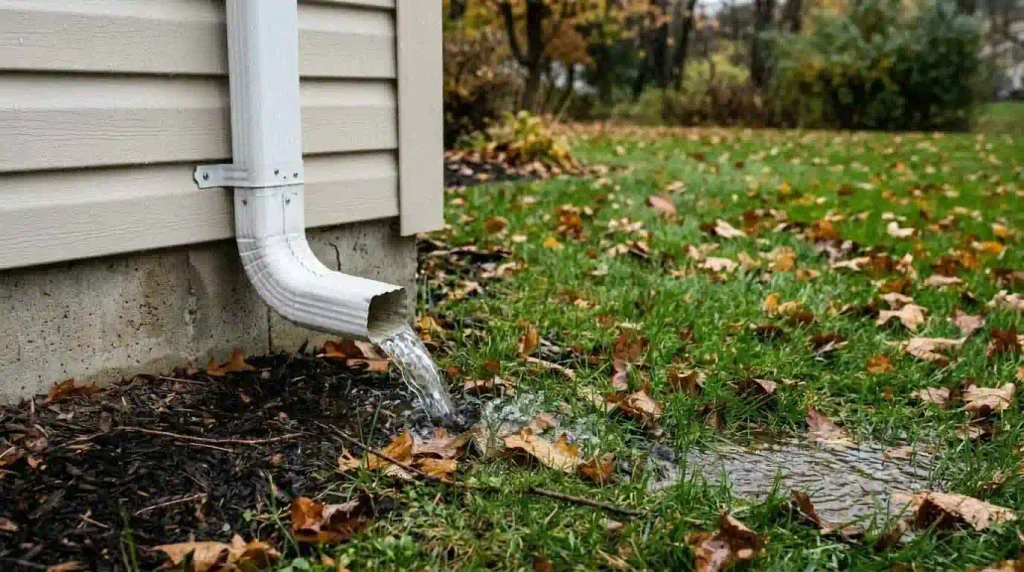
There is a dark patch of saturated soil directly below one of the downspouts. A little farther along, the foundation wall is damp-looking. Nothing is overflowing, and nothing appears broken.
The gutter seems to be doing its job. So why is all that water ending up right there?
It is an easy thing to overlook in the middle of a rainy afternoon. A wet patch of soil does not necessarily mean something is wrong with the house. But it is worth following the water before the weather turns colder. Because the gutter is only the beginning of the drainage system.
A homeowner checking the outside of the house before winter will often look up first. Are the gutters full of leaves? Is water spilling over the edge? Is a downspout visibly blocked? Those are useful questions, but they are not the whole inspection.
A downspout can carry water perfectly well and still release it too close to the foundation. That can be particularly easy to miss during a dry stretch. The ground looks fine, the extension is lying where it has always been, and there may be no obvious sign of trouble inside the house. Then a long rain arrives.
The same patch of soil becomes saturated again. Water collects near a basement window, a little channel develops beneath the end of the downspout, or runoff follows the slope of the yard back toward the house instead of away from it. None of those observations automatically means a foundation is damaged. They do tell you something more useful: the water has a path, and it is worth finding out what that path is.
The first thought is usually the obvious one: the gutters need cleaning.
In fall, that is a perfectly reasonable suspicion. Leaves and other debris can obstruct gutters and downspouts, causing roof water to spill close to the house rather than travel through the intended drainage route. University of Missouri Extension recommends checking gutters and downspouts and making sure downspouts drain away from the foundation.
But imagine the gutters have already been cleaned. The downspout is clear, and water is coming out exactly as it should. The problem can still remain.
That is because a clean gutter only tells you that the first part of the system is functioning. It does not tell you whether the water is being released in a sensible place. That distinction is easy to miss.
A gutter collects water, a downspout concentrates it, and at the bottom, something has to determine where that concentrated flow goes next.
The easiest way to understand the problem is to stop looking at the gutter and follow the water. Start at the roof.
Rain lands across a surprisingly large surface area and runs downhill toward the roof edge. The gutter catches that runoff instead of allowing it to fall directly around the perimeter of the house.
From there, the water moves into the downspout. The downspout does something important: it takes water that was spread across a roof and brings it to one relatively small discharge point.
Then comes the extension. That short piece of pipe, plastic, aluminum, or flexible material can seem almost incidental. It is not. It determines where the concentrated stream leaves the house.
And then the ground takes over. The water has to move through or across the soil. The slope of the property, the soil itself, landscaping, pavement, window wells, and the position of the foundation all influence what happens next.
The U.S. Department of Energy’s Building Science Education guidance describes the same basic chain: gutters and downspouts should carry roof water away from the building so the soil around the foundation does not become saturated.
Suddenly, the wet patch beside the house makes more sense. The gutter may have been doing its job all along. The question was what happened after the water left it.
That dark patch beside the downspout is only the part you can see.
Roof runoff is not just an occasional trickle. A broad roof surface can funnel a large amount of water into just a few discharge points. The Department of Energy notes that even a few inches of rain falling on a home’s roof can produce thousands of gallons of runoff that need to be managed away from the foundation.
When that water repeatedly lands in the same small area, the surrounding soil can become saturated. That matters because the foundation is sitting right beside it.
Some parts of a house are more exposed to surrounding soil and surface water than others. A basement that extends below grade, for example, has more wall area in contact with surrounding soil. A basement window or window well can also become a vulnerable point if surface water collects nearby.
The same observation matters around foundation corners, low sections of a yard, and properties where the natural grade sends water toward the house.
A sloped yard can help water move away. A poorly graded yard can do the opposite.
University of Georgia Cooperative Extension recommends checking both the discharge from gutters and the slope of the ground around the foundation, noting that persistent pooling near the house is a sign that drainage deserves attention.
That does not mean every puddle is a foundation problem. Rain leaves wet ground, heavy storms create temporary pooling, and soil sometimes drains slowly. The useful question is whether the same drainage problem keeps happening, particularly close to the foundation.
The basic building-science idea is simple: water needs a controlled path away from the building. Think about the sequence again.
Rain falls. The roof turns it into runoff, the gutter collects it, and the downspout concentrates it. An extension moves the discharge point before the ground takes over. At that final stage, the property’s grading and soil determine whether the water moves away, spreads out, soaks in, or collects beside the house.
That is why the answer to “How far should downspouts extend from the house?” is not simply one number for every property. There is authoritative guidance that does provide useful reference points. UGA Cooperative Extension recommends downspouts extend 6 to 10 feet from the foundation, while the U.S. Department of Energy’s Building Science Education guidance calls for above-grade discharge farther than 5 feet from the foundation under the applicable construction guidance it describes. Those figures should be treated as guidance, not a magic number that makes every property safe.
A house on a steep lot will move that water differently from a house on flat ground. A basement window, retaining wall, paved surface, or neighboring property can change the sensible discharge route. The goal is not to win a measuring contest with the tape measure. It is to get concentrated roof runoff somewhere it can drain without repeatedly loading the soil beside the foundation.
Before buying a new extension or digging anything into the yard, watch what your house actually does during rain. You do not need special equipment; just stand somewhere safe and look at the downspout discharge.
Where does the water land? Does it fall almost directly against the foundation? Does an extension carry it outward, or has the extension slipped, cracked, or disconnected? Does the water immediately run back toward the house? Does the soil become saturated while the rest of the yard remains relatively dry?
Look around the corners of the foundation, basement entrances, and window wells. Then watch what happens after the rain eases. A temporary puddle that disappears normally is different from water that repeatedly collects in the same place.
University of Missouri Extension advises homeowners to look for pooling and low areas and to make sure roof drainage is directed away from the foundation. This is not a professional inspection. It is simply paying attention to something the house has been doing every time it rains.
Wet ground is not automatically bad drainage. After a heavy storm, a lawn may be saturated. A shallow puddle may sit for a while. Leaves may collect around a drain or gutter before they actually obstruct water flow. Those things can be ordinary. What deserves a closer look is the pattern.
Usually ordinary:
- Soil that becomes damp during or shortly after a storm
- Temporary puddles after unusually heavy rain
- Normal runoff during the storm itself
- Leaves collecting in gutters before they obstruct water flow
Worth investigating:
- Water repeatedly pooling beside the foundation
- A downspout releasing concentrated water directly beside the house
- Soil that stays saturated well after rain
- Erosion beneath the end of a downspout
- Runoff flowing toward the foundation
- Water collecting around basement entrances or window wells
- A downspout extension that has disconnected or shifted
- Recurring moisture or water intrusion in a basement or below-grade space
Persistent moisture around a structure has more than one possible cause. UGA Extension identifies poor landscape grading, roof leaks, clogged gutters and downspouts, and other drainage problems as potential sources of excessive or persistent moisture.
The point of the check is not to diagnose the foundation from the backyard. It is to notice when the same water problem keeps repeating. Once you have followed the water, the pre-winter check looks different.
You are not simply “doing the gutters.” You are checking the entire route.
Step 1 — Check the gutters
Remove accumulated leaves and debris. Look for sections that are sagging or holding water instead of draining normally.
Step 2 — Check the downspouts
Make sure water can move through them. Look for obvious blockages, loose connections, or sections that have separated.
Step 3 — Watch the discharge point
Do not stop at the bottom of the downspout. Look at where the water actually lands.
Step 4 — Inspect the extension
Make sure it is still connected and intact. A downspout extension that has shifted over time may no longer send water where it once did.
Step 5 — Look at the ground
Check the slope around the house. Is water naturally moving away from the foundation, or does the surface send it back toward the building?
Step 6 — Check vulnerable areas
Look around basement entrances, window wells, foundation corners, low sections of the yard, and nearby paved areas.
Step 7 — Recheck after rain
This is the part that tells you the most about where the water is actually going.
A dry afternoon can make a drainage system look fine. Rain reveals the actual path.
Sometimes moving the discharge point farther from the house solves the obvious problem. Sometimes it does not. If water continues to collect beside the foundation, the larger site may be the issue.
The ground could be graded toward the house. The soil may drain slowly. A low area may be collecting runoff from more than one direction. An underground drainage system may be blocked or may not be carrying water where it needs to go. In other cases, water may be entering through a basement wall, window well, crack, or another part of the building’s water-management system.
This is where it helps not to keep adding longer pieces of downspout simply because the first one did not solve the problem.
The U.S. Department of Energy recommends several possible approaches to roof runoff management, including discharge to an appropriately sloped final grade, underground catchment systems, rainwater harvesting with adequate overflow drainage, or other site-specific drainage solutions.
If a basement repeatedly takes on water, the foundation stays persistently wet, or drainage problems continue despite straightforward surface corrections, that is a reasonable time to have the drainage problem professionally evaluated. It helps to evaluate the whole water path rather than treating one piece of it as the entire problem.
The useful question before winter is not simply: Are my gutters clean?
It is: Where does the water go after it leaves the gutter?
That question changes what you look at: the end of the downspout instead of stopping at the roofline, whether the extension is still connected, the slope of the ground, a basement window sitting below the level of the yard, and whether the same patch of soil keeps becoming saturated every time it rains.
A drainage system is doing more than carrying water off the roof. It is deciding where that water meets the ground. The next time autumn rain settles over the house, the gutters will probably look much the same.
Water will run along the roof edge, disappear into the downspout, and at the bottom emerge onto the ground. That last part is easy to ignore because it happens below eye level.
But that is where the rest of the drainage story begins. Look at where the water lands, watch which direction it takes, and notice what happens to the soil after the rain has stopped.
The dark patch beside the foundation may turn out to be nothing more than wet ground, or it may be the small clue that tells you the water has been stopping too close to the house. Either way, you will know what to look for. Before winter settles in, follow the water a little farther than you normally would.