The first cold evening of autumn usually arrives without much ceremony. The thermostat has spent the summer telling the air conditioner what to do. The furnace has been sitting quietly for months, largely forgotten while the house relied on cooling, open windows, fans, or simply warmer weather.
Then the temperature drops enough that someone switches the thermostat to heat. A few minutes later, warm air starts moving through the vents. And then you smell it.
Not smoke, exactly. More like hot dust. Dry air. Something faintly burnt.
You stop what you’re doing. Maybe you walk over to the nearest vent. Maybe you check the thermostat again, as if it might explain itself. And almost immediately, the question appears: Why does my house smell like something is burning?
It is a reasonable question. A furnace is not the kind of appliance most people want to investigate by trial and error. The reassuring part is that a brief dusty odor during the first heating cycle of the season can have a very ordinary explanation. Dust and other particles can accumulate while the heating system sits unused, and when heated components warm up again, that material can produce a temporary burning-dust smell. Trane and Carrier both identify accumulated dust as a common explanation for odors when heating is first switched on after a period of inactivity.
But “probably dust” is not the same thing as “every burning smell is harmless.” What happens next tells you more.
The Smell That Makes You Stop
During those quiet months, dust settles on surfaces inside and around the heating system. When the furnace starts again, those surfaces are suddenly being heated, which is one reason the first heating cycle can feel different from the ordinary furnace operation that follows. The smell arrives before you have any context for it, and your mind fills in the blank.
Is a wire overheating? Is something trapped inside the ductwork? Is the furnace itself failing? Should you shut it down? Those are sensible questions, especially because a burning odor is difficult to ignore. You cannot see what is producing it, so you’re left trying to interpret a smell coming through the same vents that are supposed to be delivering warm air.
A dusty odor during the first heating cycle is different from a strong electrical or melting-plastic odor, visible smoke, a gas smell, or a furnace that begins behaving abnormally. The important thing is to pay attention to how the smell behaves rather than assuming every burning odor means the same thing.
What May Actually Be Happening Inside the Furnace
The simplest way to understand the first-burn smell is to think less about the furnace suddenly producing an odor and more about what has been sitting on or around it. For much of the warmer season, the heating side of a forced-air system may be relatively inactive, giving dust and other particles time to settle.
Dust does not need an invitation.
Small particles can settle on furnace components and in parts of the air-distribution system, while pet hair and other household debris can contribute as well. The research behind this article identifies accumulated particulate material on furnace components as a likely source of the initial seasonal odor. Then the thermostat calls for heat, the components warm up, and material that has been sitting on those surfaces is exposed to the heat. The resulting odor can move through the home’s air circulation and become noticeable at the supply vents.
The smell itself is real. What may be less alarming is what’s causing it.
Follow the Smell Backward
When something smells burnt, the instinct is usually to look for the thing that is burning. With a furnace, that is not always as straightforward as it sounds. The system moves air through the house, so an odor can become noticeable at a vent even though the material producing it is somewhere farther upstream.
The furnace has been relatively quiet for months, giving dust and other household particles time to settle. Then the heating system starts, components warm up, and that settled material is exposed to heat. The odor moves with the home’s air circulation until you notice it at a vent.
The process also helps explain why the smell can appear suddenly throughout the house even though nothing visibly dramatic has happened, and why it may change as the system continues to operate. If accumulated dust is the source, you’d expect the smell to fade rather than keep getting stronger. That change is worth paying attention to.
Why the First Heating Cycle Is Different
There is a reason this smell tends to surprise people every fall. You probably do not notice what your furnace smells like during a normal heating cycle in January. By then, the system has already been running regularly, so the dust that accumulated during the warmer months may no longer produce the same noticeable odor. The first cycle is different because the system is coming back from a long period of relative inactivity, making early autumn a particularly useful moment to pay attention. The experience can vary from one home to another, too. A furnace in a house with more accumulated dust, pet hair, or other airborne debris may produce a more noticeable odor than a system that has remained relatively clean.
The Part Worth Watching
What matters more is the pattern. Instead of standing next to the furnace trying to decide whether a smell sounds “normal,” pay attention to what the system does next. Start with the character of the odor. A dusty, dry, slightly burnt smell during the first heating cycle is consistent with the seasonal dust-burnoff explanation described in the research and manufacturer guidance. A smell that is distinctly like melting plastic or electrical wiring points in a different direction, while a rotten-egg smell from a gas furnace is a separate category again.
Then watch the intensity and the rest of the system. Does the smell become less noticeable as the furnace continues to run, or does it become stronger? Is the furnace operating normally? Are there unusual sounds or visible smoke? Does the smell remain strongly noticeable instead of fading?
The research report proposes a 15-to-30-minute observation window as part of its editorial angle. That can be useful for encouraging homeowners to observe the progression rather than immediately assuming the worst, but it should not be treated as a universal safety cutoff. Different systems, homes, odors, and conditions can behave differently. The better principle is simpler: A temporary odor that fades is different from an odor that persists, intensifies, or arrives with other warning signs.
Dust Burn-Off or a Warning Sign?
The more reassuring pattern is a furnace that has been sitting unused, begins heating for the season, produces a dusty or burnt-dust odor, and then gradually loses that smell as the system continues operating. That fits the basic explanation offered in the research: dust and other accumulated material can be exposed to heat when a dormant heating system is brought back into service.
Be more cautious when the odor persists rather than fades, becomes stronger, smells distinctly like melting plastic or electrical wiring, occurs with visible smoke, or appears alongside unusual furnace noises or behavior. Those are not situations to casually label “burning dust.” A strong electrical or melting-plastic smell is a reason to stop treating the odor as ordinary startup dust and contact a qualified HVAC professional.
A gas odor requires a different response altogether. If you smell natural gas or a rotten-egg-like odor, do not experiment with the furnace to find the source. Leave the home and contact the gas utility or emergency services from a safe location, following local emergency guidance.
And carbon monoxide is particularly important because you cannot smell it. A working carbon monoxide alarm is therefore much more useful than trying to decide whether the air “smells dangerous.” The U.S. Consumer Product Safety Commission recommends carbon monoxide alarms on every level of the home and outside sleeping areas. If a carbon monoxide alarm sounds, treat that as an emergency, not as part of a furnace-smell experiment.
The distinction is between an odor you can observe and a warning that requires action.
The First-Burn Furnace Check
You do not need to take apart your furnace to investigate a first-season odor, and you should not. A useful homeowner-level check starts with the things you can safely see and observe.
Start with the filter. If you cannot remember the last time you changed the furnace filter, check it. A dirty filter is a basic maintenance issue worth addressing before the heating season gets underway. The correct replacement interval depends on the filter and system, so follow the manufacturer’s guidance rather than relying on a universal calendar.
Look at the accessible surroundings. Check for obvious dust or debris around areas you can safely see without removing furnace panels or entering internal equipment. You are looking for ordinary housekeeping problems, not trying to perform an HVAC inspection.
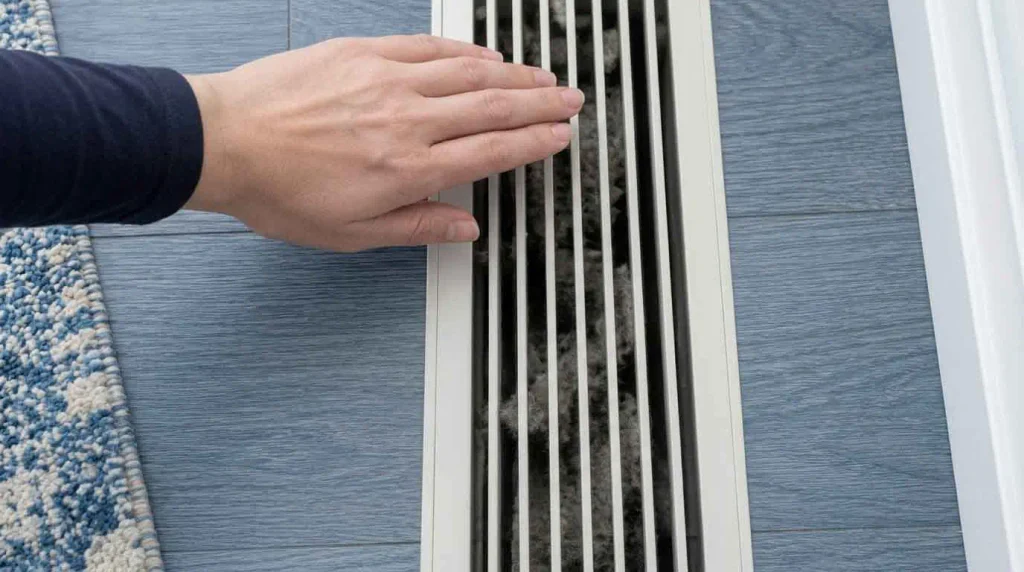
Check the registers and returns. Make sure supply vents and return-air grilles are not blocked by furniture, rugs, curtains, or other household items. This is especially easy to overlook when a room has been rearranged since the previous heating season.
Pay attention to the odor itself. Dusty and temporary is different from electrical, plastic-like, gas-like, or increasingly strong. Your nose is not a diagnostic instrument, but it can tell you when the character of the problem has changed.
Listen. Your furnace will have its usual startup and operating sounds. New or unusual banging, grinding, rattling, hissing, or other noises deserve attention rather than being folded into the “first-day dust” explanation.
Check your carbon monoxide alarms. This is a good seasonal habit regardless of whether your furnace smells dusty. Make sure your alarms are installed appropriately and functioning.
Do not remove combustion components, open sealed sections of the furnace, bypass safety controls, or attempt to repair electrical or gas components because you want to find the source of the smell. There is a point where observation stops being a homeowner task and becomes a technician’s job.
When Not to Ignore the Smell
The goal isn’t to prove that the smell is harmless. It’s to notice when it no longer behaves like ordinary startup dust.
If the odor refuses to fade, becomes stronger, or is accompanied by visible smoke or unusual furnace behavior, stop treating it as an ordinary seasonal nuisance and have the system evaluated. A strong electrical or melting-plastic smell is different and deserves more caution; that kind of odor can indicate an electrical or mechanical problem rather than simple dust burn-off.
A gas odor requires a different response. Do not try to diagnose the furnace yourself. Leave the home and contact the gas utility or emergency services from outside, according to local guidance. If a carbon monoxide alarm sounds, leave the home immediately and call emergency services from outside. Do not reenter until emergency responders say it is safe.
There is also a limit to what you can learn from the smell itself. You can notice the odor, watch whether it fades, replace an accessible filter, and make sure the vents are unobstructed. What you can’t do is smell your way into proving that a heat exchanger, burner, wiring assembly, venting system, or other internal component is safe. When the signs point beyond ordinary startup dust, it’s time to stop trying to sort it out yourself and call a qualified HVAC professional.
Before the Next Cold Snap
It’s better to find a small problem before the first hard cold snap than during it. Before the weather turns consistently cold, check the filter, make sure supply and return vents are clear, and confirm that your smoke and carbon monoxide alarms are working. If the system has a history of unusual smells, noises, poor heating, or other problems, arrange professional maintenance rather than waiting for the first hard freeze to expose them.
The First-Burn Furnace Protocol
So the house is quiet again. The thermostat has finally been moved to heat, warm air is coming through the registers, and for a few minutes the familiar smell of the first furnace cycle hangs in the room.
If the dusty smell fades as the furnace runs, accumulated dust may explain it. If the smell grows stronger, persists, smells electrical or like melting plastic, or comes with smoke or unusual furnace behavior, don’t assume it’s dust.
A dusty smell that fades is one thing. A smell that grows stronger, changes character, or comes with other warning signs is another.