You notice the water before you notice anything else. A few beads have collected along the bottom of the bedroom window, right where the glass meets the sill. You wipe them away with a towel before breakfast, open the curtains and get on with the morning. The next day, the water is back, and then you notice the same thing beginning to appear on another window.
Nothing else about the house seems particularly wrong. The heat is running. The room feels warm enough. There is no obvious roof leak, and the outside of the glass is completely dry. Still, there is moisture on the inside of the window, sometimes enough to leave the sill damp.
Wiping the same window every morning is not exactly a home-improvement project, but after a week of it, you start wanting an explanation. Is the window leaking? Has the seal failed? Is the glass simply too old? Or is the house itself creating the conditions for the water to appear?
That last possibility is easy to overlook because condensation looks like a window problem. Sometimes it is. But often, the glass is simply the first place in the room cold enough to reveal what is happening in the air.
1. The Window Looks Like the Obvious Suspect
It is a reasonable assumption. If water is sitting on a window, the window must be letting water in—or something inside the window must have gone wrong. Older windows, damaged seals and poorly performing glazing can all create real problems, so it would be wrong to dismiss the window entirely.
The useful clue is not simply that there is water. It is where the water is.
Run a finger across the glass. Is the moisture on the room-facing surface, where you can wipe it away? Is it trapped between two panes of glass? Is the frame wet? Is water collecting on the sill? Is the surrounding trim beginning to show dampness?
Those are different situations. A little moisture appearing on the room side of the glass during a cold spell points toward a very different problem from moisture that seems to be sealed inside a double-pane unit.
That distinction is worth making before reaching for a caulk gun—or a replacement-window estimate.
2. The Water May Not Be Coming Through the Window
Condensation is easy to confuse with a leak because the end result looks similar: there is water where you do not want water.
The difference is where the water began. A leak brings liquid water into the house from somewhere else. Condensation starts with water vapor already in the indoor air. When that moist air comes into contact with a surface cold enough to bring the air down to its dew point, some of the vapor changes into liquid water. The EPA specifically identifies windows as common cold surfaces where this can happen during cold weather.
That is why the outside weather can be completely dry while the inside of the window is wet. The water did not necessarily travel through the wall or around the frame. It may have formed right there on the glass.
Everyday life supplies plenty of the moisture involved. Showers add water vapor. Cooking and boiling water add more. Dishwashing contributes some, as does breathing and ordinary occupancy. In a tightly closed home during winter, some of that moisture may remain indoors rather than quickly escaping.
Once you see condensation this way, the wet window becomes less of a mystery. It is simply where the moisture in the house becomes visible first.
3. What Dew Point Has to Do With a Wet Window
Dew point sounds more complicated than it is. You can think of it as the temperature at which air, given the amount of moisture it currently contains, reaches the point where some of that moisture has to leave the air as liquid water.
Imagine the room is warm and the air contains moisture from the night’s occupants, a shower down the hall, or yesterday evening’s cooking. The air near the window cools when it comes close to the colder glass. If the glass is cold enough to bring that nearby air down to its dew point, water begins forming on the surface.
The sequence is straightforward: moisture is present in the indoor air, the air near the glass cools, and condensation appears once that air reaches its dew point. The same basic process occurs when moist indoor air cools near a cold surface and reaches its dew point.
Relative humidity matters because warmer air can hold more moisture than colder air. If you increase the amount of water vapor in a room without changing its temperature, you move closer to the point at which condensation can occur. If the glass becomes colder while the moisture level stays the same, you can reach that point from the other direction.
This is why condensation on a window is really a story about two things meeting: moisture in the air and a sufficiently cold surface.
4. Why Winter Makes the Window Colder Than You Expect
A room can feel comfortably warm while its window glass remains surprisingly cold. That difference becomes more pronounced as outdoor temperatures fall, particularly with older or less insulating windows.
During a mild autumn week, the inside surface of a window may stay warm enough that no visible moisture forms. Then a cold front arrives. The furnace runs through the night, the windows remain closed, and the glass loses more heat to the outdoors. Suddenly, the same indoor air that seemed harmless a few days earlier can produce droplets.
That is why window condensation in winter often appears in episodes rather than as a constant problem. Outdoor temperature changes. Indoor humidity changes. The surface temperature of individual windows varies. A bedroom window facing a colder exterior exposure may behave differently from a protected interior window, even when both rooms are kept at roughly the same temperature.
Windows are commonly among the coldest interior surfaces in a home, which is why they can become the first place where excess indoor moisture becomes visible.
The important point is that there is no single humidity number that guarantees every window will remain dry in every American home. A home’s climate, window design, surface temperature, insulation, air movement and indoor conditions all matter.
5. Before You Blame the Window, Check the Room
The next time you see moisture on the glass, resist the urge to wipe it away immediately. Take a minute to look at what is actually happening.
Start with the location. If the moisture is plainly on the room-facing side of the glass, that points to surface condensation. If it appears between sealed panes, that is a different situation. If the frame, trim or sill is getting wet, pay attention to how much water is accumulating and how often it happens.
Then look for a pattern around the house. Are several windows affected, or only one? Does it happen mainly in bedrooms after everyone has slept with the doors closed? Is the bathroom window wet after a long shower? Does the kitchen window become noticeably worse after cooking? Is the problem much heavier on mornings when the outdoor temperature drops sharply?
Patterns are useful because condensation is responding to conditions. If several otherwise unrelated windows begin showing the same moisture at roughly the same time, that is a useful clue that the indoor environment deserves attention.
It is also worth checking whether curtains or blinds are trapping still air against the glass. Air circulation helps move room heat toward cold surfaces, and the EPA recommends increasing air movement where practical as one way to help prevent condensation.
You do not need to turn yourself into a building inspector. You are simply gathering clues before deciding what kind of problem you have.
6. A Small Hygrometer Can Tell You More Than Guessing
People are not particularly good at estimating indoor humidity by feel. A room can feel perfectly comfortable while containing enough moisture for condensation to develop on cold glass.
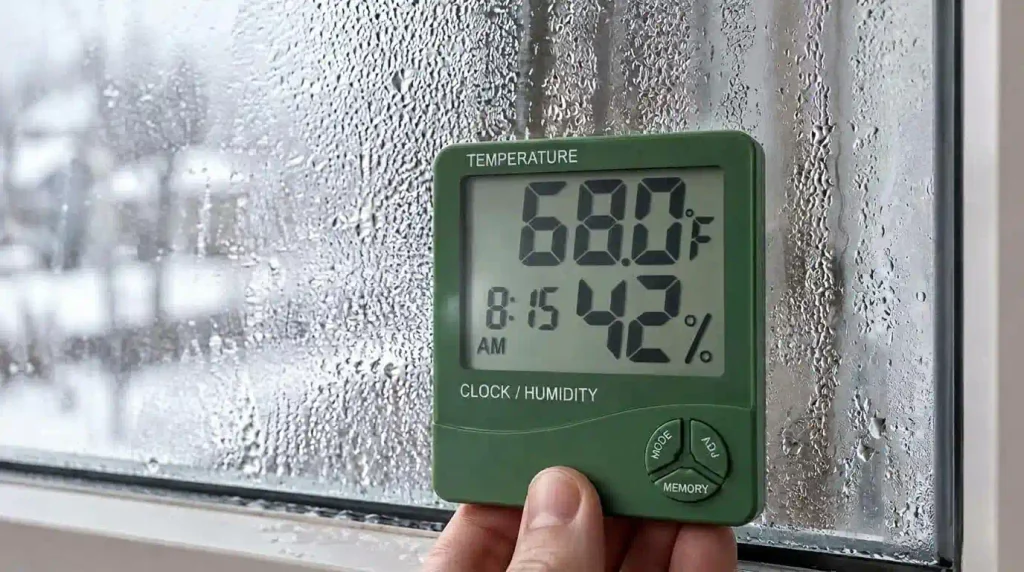
A small hygrometer gives you an actual reading. The EPA recommends using a humidity meter to measure relative humidity and advises keeping indoor humidity below 60 percent, with 30 to 50 percent described as an ideal general range for moisture and mold control.
That does not mean 50 percent is a magic line separating a dry window from a wet one. A window exposed to very cold outdoor conditions may show condensation at a humidity level that would be harmless on a milder day. The EPA’s moisture guidance also gives lower recommended indoor humidity levels as outdoor temperatures become extremely cold, illustrating why winter humidity needs can vary with conditions.
This is where a hygrometer becomes more useful than guessing. Check the reading in the room where the condensation is occurring, preferably at different times of day. You may discover that the bedroom is more humid overnight, or that the humidity rises after cooking and bathing.
Suddenly, “Why are my windows sweating in winter?” has a more useful answer than “because it is cold.” The question becomes: How much moisture is in the room, and how cold is the glass?
7. When Condensation Is Ordinary—and When It Deserves Attention
A few droplets on a cold morning do not automatically mean your house has a serious moisture problem. Condensation can occur whenever the combination of indoor moisture and surface temperature makes it possible. The important thing is what happens next.
If you wipe the glass dry and it stays dry after the indoor conditions change, there may be little more to investigate at that point. But repeated heavy condensation is different, especially when water is regularly collecting on wooden sills, trim, drywall or painted surfaces.
Moisture that repeatedly remains on building materials can eventually damage them. Persistent dampness can also create conditions that support mold growth. The EPA notes that condensation around windows can be enough to contribute to mold growth when moisture persists.
That is why the towel matters, even though it is not the solution. Drying the surface helps limit immediate moisture exposure, but it does not explain why the water keeps returning. If condensation is recurring, the more useful job is to reduce the moisture source, improve appropriate ventilation or address the cold surface.
The window is giving you information. It is worth listening before the damp sill becomes the more expensive problem.
8. What If the Moisture Is Between the Panes?
This is where “condensation inside double pane windows” can become confusing.
If you can wipe the moisture from the room-facing surface, the condensation is happening on the interior side of the glass. If moisture appears inside the sealed space between panes, you are looking at a different condition. It is not simply the same room humidity condensing on the surface you can touch.
Insulated glass units are designed with a sealed space between the panes. If that space develops visible moisture or fogging, the window assembly may have a seal or insulating-glass problem that deserves assessment.
That does not automatically mean the entire window needs replacing. The appropriate remedy depends on the type of window, the condition and age of the insulated glass unit, and whether the problem is confined to the glass or involves the surrounding frame.
The useful first step is simply identifying which side of the glass is wet. That one observation can prevent two very different problems from being treated as though they were the same.
9. How to Reduce Winter Window Condensation at the Source
Once you understand why the water is appearing, the practical fixes become much less mysterious.
Start by measuring indoor humidity rather than immediately buying equipment or changing the windows. If humidity is elevated, look for the source. The EPA recommends using exhaust fans in bathrooms and kitchens to remove moisture to the outdoors, and notes that showers, cooking, dishwashing and other everyday activities can add moisture to indoor air.
Bathroom ventilation matters most when the moisture is being produced. Run the exhaust fan while showering rather than waiting until the mirror and walls are already dripping. In the kitchen, use the range hood or other exhaust ventilation when cooking, particularly during activities that produce substantial steam.
Then look at the windows themselves. If curtains or blinds are closed tightly against the glass, they can limit the movement of warm room air across the surface. The goal is not to blast the glass with a fan all night. It is simply to avoid creating an isolated pocket of cold, still air around the window.
If the home uses a humidifier, check its setting rather than assuming more humidity is always better in winter. When condensation is already appearing, adding moisture to the indoor air can move conditions in the wrong direction. The EPA specifically recommends reducing indoor humidity when condensation is collecting on windows.
And if condensation remains heavy despite reasonable indoor humidity and ventilation, look more closely at the window and the conditions around it. A particularly cold surface can be part of the reason one window condenses before all the others.
10. Don’t Replace the Window Before You Understand the Water
A replacement window can improve thermal performance in the right situation. But replacing glass without understanding the source of the moisture can be an expensive way to misunderstand the problem.
Suppose the indoor air is carrying substantial moisture and the coldest window in the room is simply the first surface to reveal it. A new window may reduce condensation by keeping its interior surface warmer under the same conditions, but it would not remove the underlying moisture from the house.
The opposite can also happen. If indoor humidity is reasonable and one particular window is dramatically colder than the others, the window or surrounding assembly may deserve closer attention. The Department of Energy notes that window performance characteristics, including condensation resistance, affect how well a window resists moisture forming on its interior surface in cold conditions.
Diagnosis should come before replacement. First identify where the water is, measure the indoor conditions, observe when it happens and compare affected windows with windows that stay dry.
Sometimes the answer is a moisture-control issue. Sometimes the window really is part of the problem. The glass does not get to make that decision by itself.
11. Look at the Window Differently Tomorrow Morning
Tomorrow morning, you may still find a few droplets along the bottom of the bedroom window. The difference is that you will know what to look for before reaching for the towel.
Notice whether the water is on the room-facing glass. Check the indoor humidity. Think about how cold the night was, whether the bedroom door stayed closed, whether anyone showered late the previous evening and whether the kitchen produced a lot of steam. Look at another window and see whether it tells the same story.
The water is still water. But it is also a clue.
A window can be the coldest surface in a room, quietly recording the relationship between the air inside your home and the weather outside. When the indoor air contains enough moisture and the glass becomes cold enough, that relationship becomes visible as droplets on the pane.
So if you find yourself wiping windows that are sweating on the inside for the third morning in a row, you may not need to start by blaming the window. Start by looking at the room around it. The glass may simply be the first place in the house to show that the balance between indoor moisture and temperature has changed.