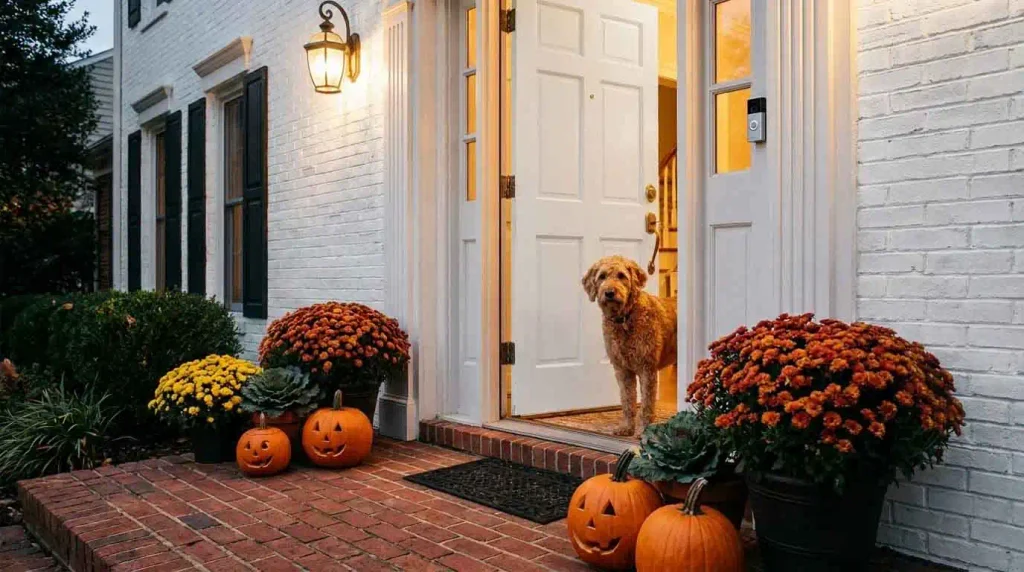
At 6:14 p.m., the first doorbell rang. Maggie was still putting the finishing touches on the candy bowl when Cooper, her six-year-old Labrador mix, shot out of the living room.
“Cooper, wait.”
Too late. He was already at the front door, barking through it.
Maggie opened the door a crack. Two children in superhero costumes stood on the porch, their parents waiting behind them. Cooper barked harder.
“Sorry,” Maggie said, reaching for his collar.
The children laughed. Someone said, “Cute dog.” The door closed, and Cooper paced back toward the kitchen.
Then the bell rang again.
By 6:45, Maggie had stopped trying to answer the door normally. She was holding Cooper back with one hand while passing out candy with the other, and every time she opened the door, she had the same thought: Please don’t let him get out.
It wasn’t only the barking anymore. Cooper was watching the windows, reacting to footsteps on the porch, and rushing forward whenever the latch moved. When a neighbor arrived wearing a long black cape, Cooper barked at him as if he’d never seen him before.
Maggie had spent the first part of the evening thinking she had a dog with a barking problem. Anyone dealing with a dog barking at trick-or-treaters may have recognized what she was seeing: the barking was only one part of what had changed around the door. By that point, she realized something else was happening: the entire front door had become an event.
For some dogs, Halloween doesn’t simply mean more people outside. It means the same sequence happening over and over: a bell, footsteps, a knock, a strange-looking person, an opening door, someone coming close, someone leaving, the door closing—and then, a few minutes later, the whole thing starts again.
The dog isn’t being asked to respond to one visitor. He’s reacting to the pattern that comes before each one: the bell, the footsteps, the door, the stranger.
That was when Maggie started thinking less about stopping the barking and more about changing what happened around the door.
The front door has become the trigger
A normal evening might bring one delivery, a neighbor stopping by or a family member coming home. Halloween is different. The doorbell may ring dozens of times, children may knock instead of using the bell, and costumes can make familiar people look suddenly unfamiliar. People stand close to the house, talk loudly on the porch and move away again, while the front door opens repeatedly, sometimes with the dog watching from only a few feet away.
For a dog who already reacts strongly to visitors, all of that activity can keep the reaction going. The reaction might look like barking, pacing, jumping, growling, staring through the window or rushing toward the entryway. Some dogs may become increasingly difficult to redirect as the evening continues, while others may become frightened rather than more outwardly reactive.
And then there is the practical danger: the open door. A dog doesn’t have to be a habitual escape artist for an unusual opening to become a problem. A busy household, an unfamiliar person standing outside and repeated door openings create opportunities that simply aren’t there on an ordinary Tuesday night.
Don’t make your dog responsible for the front door.
Instead, make the house do some of the work.
Build an entryway airlock
Think of the setup as a tiny airlock. The front door should not lead directly to the dog. Instead:
Outside → front door → physical barrier → interior space → dog
The exact arrangement depends on the house. In a home with a foyer, a baby gate or exercise pen may create enough separation between the entrance and the rest of the house. In another home, a closed hallway door may work better. A dog who is already comfortable relaxing in a bedroom, office or other interior room may simply spend the evening there. An apartment might require a different solution altogether, perhaps with the dog staying in a bedroom behind a closed door while someone handles the hallway and entry.
The point isn’t to create a perfect architectural arrangement. It’s to remove the straight line between an excited dog and an opening front door, which matters even more if your dog has a history of door-dashing. A physical barrier also gives you something training can’t give you on Halloween night: another layer of protection.
You can work on your dog’s response to the doorbell for weeks, but Halloween night is not the time to find out whether all that practice holds up when a dozen costumed children arrive in twenty minutes.
Management and training are different jobs. Training changes behavior over time, while management keeps the situation safe while that learning is happening. For Halloween, management should come first.
For Maggie, that meant there were really two jobs: keep Cooper safely away from the door on Halloween night and start teaching him that the doorbell didn’t always mean a stranger was coming through it.
Then make the doorbell boring again
If the doorbell already sends your dog into a frenzy, don’t wait until October 31 to work on it. Behavior professionals often use desensitization and counter-conditioning to change a dog’s response to a trigger. In plain English, that means making the trigger easier to tolerate while pairing it with something the dog likes.
The important part is the intensity. You don’t want to repeatedly ring the bell at full volume while your dog is already barking, lunging or panicking. That isn’t a shortcut; it can simply keep putting the dog in a situation he’s not ready to handle. Instead, begin at a level your dog can handle. For one dog, that might mean playing a recording of a doorbell very quietly. For another, it could mean having someone touch the doorbell without actually ringing it. The appropriate starting point depends on the individual dog.
At that lower level, something good happens—a reward—and then the exercise stops. Over repeated sessions, the difficulty can gradually increase if the dog remains comfortable. The goal isn’t to teach a dog that the doorbell is meaningless overnight. It’s to make the sound easier for him to handle, slowly enough that he doesn’t become overwhelmed.
That also means watching the dog rather than watching the clock. If your dog is already frantic, the session is too difficult, so back up and lower the intensity, giving the dog a chance to settle before trying again. And don’t turn Halloween preparation into a battle of wills.
Yelling “quiet” across a barking dog generally doesn’t address what is driving the reaction. Punishment-based approaches can also increase fear or anxiety in some dogs rather than teaching the dog what you actually want. For a serious reaction, a qualified reward-based trainer or veterinary behavior professional can help build an appropriate plan.
The room your dog can disappear into
For some dogs, the best place on Halloween may be the room nobody is using. Owners sometimes worry that putting a dog away means the dog is being punished or excluded from the family, but a familiar retreat doesn’t have to feel like punishment when the dog already knows the space and enjoys being there. It should be familiar and comfortable, and ideally already part of the dog’s normal life before October 31.
A bedroom, home office or other interior room can work. In some homes, a laundry room or another secure space may be appropriate. A crate can also be part of the arrangement if the dog already enjoys resting in it; Halloween is not the night to introduce a crate to a dog who has never been comfortable with one.
Inside the retreat, keep the things that make the space recognizable:
- familiar bedding
- water
- a favorite toy
- an appropriate food puzzle or long-lasting chew
- comfortable temperature
- reduced visual stimulation
- background sound if it helps soften the constant activity outside
That was the kind of room Maggie wanted for Cooper—not somewhere he was sent away, but somewhere he already knew how to settle.
A closed door can provide more visual separation than a gate, while in another home, a gate may be preferable if the dog settles better while still being able to see the household. There isn’t one universal safe den recipe. The important thing is that the dog has somewhere to go that is away from the front-door action.
Introduce it before Halloween, while the house is still quiet. Let the dog nap there, get treats there and settle with familiar enrichment, so it feels like an ordinary place rather than the room that suddenly appears when the doorbell starts ringing. That way, on Halloween night, you’re not saying, “You’re being locked away because you’re behaving badly.” You’re saying, in effect, “This is your place. The busy part of the house is happening somewhere else.”
Costumes can change the picture
There is another reason Halloween can confuse some dogs: people don’t look quite right. A familiar neighbor may suddenly have a hat, mask, cape, oversized coat or completely different silhouette. Faces may be partially covered and movements may change, so even someone the dog knows well can look unfamiliar for a moment.
That doesn’t mean every dog is frightened by costumes. Many aren’t. But if your dog already tends to react to unfamiliar people, a radically altered appearance can add another layer to the situation. If your dog seems uncomfortable with a costumed visitor, distance is perfectly acceptable, and your dog does not need a Halloween costume, either. If wearing one causes obvious discomfort, leave it off. Halloween is a human holiday; your dog doesn’t need to participate in every part of it.
The five-minute Halloween safety check
Before the first trick-or-treater arrives, walk through the house once. Nothing dramatic—just a practical check.
The barrier: Is there a secure physical separation between the dog and the front door?
The retreat: Is the dog’s familiar safe space ready?
Identification: Is the collar on, and is the identification tag current?
Microchip: Is the microchip registration information up to date?
Water: Does the dog have access to fresh water?
Enrichment: Is there something appropriate to keep the dog settled while the evening gets busy?
Candy and decorations: Are chocolate, sugar-free candy, wrappers, candles, decorations and other tempting objects safely out of reach?
Recent photo: Do you have a current photo of your dog in case an escape does happen?
Identification and a recent photo won’t prevent an escape. Current identification and microchip information simply improve the chances of getting a lost pet home if the worst happens, while the physical barrier is the part that helps prevent the escape in the first place.
When Halloween is revealing a bigger problem
Sometimes the barking is not really a Halloween problem at all. Halloween simply exposes a behavior that already exists. If your dog has extreme reactions to visitors, repeatedly attempts to escape, injures himself trying to get away, cannot settle even after being separated from the activity, or shows aggressive behavior that creates a safety concern, this is bigger than a one-night Halloween problem.
A veterinarian can help rule out medical contributors and determine whether a referral to a veterinary behavior professional would be appropriate. For some dogs, behavioral treatment may include medication prescribed by a veterinarian alongside a behavior-modification plan. Medication should never be improvised with human drugs or someone else’s prescription.
And if your dog is already showing serious distress, don’t make Halloween the test. Give the dog distance and a safe place, and get professional guidance.
By 8 p.m., Maggie had stopped fighting the door
The following Halloween, Maggie did something that felt almost too simple: she didn’t try to make Cooper answer the door. Earlier that month, she’d begun practicing with the doorbell at a manageable level, rewarding calm responses and stopping before he became overwhelmed. She also rearranged the entryway, adding a gate that created a physical boundary between the front door and the rest of the house.
And Cooper had a room of his own for the evening. His bed was there, his water bowl was there and his favorite toy was there. Maggie had spent the previous weeks making the room familiar and pleasant, so Cooper knew it wasn’t a place he was being sent because he’d done something wrong.
When the first doorbell rang, Cooper still noticed.
Of course he did. But he wasn’t standing at the threshold.
Another bell. Another group of children. Another knock. The house stayed busy. Cooper stayed in his room.
There was no magical transformation. Halloween hadn’t turned him into a dog who suddenly loved doorbells, and Maggie hadn’t “fixed” his behavior in one season. She had simply stopped asking him to manage the most chaotic part of the evening himself.
That is the real purpose of a Halloween safe den. It isn’t to make your dog love trick-or-treaters or prove that your training is perfect. It’s to redesign the evening so the front door doesn’t have to become your dog’s problem in the first place.
Because on Halloween, the safest dog may be the one who never gets asked to answer the door.