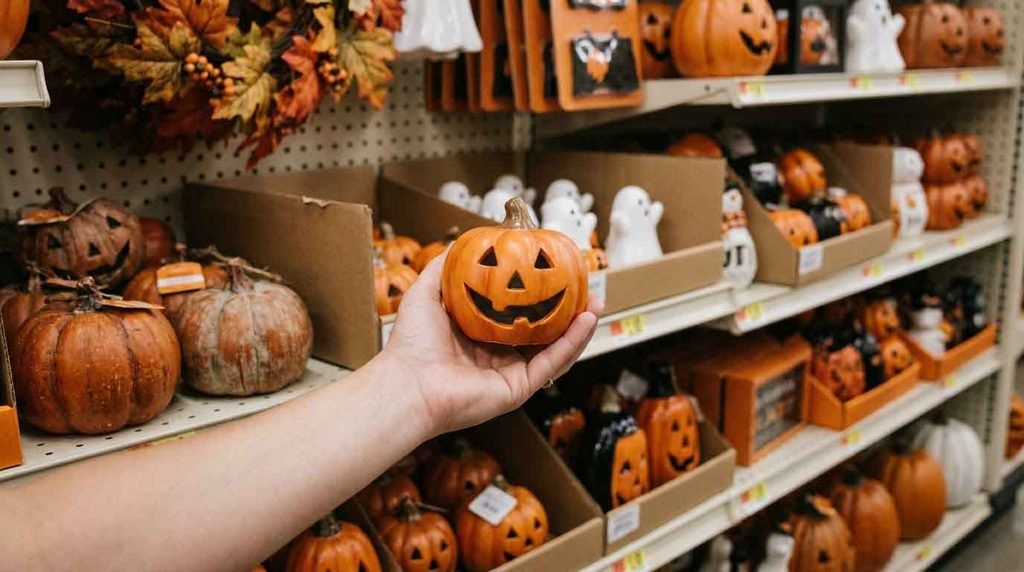
There is a particular kind of Halloween shopping decision that looks easy until you are standing in a store with the item in your hands. You have been eyeing a decoration for a few weeks—maybe a large porch piece, a set of lights, or one of those slightly ridiculous Halloween figures that somehow becomes the centerpiece of the yard—and now there is a sale sticker on it.
But Halloween is still a few weeks away. Buy it now and you might pay more than you have to; wait, and there is a chance the price will drop again. There is also a chance that when you come back, the shelf will be empty. That is the awkward part of Halloween shopping: the best time to buy something is not always the time when it reaches its lowest price.
The Halloween Shopping Trap
Halloween shopping has two clocks running at once. The first is the price clock. As October gets closer, retailers have more reason to move seasonal merchandise, and promotions may become more aggressive. The second is the inventory clock. Every day that passes is another day for popular costumes, unusual decorations and specialty pieces to disappear.
Those two clocks do not move together. A generic package of Halloween napkins is unlikely to cause much regret if you wait another week, but a very specific costume in the right size is a different story. So is the large decoration you have been looking for all month and have only seen at one or two stores.
The smartest Halloween shopper is not necessarily the person who waits until October 30. It is the person who knows what can safely wait and what probably shouldn’t.
The Best Time to Buy Isn’t Always the Cheapest
There is a difference between finding the lowest possible price and finding the best buying window. The lowest seasonal prices usually come with a trade-off. By the time a seasonal item reaches deep clearance, the selection is often thinner, leaving you with the unpopular color, the awkward size or whatever happens to be left.
Earlier in the month, the discount may be smaller, but the choice is better. That middle ground is often where the interesting decision happens: the price has become attractive enough to feel like a deal, while there is still a reasonable chance of finding the thing you actually wanted.
This year’s Halloween shopping research points to that same tension between markdowns and remaining inventory. The strongest buying opportunity is where a meaningful discount meets reasonably healthy selection, rather than simply chasing the final clearance price.
And this year, there is another reason to pay attention to value. The National Retail Federation expects Americans to spend $13.5 billion on Halloween in 2026, while its survey found that shoppers are also paying attention to affordability. Nearly half of consumers said they had started shopping by September or earlier. Waiting until the final few days is not the only way to save.
What to Buy Now
If you have something specific in mind, October is already late enough to make a decision.
Popular licensed costumes
Costumes are one of the clearest examples of the scarcity problem. A costume based on a popular character may exist in plenty of stores, but that does not mean the particular size you need will still be there later. This matters even more with children’s costumes, where one missing size can make the whole choice irrelevant.
If the costume needs to be a particular character, style or size, a modest discount now can be worth more than a larger discount later that comes with no useful inventory.
Large or specialty decorations
Big statement pieces deserve a little more thought. The giant skeleton, elaborate animatronic or unusual yard decoration that catches everyone’s attention is not quite the same thing as a bag of plastic spiders. Specialty pieces can have more limited availability, and some of the most distinctive decorations are the kinds of seasonal objects people actively seek out.
If you have been thinking about one particular piece for weeks, waiting solely for the deepest possible markdown may not be the bargain it appears to be.
Specialty pet costumes
Pet costumes can be surprisingly specific. A common-size dog costume may be easy enough to replace, but a costume for a very small dog, a very large dog, or a pet who needs a particular fit is another matter. The NRF estimates that Americans will spend about $920 million on pet costumes this Halloween, a reminder that pet Halloween shopping is no longer a particularly small category.
If you already know exactly what you want, there is little benefit in gambling on a later markdown just for the sake of waiting.
Handmade and personalized decorations
These are less about retail markdowns and more about time. Anything that needs to be made, customized or shipped needs a little more breathing room; a small saving is not particularly useful if the item arrives after the party.
Anything very specific
This may be the simplest rule of all: if you want that thing, rather than merely something in that category, waiting becomes riskier. There is a big difference between wanting a Halloween wreath and wanting the particular wreath you have already pictured on your front door.
What You Can Afford to Wait For
Some Halloween purchases are much easier to postpone. Generic yard inflatables, basic seasonal lighting, craft stems, floral pieces, paper plates, napkins and other ordinary party supplies are the kinds of purchases where waiting can make more sense. There are usually more alternatives, and it is easier to swap one product for another.
Bulk candy is another category where last-minute buying can be perfectly sensible, particularly when the candy is needed for trick-or-treaters rather than for a party weeks in advance. The shopping analysis puts these higher-volume categories on the more patient side of the Halloween calendar because they tend to have more room for late-season promotions.
That does not mean every item will suddenly become half price; retailers do not owe us a clearance sale. It simply means that when plenty of similar merchandise is still available, waiting carries less risk.
The Halloween Shopping Calendar
If you are shopping in October 2026, the timing can be thought of in broad windows rather than one magical sale day.
| When | What makes sense |
|---|---|
| October 7–10 | Popular costumes, specialty pet costumes, large or limited decorations, handmade pieces |
| October 11–17 | Tabletop décor, seasonal kitchenware, linens and indoor decorative accents |
| October 18–23 | Lighting, party supplies and mid-range outdoor décor |
| October 24–27 | Generic decorations, craft supplies, secondary costumes and inexpensive porch pieces |
| October 28–30 | Candy, party food and final Halloween essentials |
| October 31 | Last-minute essentials and whatever final markdowns remain |
| November 1–7 | Durable clearance pieces worth storing for next Halloween |
This is not a promise that every store will follow the same schedule. Retailers move inventory differently, and online and in-store pricing can change independently, but it gives the month a useful shape.
The research points to deeper general décor markdowns around October 24–27, with candy becoming a more logical late-month purchase around October 28–30. Michaels, for example, is currently advertising 50% off select Halloween décor collections, a reminder that substantial promotions can appear before the final week, although one retailer’s promotion is not a universal Halloween calendar.
So, When Do Halloween Decorations Actually Go on Sale?
There is no single date when Halloween decorations suddenly “go on sale.” Sales are already happening in early October, while more category-specific promotions can appear as the month progresses and deeper markdowns can arrive during the final week as retailers work to clear seasonal merchandise.
The trade-off is selection. Early October gives you more choice and, increasingly, some genuine promotions, while mid-October can be a good compromise for people who want a deal without waiting until the shelves have been picked over. Late October is where patience can pay off for generic décor, craft supplies and other items with plenty of substitutes.
The final days are different: prices may be attractive, but you are shopping from what remains rather than from the full Halloween assortment. A 40% discount on something you did not particularly want is not necessarily a better deal than paying 20% less for the exact decoration you were hoping to find.
Don’t Let a Red Sale Sticker Make the Decision for You
A sale price has a strange psychological effect. Once an item is marked down, it can feel as though not buying it means missing an opportunity. Sometimes it does. Sometimes the “opportunity” is simply a reason to bring home another plastic skeleton.
Before buying a seasonal item, it is worth asking a quieter question: Would I want this if it weren’t on sale? If the answer is no, the discount may not have saved you money.
It is also worth looking at the original price with a little skepticism. A percentage-off label tells you how much the retailer says you are saving against a reference price; it does not tell you whether the item was ever worth that original amount.
And then there is the question of next year. A sturdy decoration that you genuinely like and can store easily has a longer life than a disposable novelty purchase. If the item is likely to come out of the attic every October for years, a reasonable price today may be perfectly good value even if it becomes slightly cheaper next week. The same cannot necessarily be said for something you bought just because the sticker was red.
The Simple Rule for Halloween Shopping
Buy for scarcity. Wait for abundance.
If the item is specific, popular, hard to replace or available in a size you actually need, buying earlier can protect you from the most frustrating kind of Halloween bargain: the one you find after the thing you wanted has disappeared. If the item is generic, plentiful and easy to replace, waiting becomes much less risky.
You do not have to predict the exact day a retailer will make its deepest markdown. You only need to understand what kind of purchase you are making. Once Halloween is over, the calculation changes. November clearance is no longer about getting your porch ready for October 31; it is about deciding which durable pieces are inexpensive enough, useful enough and easy enough to store that you would be happy to see them again next year.
[Read next: What to Buy on November 1: The Halloween Clearance Items Worth Saving for Next Year]
The best Halloween deal, after all, is not necessarily the lowest number on the price tag. Sometimes it is getting the thing you actually wanted while there is still a choice.