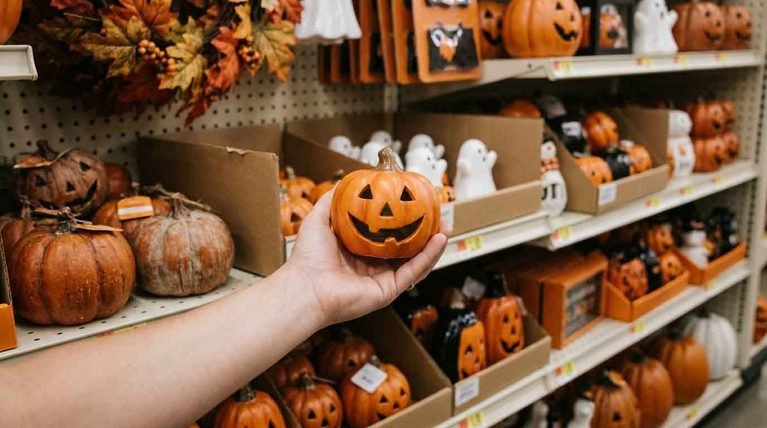
A plastic skeleton with movable arms, a pair of orange porch lights, a ceramic pumpkin that doubles as a serving dish: on November 1, all three might look like sensible purchases at a reduced price. The trouble is that they won’t necessarily offer the same value once the Halloween decorations have been packed away and another eleven months have passed.
The skeleton needs somewhere to live. The lights need to work after months in storage. The pumpkin needs to earn its place in a kitchen cabinet that already holds everyday dishes. A discount can make each item cheaper at the register without making it worth owning.
That distinction matters when shopping post-Halloween clearance sales in 2026. For households hoping to decorate again in 2027, the morning after Halloween offers a chance to buy ahead—but also an easy way to accumulate things that will eventually be thrown away.
The smartest clearance purchase is the decoration that will survive the year, fit the household that owns it, and still feel worth bringing out next October.
What Halloween Clearance Really Means
November 1 can be an appealing day to browse seasonal aisles. Retailers have an incentive to move past Halloween merchandise as they make room for Thanksgiving and Christmas displays, and whatever remains may be reduced to encourage a sale.
But there is no universal clearance timetable. Prices and stock vary by retailer, store location, product category and remaining inventory. One store might have a useful selection of discounted lighting; another might have little more than damaged packaging and a few unwanted costume sizes. Online listings can differ from what is available on a local shelf.
The National Retail Federation’s 2026 Halloween survey offers some context for the scale of the market. It estimates that Americans will spend $13.5 billion on Halloween this year, with decorations accounting for an expected $4.3 billion. The survey also found that 34% of consumers plan to look for items they can reuse in future years or repurpose for other occasions if Halloween prices are higher than expected.
The appeal of reusable decorations is easy to understand: a well-made item may last for years, while a flimsy one might need replacing next October. But the survey says nothing about what individual retailers will discount on November 1, and a percentage-off sticker doesn’t tell you whether the original price was good value.
Before comparing markdowns, look at the price you would actually pay and the condition of the item. Check whether the same product has been discounted elsewhere, whether the displayed reduction applies at checkout, and whether a damaged box conceals missing pieces.
A 70% reduction on something you would never have bought at full price is not automatically a saving. It is simply a lower price for an unnecessary purchase.
The Halloween Decorations Worth Saving for Next Year
The decorations worth buying ahead are rarely the ones that demand the most attention on the shelf. They’re the ones that will still be useful when next October rolls around—and that you can store without rearranging half the house.
Outdoor LED lights and landscape spotlights
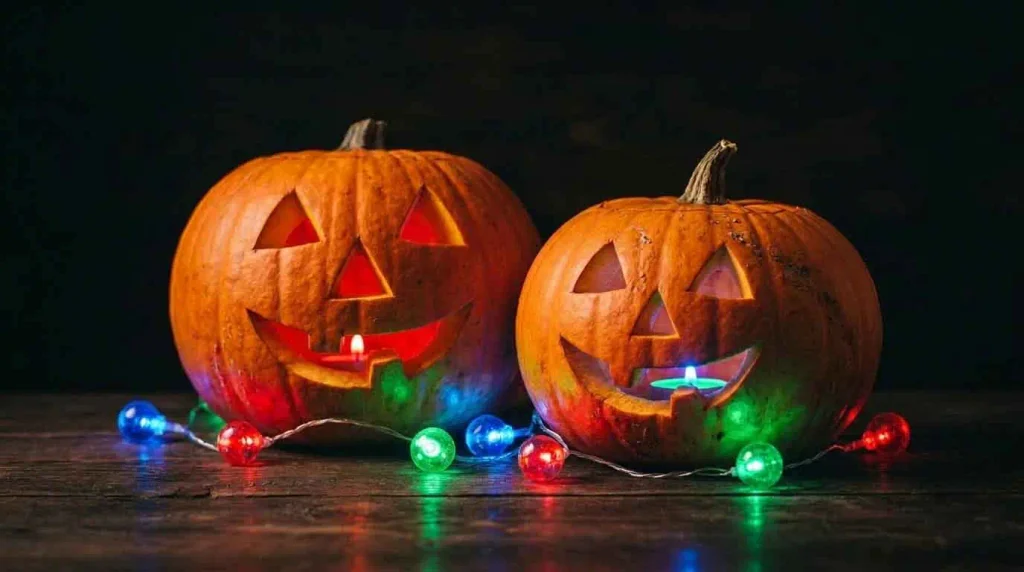
Lighting is a good place to start because it can transform a porch or yard without requiring a collection of large props. Orange and purple string lights, warm-white strands and adjustable landscape spotlights can all have a place in next year’s display.
Frayed wires, cracked sockets, corrosion, damaged plugs and missing connectors are reasons to leave a set behind. If the packaging prevents inspection, the manufacturer’s return policy becomes more important—especially when the box has been sitting on a clearance shelf.
For outdoor use, check that the lights are rated for the location and conditions in which they’ll be installed. That rating doesn’t make them weatherproof under every condition, so follow the manufacturer’s instructions for installation and storage.
A modest discount on lights that fit your existing setup can be a better buy than a steep markdown on a system that needs extra equipment you don’t own.
Sturdy yard decorations
A durable plastic skeleton or solid yard figure can become a familiar part of an annual display. Unlike a novelty item designed around a particular trend, a classic skeleton, ghost or pumpkin can work with different decorating styles over time.
Pay particular attention to the joints, stakes and mounting points. A large figure may look substantial on the shelf but depend on thin plastic hinges or fragile connectors. If one breaks, finding a replacement a year later may be difficult, especially for a seasonal product.
A tall skeleton might fold or separate into manageable pieces, or it might require a long, awkward box. Think about where it will live for eleven months—and how much effort it will take to get it back outside.
If you have a small apartment, a few compact decorations that fit in one tote may be a better investment than a towering prop that spends most of the year obstructing a closet.
Wreaths and reusable decorative accents
Wreaths, artificial foliage, fabric garlands and neutral autumn accents can work beyond Halloween. A wreath without a highly specific character or slogan may remain attractive through November, while a simple black-and-orange arrangement can be refreshed with different ribbons or small decorations.
Look closely at the base, attachment points and foliage. Loose pieces, brittle stems and heavy embellishments that pull away from the frame can turn a bargain into a repair project.
For wreaths and other delicate decorations, protective storage matters as much as construction. A sturdy wreath stored beneath a pile of boxes may emerge flattened or misshapen.
Ceramic pumpkin bakeware and serving pieces
Functional seasonal pieces deserve consideration because they don’t have to remain decorations for most of the year. A pumpkin-shaped baking dish, serving platter or ceramic bowl can earn its cabinet space through ordinary use.
Check for chips, hairline cracks, uneven finishes and damaged handles. Read the manufacturer’s instructions before assuming a ceramic item is suitable for the oven, microwave or dishwasher. Decorative ceramics are not necessarily designed for food preparation or high temperatures.
A serving dish that works for autumn dinners, Thanksgiving or everyday entertaining may be more useful than another decorative object destined for a storage box. The best purchase is the one that fits a habit you already have, not one that requires you to invent a new occasion to justify it.
Storage containers and organizers
Sometimes the best post-Halloween purchase is not a decoration at all. A sturdy tote, divided ornament box or protective wreath bag may be a better investment than adding another decoration to a collection that already needs protecting.
A large container is useful only if you have somewhere to put it, and a lid doesn’t make every tote airtight or suitable for damp environments. Decorations should be clean and completely dry before storage, with heavy items kept away from fragile props.
Buying storage to protect a planned purchase can be sensible. Buying decorations and then discovering you need several more containers is a different calculation.
The Clearance Bargains I’d Leave Behind
Some products become poor investments simply because their useful life doesn’t match the time between Halloweens.
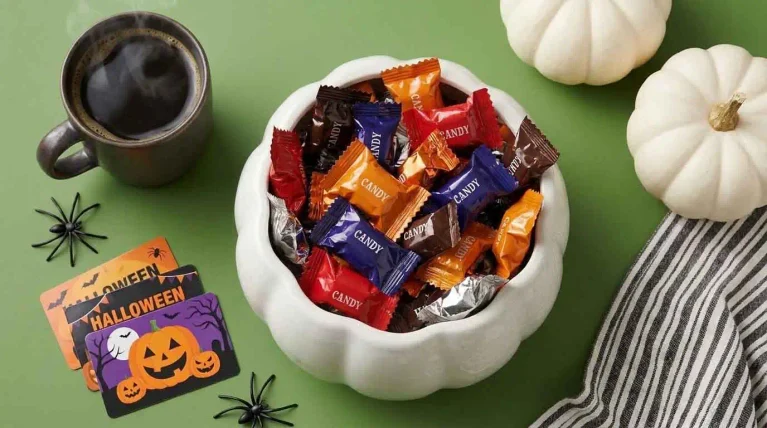
Candy is the obvious example. Buying leftover Halloween chocolate in November and keeping it until October 2027 is a poor strategy for most households. Chocolate can develop a pale, chalky-looking surface called bloom. Temperature changes can cause cocoa butter to rise to the surface, while moisture can leave sugar crystals behind. Bloom can affect chocolate’s appearance and texture, but it doesn’t by itself mean the chocolate is unsafe to eat. Check the manufacturer’s date and storage guidance, and buy next year’s treats closer to the holiday instead.
Liquid makeup and fake blood deserve a closer look, as do adhesives sold for costume or prop use. Their usable life depends on the product and how it has been stored. The U.S. Food and Drug Administration explains that cosmetics can deteriorate, separate, dry out or become contaminated over time, with heat and moisture contributing to some of these problems. Its guidance on cosmetic shelf life is a useful reminder that an unopened package isn’t a guarantee of indefinite usability.
An unopened product with clear manufacturer guidance may be reasonable to buy for later use. A nearly empty bottle, an opened adhesive or a product with no identifiable ingredients or storage instructions is a much less attractive bargain.
Costumes deserve a closer look than their price tags suggest. Thin fabric, weak seams, poorly attached decorations and flimsy closures may not survive a year of storage and another evening of wear. Children’s sizes create an additional problem: a costume that fits today may not fit next Halloween.
There are exceptions. A simple cape, oversized robe or flexible accessory might work for several years or suit different costumes.
Paper decorations and inexpensive foam props are worth judging individually. Paper honeycomb ornaments can fold neatly if their mechanisms remain intact, and lightweight foam can work well when handled carefully. But once a decoration has crushed edges, torn tabs or broken mounting points, the savings may disappear into repairs.
An incomplete set can be worth buying if the remaining pieces are still useful on their own. Missing stakes, adapters, remote controls or connecting parts can otherwise turn an attractive decoration into a search for replacements. A low price cannot compensate for a function the item no longer performs.
The Cost Nobody Sees on the Clearance Sticker
The easiest cost to overlook is the space a decoration occupies between October and the next Halloween.
Imagine two porch displays. The first uses a compact set of lights, a reusable wreath and a few small figures that fit in one container. The second depends on an oversized inflatable, fragile props and accessories spread across multiple boxes. Even if the second display cost less during clearance, its footprint doesn’t end when Halloween does.
That difference matters in a home without a garage, attic or spare closet. Storage space is not free simply because nobody charges rent for a particular shelf.
An attic, basement or garage can introduce problems that aren’t obvious at the checkout. Heat and temperature swings may affect sensitive materials; damp conditions can damage cardboard packaging, while loose components are easily lost among other household items. An unsealed box may also leave decorations exposed to dust and pests.
Before storing decorations, clean off dirt and outdoor residue, let everything dry thoroughly, and keep small accessories together in labeled bags. Remove batteries if the manufacturer’s instructions call for it, and follow the storage guidance supplied with electrical products.
A complicated animatronic may need batteries, replacement parts or careful packing to protect its moving components. That doesn’t make it a bad purchase, but the markdown is only part of what it will cost to own.
Would you still want the decoration if you also had to buy a container to store it? If not, it may be taking up more space than it’s worth.
Should You Buy on November 1 or Wait?
The decision depends less on the date than on the item and the price. Buying early makes sense when you find something durable, in good condition, at a price you’re comfortable paying. Waiting may bring a lower price on unsold merchandise, but it can also mean losing the item you wanted. Neither the discount nor the remaining selection is guaranteed.
There is no dependable national schedule that guarantees 50% off on November 1, 70% a few days later or 90% by the end of the first week. Those figures may appear in individual promotions, but they aren’t a reliable forecast of what you’ll find at any particular store.
A sensible approach is to divide your shopping into three decisions:
- Buy now: You have already wanted the item, its condition is sound, the price is acceptable, and you have room to store it.
- Wait: You like the item, but the current price isn’t compelling enough to buy it now—and you’re willing to risk losing it.
- Leave it: You are interested mainly because of the markdown, the product is damaged or incomplete, or you cannot picture where it will go.
A large skeleton you’ve planned to display for years may justify a considered purchase. A similarly large prop bought on impulse because the price looks impressive is a different matter.
If you are undecided between two products, compare their condition, storage requirements and likely usefulness—not just the percentages printed on their labels. A smaller discount on the better-made item may represent the stronger long-term value.
Before You Put It in the Cart
Before buying, run through five quick questions:
- Price: Is the actual checkout price worth paying, even without the dramatic markdown?
- Condition: Are the essential parts present, intact and working?
- Use: Can you realistically imagine displaying or using it in 2027?
- Storage: Do you have a suitable place to keep it for eleven months?
- Durability: Is it likely to survive packing, storage and another season of use?
Not every purchase needs to pass all five tests. A fragile paper decoration might be worth a dollar for a party next week; a more expensive light set might earn its price through years of use. The right choice depends on what you intend to do with it.
The Best Bargain Is the One You’ll Bring Out Again
The temptation to find one last Halloween deal is understandable, especially when next year’s decorations are suddenly available at reduced prices.
A good purchase should make next October easier, not leave you wondering why you bought another box of things you barely remember owning.
Before taking a decoration home, picture it coming out of storage in the fall of 2027. If you can still see a place for it in your home and your plans, the markdown may be worth it. Otherwise, leaving it on the shelf is a perfectly good way to save money.