
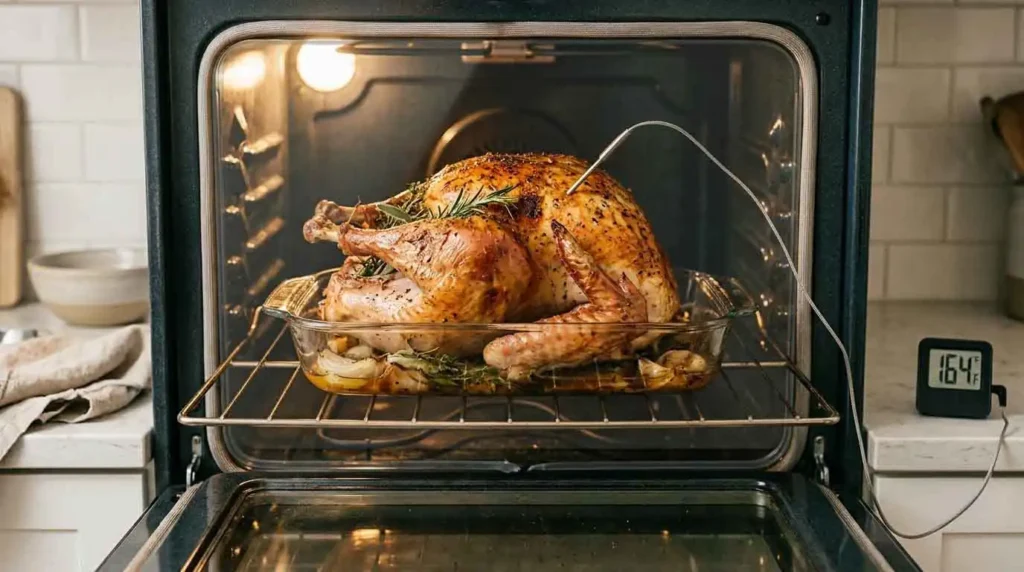
Thanksgiving has a particular kind of kitchen tension.
The turkey is in the oven. The rolls are waiting. The casserole needs another 15 minutes. Someone has just asked whether the gravy is ready, and the person responsible for the Brussels sprouts has disappeared.
And then comes the question that can stop everything for a moment: Is the turkey actually done?
Most home cooks have been taught to answer that question with a clock. Maybe the turkey has been roasting for the recommended number of hours. Maybe the skin is browned. Maybe the little pop-up timer has finally risen.
But none of those things tells you exactly what is happening inside the thickest parts of the bird. That is the reason a leave-in, multi-probe food thermometer becomes much more interesting in November than it seems on an ordinary Tuesday.
It is not really a gadget for watching numbers. It is a way of replacing one of the most stressful forms of Thanksgiving guesswork with information.
When the Turkey Is the Thing Holding Up Dinner
Fall cooking changes the rhythm of an American kitchen. The quick summer meals give way to whole chickens, pork roasts, braises, casseroles and, eventually, the Thanksgiving turkey. Large pieces of poultry are harder to judge by appearance or cooking time alone, which makes Thanksgiving a particularly good example of the problem.
Thanksgiving makes the problem more obvious because everything else is happening at the same time. A turkey may occupy the oven for hours while side dishes wait their turn. The cook has plenty to do without repeatedly opening the oven, pulling out a heavy roasting pan and trying to decide whether the meat is finally ready.
That temptation is understandable. You want to know what is happening. But the turkey does not care how busy the kitchen is.
Different parts of the turkey can heat at different rates, and cooking time is only an estimate. USDA notes that factors such as turkey size, whether it is stuffed, oven accuracy, pan characteristics and even rack position can affect roasting time.
So the useful question is not really, “How long has it been in there?” It is, “What temperature has the meat actually reached?”
A Clock Can Tell You When to Check. It Cannot Tell You When It Is Safe.
USDA’s guidance is unusually straightforward on this point: use a food thermometer.
For a whole turkey, the internal temperature should reach at least 165°F. USDA recommends checking the thickest part of the breast and the innermost part of the thigh and wing. The thermometer should be positioned in the meat, away from bone, so the reading reflects the food itself.
That matters because there can be a considerable difference between what the outside of a turkey looks like and what is happening in its interior. A beautifully browned bird is not automatically a safely cooked bird, and a turkey that has been cooking for the expected number of hours isn’t automatically safe either.
Even a familiar pop-up timer isn’t a substitute for checking the turkey with a food thermometer. USDA recommends checking the turkey in the three recommended locations even when it has a pop-up indicator.
That is the small detail that changes the whole argument for a thermometer. You are not buying it because Thanksgiving needs another electronic object. You are buying it because temperature is the thing that actually answers the question.
What a Multi-Probe Thermometer Changes
A conventional instant-read thermometer works well when you are standing at the oven with the door open and ready to check the meat. A leave-in thermometer changes how you monitor the cooking: the probe goes into the meat before cooking or during the appropriate stage, depending on the manufacturer’s instructions, and remains in place while the turkey roasts. A multi-probe model can monitor more than one location at once.
That turns temperature checking from an interruption into an ongoing piece of information, and the difference becomes more useful when you are cooking a large turkey while simultaneously trying to get everything else onto the table. Instead of opening the oven every so often because the turkey “should be getting close,” you can watch the temperature rise and decide when a physical check is actually necessary.
The practical advantage is simple: you can monitor the turkey without repeatedly opening the oven to check the bird. USDA describes wireless and smart thermometers as tools that allow cooks to focus on other dishes while monitoring the food’s internal temperature.
You can stop treating the turkey like a countdown.
But One Probe Is Not a Magic Wand
This is where the thermometer deserves a little honesty. A multi-probe thermometer does not make an incorrectly positioned probe accurate. USDA recommends placing thermometers in the thickest part of the food and away from bone, fat and gristle. For a whole turkey, it specifically identifies three areas for checking: the thickest part of the breast, the innermost thigh and the innermost wing.
A two-probe device, for example, cannot physically monitor three locations simultaneously. So the smart way to use one is not to assume that the electronic display has magically done every job for you. Use the leave-in probes to watch the cooking process, then make a final verification in the recommended locations with an appropriate food thermometer. That is a much more realistic picture of what the appliance does: it reduces guesswork without eliminating judgment.
The Real Advantage Comes While You Are Doing Everything Else
Thanksgiving is less a cooking problem than a coordination problem. The turkey needs attention, but so does everything around it, and Thanksgiving compresses a lot of cooking into the same stretch of time. A leave-in thermometer fits into that reality because it gives the cook information without requiring constant physical inspection.
You can be peeling potatoes while the turkey temperature climbs, assembling a casserole while watching the progress, or setting the table instead of opening the oven simply because you feel nervous about the bird. That does not necessarily make the cooking dramatically faster; it makes the work easier to organize, and those are not the same thing.
Where a Multi-Probe Thermometer Is Especially Useful
The strongest use case is a large piece of meat where different parts can cook at different rates.
A whole turkey is the obvious November example. Whole chickens, large pork roasts and beef roasts make sense too. A leave-in thermometer is most useful when you want to monitor more than one area of a large piece of food without repeatedly opening the oven.
That matters with poultry because the breast and darker leg meat are not identical cooking problems. A thermometer lets you see that difference rather than discovering it after carving.
For foods that are thin and quick-cooking, though, the advantage shrinks. There is little reason to leave a wired probe in a half-inch chicken cutlet when an instant-read thermometer can give you an answer in seconds. A good kitchen tool is not automatically a good tool for every kitchen.
The Small Irritations Matter Too
A leave-in thermometer also comes with its own collection of annoyances. The probes need to be positioned correctly, and cables or wireless connections can introduce their own practical complications depending on the design. Probes and their cable connections also need to be cleaned according to the manufacturer’s instructions.
And then there is the slightly ridiculous reality of Thanksgiving itself. Someone will eventually try to move the roasting pan, bump the cable, or ask whether the thermometer is still reading correctly.
That is not a reason to reject the device. It is a reason to remember that the tool still belongs to the physical kitchen. Technology does not remove the need to pay attention.
USDA advises washing food thermometers according to the manufacturer’s instructions, and notes that most should not be immersed in water.
Who Actually Gets Value From One?
A multi-probe leave-in thermometer makes the most sense for the cook who regularly prepares large proteins and finds temperature checking stressful. That includes the Thanksgiving host cooking a whole turkey, the person who regularly roasts whole chickens or large cuts of meat, and anyone managing several kitchen jobs while dinner cooks.
It is particularly useful for cooks who are tired of repeatedly opening the oven because they are trying to figure out whether the roast is close. The case is weaker for someone whose cooking is mostly soups, pasta, vegetables, grain bowls and thin cuts of meat. An instant-read thermometer may already be doing everything that kitchen needs. The expensive-looking version of a problem is not necessarily a better solution to it.
The Question Is Not Whether You Need a “Smart” Thermometer
That word can make the whole category sound more complicated than it is. What you really want is a reliable way to know what is happening inside the food without constantly interrupting the cooking process.
That can be accomplished with a straightforward wired probe. A wireless model can add remote monitoring, but remote connectivity is not the central reason the tool works. The important part is having a reliable probe, positioning it correctly, and using the temperature reading alongside established food-safety guidance rather than treating a manufacturer’s screen as its own authority.
USDA’s minimum for poultry remains 165°F, measured with a food thermometer in the appropriate locations.
So, Does It Actually Make Thanksgiving Easier?
Yes, but in a narrower way than kitchen-gadget marketing often suggests. It does not chop the vegetables, make the gravy, or create more oven space. It does not rescue a Thanksgiving schedule that was already planned too late. What it does is remove one recurring uncertainty.
Instead of opening the oven because the turkey has been cooking “long enough,” you can watch the temperature and know when it is time to check. Rather than judging doneness by appearance alone, you have a measurable target. And instead of trusting a pop-up indicator as your only answer, you have a proper food thermometer, which USDA actually recommends for determining whether turkey has reached a safe internal temperature.
That may sound modest, but on Thanksgiving, modest improvements are often the ones that matter. The turkey will still take time. The casseroles will still compete for oven space. Somebody will still discover that the rolls needed to go in ten minutes ago. But one question becomes much easier to answer:
Is the turkey done?
You just have to read the thermometer.