There is a particular kind of disappointment in unloading a dishwasher and finding that the glasses look less clear than when you put them in.
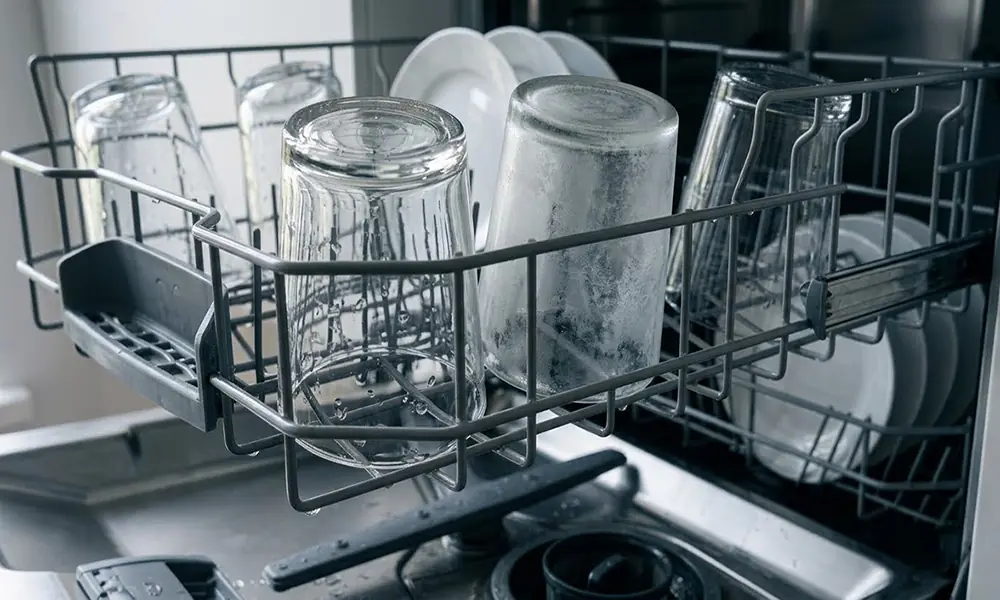
The food is gone, the glasses are dry and nothing smells strange. They have, in every ordinary sense, been washed, and yet, hold one up to the kitchen light and there it is: a faint white haze, sometimes almost milky, sometimes more like a dull film that seems to float across the surface. You wipe it with a finger and wonder whether you are looking at residue or simply a glass that has seen better days.
My first assumption was the obvious one. The glass needed cleaning again. It seemed reasonable. A dishwasher had just washed it, after all, so perhaps something hadn’t rinsed away properly. I was tempted to run the glass through another cycle and forget about it.
But that was where the question got more interesting. If the glass was clean enough to drink from, why did it look dirty? And if I could wash the cloudy coating away, what exactly was I washing off?
I eventually realised that “cloudy” doesn’t really tell you what is wrong. A hazy glass can have a removable coating on it, or the glass itself can have changed. The two can look remarkably similar in the cupboard, even though the solution is completely different.
Why are my glasses coming out cloudy?
Hard-water minerals can remain on glass when water evaporates, producing spots or a white, cloudy deposit. The EPA has described this basic phenomenon in household terms: minerals left behind as water evaporates can cause spots on glassware.
There is another possibility that looks similar at first but is much harder to fix: etching. It changes the glass surface itself rather than leaving a coating that can simply be washed away.
Residue can be part of the problem, too. Too much detergent, poor rinsing or loading that keeps water from reaching the glass properly can affect the finish you get. Water conditions can play a role as well.
So the cloudy glass was only telling me where to start looking.
The first useful question is much simpler: is something sitting on the glass, or has the glass itself been altered?
The first thing I tried
I washed the glass again.
That instinct is hard to resist. A cloudy drinking glass looks like something that has failed to get clean, so the obvious response is more cleaning. I scrubbed, rinsed and dried it, expecting the haze to disappear.
It didn’t, which was useful even if it wasn’t particularly satisfying.
A second wash isn’t necessarily going to remove mineral deposits that have accumulated from the water, and it certainly won’t restore glass that has been etched. A dishwasher can remove food and grease while still leaving minerals or other residue on the glass during washing and drying.
After that, I stopped treating the cloudy glass as a cleaning failure and started wondering what was actually causing it.
When the film is something sitting on the glass
Hard water is one of the first things worth considering, but I wouldn’t assume it immediately.
“Hard water” simply means water containing relatively high amounts of dissolved minerals, particularly calcium and magnesium. The water supply can vary considerably from one place to another, and a home with a water-softening system may have a different experience again.
When mineral-rich water dries on glass, some of those minerals can remain behind. Over time, that can produce the familiar chalky or milky appearance.
There are usually other clues if hard water is involved. You might have noticed mineral spots around a faucet or a similar white deposit elsewhere in the kitchen. None of those confirms that hard water is responsible for the glasses, but together they make the possibility more convincing.
Take one cloudy glass rather than treating the whole cupboard at once. A small amount of white vinegar on a soft cloth can be used to test a patch of the haze. If the film lifts, that suggests you’re dealing with something on the surface rather than permanent etching.
If you do use vinegar on glassware, rinse the glass thoroughly afterward. And check the care instructions first for delicate, decorated or otherwise unusual pieces.
I wouldn’t take the vinegar test as a laboratory diagnosis. It is simply a useful household clue.
The catch is that another problem can look almost exactly the same.
When the glass itself has changed
Glass etching is the more frustrating explanation because there isn’t a cleaning product waiting to rescue the glass.
Etching is permanent damage to the glass surface, and dishwasher conditions such as detergent concentration, water chemistry and heat can contribute to it.
The distinction that helped me was simple:
A removable film is sitting on the glass. Etching is a change to the glass itself.
If you gently clean or test an area and the haze lifts, you’re probably dealing with something on the surface. If the cloudiness stays unchanged after appropriate cleaning, the glass may be etched.
That is also why I would resist the temptation to attack a cloudy glass with increasingly aggressive scrubbing. If the surface is permanently damaged, more elbow grease isn’t going to bring back the original clarity.
Some glassware is also more vulnerable to dishwasher conditions. Fine, thin, antique or decorative pieces may have different care requirements, so check whether a particular piece is dishwasher-safe rather than assuming every glass belongs in the machine.
This is one of those irritating household discoveries where the word “dishwasher-safe” doesn’t necessarily mean “will look exactly the same forever.”
What detergent has to do with cloudy glasses
I had already been thinking about detergent because of an earlier Oakwood Daily piece on using too much laundry detergent. The household instinct is remarkably consistent: if a little product gets things clean, surely a little more will get them really clean.
The amount of detergent that makes sense depends on the dishwasher, the detergent and the water conditions. Too much can contribute to residue and, under some conditions, glass etching.
I wouldn’t respond to cloudy glasses by automatically cutting the detergent dose in half either.
It means the detergent compartment isn’t a place where more is automatically better.
A product that works beautifully in one household may behave differently with different water, a different dishwasher or different loading habits. If you’re getting a recurring film, follow the detergent manufacturer’s dosing instructions and your dishwasher manual rather than inventing a universal amount.
There is another habit worth reconsidering: pre-rinsing everything until it is practically clean before it goes into the machine.
Modern dishwashers are designed to handle food soil, and some models use sensors to adjust parts of the cycle according to the load. Scrape off excess food, but there’s generally no need to rinse dishes until they’re practically clean before loading them. On some machines, pre-rinsing can also interfere with soil-sensing functions.
Pre-rinsing won’t solve cloudy glasses by itself, but it is part of the bigger picture. Water, detergent, food soil, spray and rinsing all affect what happens inside the dishwasher, so changing one part of the routine can sometimes create a different problem.
And then there is rinse aid
Rinse aid was the part of this that made the most sense once I understood what it was actually doing.
Rinse aid helps water sheet off surfaces during the final rinse, rather than sitting on them in droplets. That can improve drying and reduce water spots and filming on glassware.
Rinse aid still won’t explain every kind of cloudiness.
If a glass has already been etched, adding rinse aid won’t undo the damage. If there is already a thick mineral deposit on the glass, better rinsing won’t necessarily remove it.
But if the problem is recurring water spotting or poor drying, rinse aid can be one part of a better routine.
The exact setting is another place where I would resist generic advice. Dishwashers differ, and the right setting depends on the machine and what you’re seeing on the glasses.
How I figured out what was happening
The most useful thing I did was stop trying to fix the whole dishwasher at once.
I chose the glass that bothered me most and started paying closer attention to what was actually happening to it.
First, I wanted to know whether the haze would actually come off. A gentle clean or small vinegar spot test can give you a clue. If the cloudiness changes, something is probably sitting on the surface; if it stays unchanged, etching becomes more likely.
I also paid attention to whether the problem came back. If a glass cleared up and then turned cloudy again after several cycles, that was a reason to look at what was happening inside the dishwasher rather than reach for a stronger cleaner.
I noticed whether the problem affected everything or only certain glasses. If one type became cloudy while sturdier everyday tumblers stayed clear, the glassware itself could be part of the story. Delicate and antique glass can be more vulnerable to dishwasher damage.
I also looked at whether other dishes were showing the same film. If several kinds of dishes were affected, that pointed me more toward water conditions, rinsing or dishwasher performance than one glass simply being past its best.
For a persistent problem, I would also want to know something about the water supply rather than guess. A municipal water report or a household water-hardness test can provide a better starting point than assuming every cloudy glass is caused by hard water.
That was the part I found reassuring. I didn’t need to become an appliance expert. I just needed to stop treating every cloudy glass as though it had the same problem.
What I changed
I started by making sure the dishwasher wasn’t being packed so tightly that glasses were blocking one another or the spray. Poor loading can prevent water from reaching surfaces properly, so I paid more attention to how I was arranging the glasses.
I also paid more attention to how much detergent I was using instead of assuming that extra detergent meant extra cleaning.
I checked the rinse-aid reservoir and used the setting recommended for the dishwasher instead of treating rinse aid as an optional mystery liquid.
And I became a little more selective about what went into the dishwasher. Ordinary dishwasher-safe glasses can go through the machine, while delicate, antique or decorative pieces deserve a closer look at their care instructions.
For glasses that were already cloudy, I tested rather than endlessly rewashing. If a surface deposit came away, I could deal with it separately. If it didn’t, I stopped expecting another dishwasher cycle to perform a miracle.
One change I did not make was start pouring vinegar into every dishwasher cycle because I’d seen the suggestion online.
Vinegar can be useful for testing or removing certain mineral deposits from appropriate glassware, but that doesn’t make it a universal dishwasher treatment. Cleaning recommendations vary by machine, and repeated exposure to acidic cleaners may not be appropriate for every appliance or component. I’d follow the care and cleaning guidance for the particular dishwasher rather than turn a household remedy into a permanent routine.
When cloudy glasses probably aren’t a cleaning problem
There is a point when you have to stop cleaning the glass and consider that the glass itself may be the problem.
If the haze remains after appropriate cleaning and doesn’t respond to a gentle test for mineral residue, etching becomes more likely. The basic distinction is straightforward: a mineral film can often be removed, while etched glass generally cannot.
That is frustrating, particularly when several glasses have acquired the same faint gray-white veil. Still, knowing the difference is useful.
There is no reason to keep escalating the cleaning, reach for harsher abrasives, or spend an afternoon working through internet remedies.
Instead, the question becomes how to avoid doing the same thing to the next glasses you buy.
If the dishwasher is suddenly leaving everything dirty, spotted or filmed, however, that’s a different matter. A blocked spray arm, poor loading, dirty filters, water-temperature problems or other dishwasher-performance issues can affect cleaning and rinsing. Whirlpool notes that inadequate water temperature can contribute to cloudy glasses and filming, while loading and blocked spray arms can interfere with water circulation.
If that is happening, the dishwasher itself deserves attention rather than another round of glass polishing.
What I learned from a cupboard full of cloudy glasses
The funny thing about the cloudy-glass problem is how convincing the glass looks.
It looks dirty.
That’s what kept sending me back to the sink.
A dishwasher can clean away the dinner from a glass and still leave something behind. Under certain conditions, repeated dishwasher cycles can also change the surface of the glass itself. The frustrating part is that both can look much the same.
Separating the two made the problem much less mysterious.
A removable mineral coating calls for a different fix from etched glass. Detergent residue and hard-water deposits need to be approached differently too, while a dishwasher that isn’t rinsing properly needs attention of its own.
I also stopped expecting one household trick to solve all of it.
There is something oddly satisfying about knowing why a thing looks the way it does. The next time a glass comes out of the dishwasher with that pale, cloudy veil, I don’t automatically assume it needs another wash.
I hold it up to the light and ask a better question: what, exactly, am I looking at?