When every Thanksgiving dish seems to need the oven at the same time, the answer isn’t another recipe. It’s a better order of operations.
The Kitchen Gets Crowded Before Dinner Does
By late morning, Thanksgiving has usually stopped looking like a collection of recipes and started looking like a traffic problem. A roasting pan occupies most of the oven. On the counter, a casserole dish waits under foil. Another is assembled but not baked. The refrigerator door opens, closes, opens again. Someone is looking for the butter. A timer goes off, although nobody can immediately remember which dish it belongs to. From somewhere in the house comes the question that always seems to arrive at the least convenient moment: When are we eating?
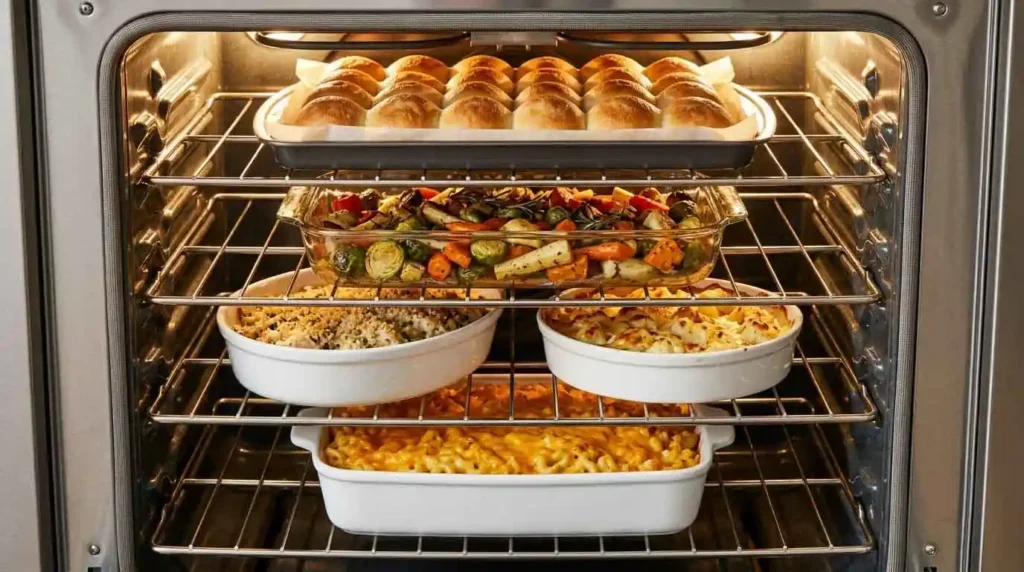
The turkey is still cooking. The rolls need the oven later. The green bean casserole needs the oven. The macaroni and cheese needs the oven. The sweet potatoes are ready to go, except they need the oven, too. And suddenly the person who managed to shop for twelve people, thaw a turkey, make a pie and remember that somebody doesn’t eat onions is standing in front of one oven trying to make everything fit. This is the part of Thanksgiving cooking that recipes don’t usually prepare you for.
The individual dishes may be completely manageable. The problem appears when all of those perfectly reasonable cooking instructions collide between noon and 3 p.m. A casserole wants 350°F. Another wants 375°F. The turkey is occupying the oven at 325°F. The rolls need only fifteen minutes, but they need those fifteen minutes at exactly the moment someone is trying to make gravy and clear the counter.
There is still only one oven. That is not a cooking failure. It is a scheduling problem.
The Problem Isn’t the Recipes
A Thanksgiving menu is often planned one dish at a time. The turkey gets its recipe. The stuffing gets its recipe. The potatoes get their recipe. Someone prints a recipe for green bean casserole and another for macaroni and cheese, and each one tells the cook exactly what to do. What the recipes rarely tell you is what happens when six dishes all need the same appliance. That is when the afternoon gets complicated.
The natural instinct is to make everything finish at approximately the same moment. It sounds efficient. In practice, it leaves no room for the things that have to happen between cooking and eating: the turkey needs to rest, gravy needs finishing, the table needs attention, serving dishes need filling and somebody has to actually carve the bird.
A better Thanksgiving cooking timeline works backward from dinner rather than forward from individual recipes.
The question is not, When should I cook the stuffing?
It is, When does the stuffing need to be ready, and where can it wait before then?
That small change in thinking makes the kitchen look different. The turkey’s resting period is no longer an empty stretch of time. It is when the oven finally becomes available for the sides. Mashed potatoes can stay on the stovetop, gravy can wait on low heat, and the rolls can have the final oven slot instead of being squeezed into whatever space happens to remain. The meal becomes one system.
The rule is simple: not everything should finish at once.
Start Thinking in Oven Time
Before Thanksgiving morning, it helps to look at the menu a little differently: not by where each dish appears on the table, but by what it actually needs to get there. Some foods genuinely need to be cooked close to serving. The turkey is the obvious example, along with anything whose texture suffers badly if it sits too long. Other dishes can be completely cooked earlier. Some can be assembled ahead and baked later. Others can be reheated or held hot without occupying the oven. That distinction is what makes the afternoon manageable.
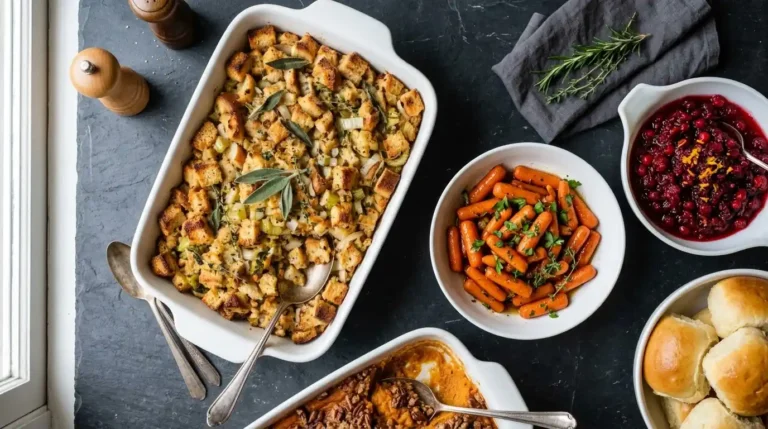
For a menu like this, the turkey and freshly baked rolls are likely to claim valuable oven space late in the process. Stuffing, sweet potato casserole, macaroni and cheese and green bean casserole may be more flexible, depending on the recipe. Mashed potatoes can stay on the stovetop. Gravy can be finished in a saucepan. Cranberry sauce can be made well ahead and served cold or chilled.
The arrangement changes with the menu, the turkey and the dinner time. A family serving turkey at 1 p.m. needs a completely different schedule from one sitting down at 5 p.m. A 10-pound turkey is not the same planning problem as a 20-pound turkey, and a recipe calling for 375°F cannot simply be treated as though it were written for 325°F.
The point is not to make every Thanksgiving follow the same schedule. It is to give the oven a job description. For the sample schedule below, assume a 3 p.m. dinner and a thawed, unstuffed turkey in roughly the 14-to-16-pound range, roasted according to a reliable recipe at 325°F. That gives you an approximate 3¾-to-4¼-hour roasting window, but it is only a starting point for the schedule. A thermometer—not the clock—decides when the turkey is done.
The sample also assumes the stuffing and casseroles are baked separately from the turkey, and that their recipes can work at a common reheating temperature. If the recipes on the menu use different temperatures, the same sequencing principle applies; the individual oven slots simply need to move.
Build the Thanksgiving Timeline Before the Oven Gets Busy
The easiest way to create a single-oven Thanksgiving schedule is to work backward from the time everyone will sit down. For a 3 p.m. dinner, the final half-hour should not be devoted to discovering that the rolls still need twenty minutes. The turkey should already be out, the sides should be hot or safely held, gravy should be finished, and the carving board should be ready. The serving spoons should have stopped disappearing into mysterious corners of the kitchen. That means the last oven slot belongs to the food that genuinely needs it most—not necessarily the dish with the longest cooking time.
It also means the turkey should have enough breathing room to finish before dinner rather than being timed to come out at 2:58 p.m. USDA advises using a food thermometer to verify a whole turkey has reached at least 165°F in the innermost thigh and wing and the thickest part of the breast. If the turkey is stuffed, the center of the stuffing should also reach 165°F before the bird is removed. That makes the clock useful for planning, but never authoritative.
A turkey that finishes early is inconvenient. A turkey that is still undercooked when everyone is sitting at the table is a much bigger problem.
| Time | What happens | Why it works |
|---|---|---|
| 8:00 AM | Finish cold preparations. Assemble casseroles, make cranberry sauce, set out serving dishes and organize ingredients. | The oven is still free, so this is the time to clear the counter and get the cold work out of the way. |
| 8:30 AM | Prepare the turkey and preheat the oven according to the turkey recipe. | Getting the bird ready first means the oven can start working as soon as it is hot. |
| 8:45 AM | Turkey goes into the oven at 325°F. | The long oven block gives the turkey room to finish when it is actually done, rather than forcing it to match the clock. |
| 9:00–11:30 AM | Prepare mashed potatoes, gravy ingredients and stovetop vegetables. Finish cold dishes. Clear counter space as you go. | The turkey has the oven. Everything else can keep going on the counter or stovetop. |
| 11:30 AM | Check the turkey’s progress according to the recipe and thermometer instructions. Begin warming or finishing dishes that do not need the oven. | This is a checkpoint, not a demand that the turkey be finished. |
| 12:15–1:00 PM | Continue preparing the final stovetop dishes. Warm mashed potatoes and prepare the gravy base while the turkey finishes. | The goal is to have the stovetop dishes well underway before the oven opens. |
| Around 12:30–1:00 PM | Check the turkey temperature. Remove it only when it reaches the required safe internal temperature. | The thermometer determines the moment; the schedule flexes around it. |
| 1:00–1:20 PM | Turkey rests while the oven is changed to the temperature required for the side dishes. | This is the handoff: the turkey comes out, and the sides take over the oven. |
| 1:20–1:50 PM | First group of casseroles goes into the oven. | Dishes that can share an oven temperature can share the same oven block. |
| 1:50–2:20 PM | Second group of casseroles or reheatable sides goes in. | The first dishes are out of the oven and can move to a safe hot-holding method while the next batch cooks. |
| 2:20–2:40 PM | Final oven slot: rolls or another dish that is best served freshly baked. | The rolls get their oven time close to dinner, when they are most useful. |
| 2:30–2:45 PM | Finish gravy, taste and adjust stovetop dishes, transfer sides to serving bowls. | The turkey is resting or ready to carve, leaving the last few minutes for gravy, serving bowls and the table. |
| 2:45 PM | Carve the turkey. Set out sides, gravy and rolls. | The cooking is essentially done; what remains is carving, serving and getting everyone to the table. |
| 3:00 PM | Dinner. | The oven has done its work. |
The exact times will move depending on the turkey and the recipes, but the order matters more than the numbers.
The turkey gets the longest uninterrupted oven block. When it comes out to rest, the oven opens up for the sides. The casseroles can move through in batches, while potatoes and gravy stay on the stovetop and the rolls get the final window.
What Goes Where When There Is Only One Oven
Once the turkey has claimed the oven, the stovetop becomes part of the Thanksgiving plan too. Mashed potatoes are a good example. There is no reason for them to compete for oven space when they can be cooked on the stovetop and held hot appropriately. Gravy can be handled the same way, while cranberry sauce can be finished hours earlier. Green vegetables may also have more flexibility than a casserole and can often stay on the stovetop until closer to dinner. The refrigerator has a job, too. Dishes that are intended to be served cold do not need precious oven time simply because everything else on Thanksgiving happens to be warm.
The other question is what happens when a dish is ready before dinner. A covered, properly cooked dish can sometimes be held warm for a short time, depending on the food and the equipment. A slow cooker can be useful for holding foods that are already fully cooked, provided the food is kept at a safe temperature and the appliance is suitable for the dish. USDA recommends keeping hot cooked food at 140°F or above. It also advises against using a slow cooker to reheat cold leftovers; reheat them properly first, then use the appliance for holding if appropriate.
This matters because “keep it warm on the counter” is not a food-safety strategy. If a casserole comes out of the oven and is meant to remain hot, keep it hot. If it will sit before reheating, follow the appropriate food-safety guidance. Perishable foods should not be left at room temperature for more than two hours, or one hour when the surrounding temperature is above 90°F.
An insulated carrier, warming tray or slow cooker can be useful if a household already owns one. You don’t need to buy any of them just to make the schedule work. The real resource is oven time.
The Mistake Is Trying to Finish Everything at 2:45
There is a version of Thanksgiving in which every dish emerges from the kitchen at 2:45 p.m., piping hot and perfectly synchronized, and somehow everyone is at the table five minutes later.
Real kitchens do not behave that way. If everything is scheduled to finish at 2:45, then nothing has any room to move. The turkey is too close to carving time, the gravy is competing with the rolls, and a casserole is still bubbling when somebody needs the oven for something else. Meanwhile, the person setting the table is being asked where the serving spoon went.
A better schedule deliberately creates gaps. The turkey can rest while the casseroles bake. A casserole can be ready twenty minutes before dinner and stay hot while the last dishes finish, provided it is held safely. The gravy can be finished while the rolls bake. The person carving the turkey can work while somebody else carries dishes to the table. That little bit of extra time is not wasted.
The turkey’s resting period is especially useful. USDA recommends letting a cooked turkey rest before carving, giving the cook time to move on to the rest of the meal. In a single-oven kitchen, that rest is also when the sides get their turn.
When the Schedule Goes Sideways
It will. The turkey may take longer than expected. A casserole may need another ten minutes. Someone may realize at 1:40 that the rolls were never thawed. The point of a Thanksgiving schedule is not to make the day go exactly as planned. It is to give you a next move when it doesn’t.
If the turkey is running late: protect the turkey’s cooking time first. Don’t pull it early just to make room for a casserole. Where the recipe allows, move the sides to the stovetop, microwave or another suitable reheating method. Dinner can move later; an undercooked turkey is not worth saving ten minutes.
If the turkey finishes early: use the resting period to get the next dishes moving, but don’t treat the turkey as though it can sit indefinitely. Once it has reached a safe temperature, it can be held hot for a limited period, but prolonged hot holding can hurt quality. USDA notes that holding a cooked turkey at 140°F or above for more than a couple of hours can dry it out.
If two casseroles need the oven at the same time: look at which one is most sensitive to timing and which one can be reheated or held. Give the oven to the dish that will suffer most from waiting; the more forgiving one can move.
If dinner is 30 minutes behind: shift the final stages rather than rebuilding the entire day. Keep hot food hot, delay the rolls if necessary, finish the gravy later and serve at 3:30 rather than trying to force a 3:00 dinner.
If everything seems to need the oven: look at the dishes again. The turkey comes first while it is cooking. After that, give oven space to the foods that genuinely need baking or reheating, and keep everything else on the stovetop or in a safe holding setup where the recipe allows. A dish does not get oven priority simply because its recipe happens to mention an oven.
That last distinction can rescue an afternoon. The oven is not the kitchen. It is one tool in the kitchen.
The Dinner Still Gets to the Table
By the time the first plates are being carried into the dining room, the kitchen may still look unmistakably like Thanksgiving. There will be a roasting pan to deal with. Someone will probably ask for more gravy. A child will appear looking for a roll before everyone has sat down. The dishwasher will already be losing the battle. The oven has not grown another rack. What has changed is the order.
The turkey was given the time it actually needed instead of being forced to compete with the sides. Once it was resting, the oven became available for the casseroles. Potatoes and gravy stayed on the stovetop, and the dishes that could be made ahead had already been taken care of. A good Thanksgiving cooking timeline doesn’t promise perfection. It doesn’t make the kitchen perfect, or keep everything from going wrong. It gives the cooking a sequence.
For the cook standing at 11:30 with a crowded counter and a full oven, that can be enough.
The question stops being How am I going to get all of this done? and becomes What needs the oven now, what can wait, and what can happen somewhere else?
There is still only one oven. But now it has a plan.