I first noticed it when I opened the dishwasher expecting the usual smell of hot water and clean dishes. Instead, there was something faintly… damp. Not exactly rotten. Not quite sour. More like that strange smell you get from a dog who has just come in from the rain and is drying off somewhere nearby.
Wet dog.
It was an oddly specific comparison, but once I thought of it, I couldn’t smell the dishwasher any other way.
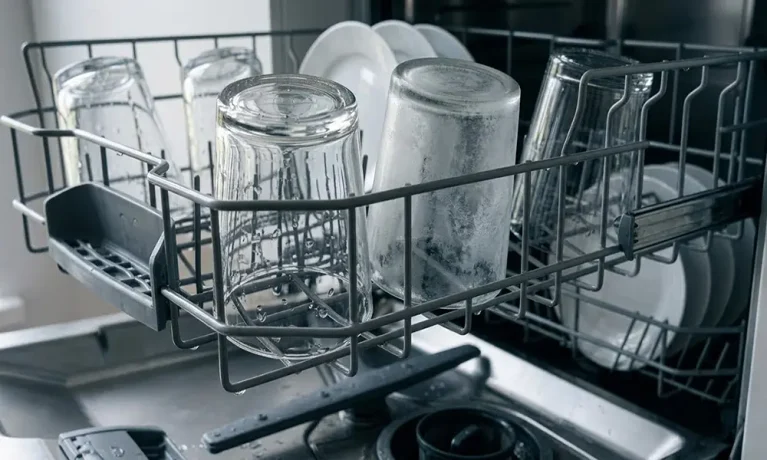
The dishes looked clean. The cycle had finished. Nothing obvious was stuck to the plates, and I couldn’t see anything alarming when I opened the door. My first thought was that perhaps something in the sink smelled and I was blaming the dishwasher for it.
A few days later, I noticed the smell again. The smell wasn’t overwhelming. That almost made it easier to ignore. I could easily have ignored it again, except I had started noticing it every time I opened the door. Eventually I stopped wondering whether I was imagining it and started looking. That was when I realized a dishwasher can be much dirtier in a few hidden places than it looks from the outside.
What made me look inside
I had always thought of the dishwasher as a fairly self-contained cleaning machine. Dirty dishes went in. Hot water, detergent and a few hours later, clean dishes came out.
The assumption hiding underneath that routine was slightly ridiculous: I had been trusting the dishwasher to clean itself.
During a wash, food particles and water are moving around inside the machine. Depending on the design, debris is caught by a filter or filtration system, while water is circulated through the dishwasher and drained away. That means some of what comes off the dishes has to be caught or carried away somewhere inside the machine.
I started wondering where all that residue was ending up.
The dishes could come out clean while traces of what had been washed off them remained somewhere inside the machine.
So I pulled out the bottom rack and looked properly.
The bottom of the dishwasher told me more than I expected
There wasn’t some dramatic pile of spoiled food waiting for me.
There were small bits of residue around the bottom of the tub and the areas where water and debris collect. Some of it was the sort of thing I would never have noticed during ordinary loading and unloading.
A dishwasher doesn’t need a visible pile of food sitting inside it to develop an unpleasant smell.
Food residue can become noticeably unpleasant when it remains inside the dishwasher between cycles. Grease and other residue can collect in areas that don’t receive the same direct water spray as the dishes.
And then I found the part I had somehow managed to ignore for far too long.
The filter.
The filter was the part I had been ignoring
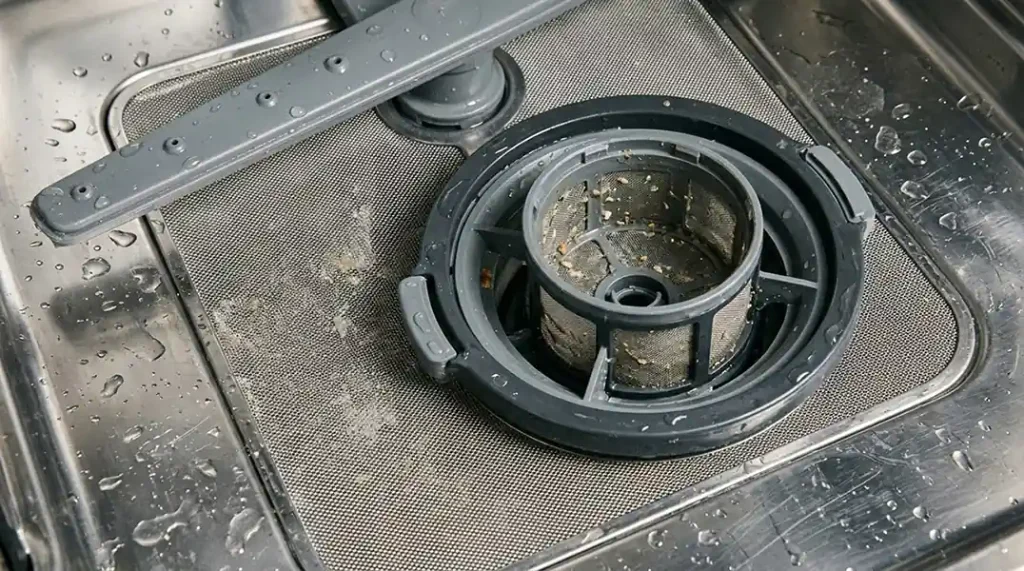
If your dishwasher has a user-cleanable filter, If your dishwasher has a user-cleanable filter, it is usually at the bottom of the machine, beneath the lower rack. The exact design varies considerably, which is why the owner’s manual is worth checking before twisting, pulling or removing anything.
Its job is fairly straightforward: food debris has to go somewhere.
On many modern dishwashers, the filter helps trap food particles and other debris so they aren’t continually recirculated with the wash water. If the filter becomes heavily soiled or blocked, it can contribute to residue buildup and, on some machines, drainage problems.
I had never really thought about the filter that way.
I thought of it as one of those technical parts hidden inside an appliance, vaguely important but mostly somebody else’s problem.
It wasn’t.
I checked mine according to the instructions for the machine, and there was enough residue there to make me suspect I had found at least part of the problem.
There was nothing horrifying hiding inside the dishwasher.
The filter was doing exactly what it was supposed to do. It had simply collected a layer of the food residue I had never thought about cleaning.
So why can a dishwasher smell after a hot cycle?
I had assumed that a hot wash would basically reset the entire machine.
But the dishes and the dishwasher itself aren’t quite the same thing.
A wash cycle moves water around the tub and cleans the surfaces that the water and detergent reach. It doesn’t guarantee that every hidden area of the machine will be free of residue afterward.
That made me look at the rest of the dishwasher differently.
I started paying attention to the less obvious parts of the machine: around the bottom of the tub, the door seal and the spray arms.
There were small openings I had never paid attention to before, and it wasn’t hard to imagine how food particles could end up in places I would never normally think to inspect.
A blocked spray-arm opening can also affect how water is distributed during a wash, which means an odor may arrive alongside another clue: dishes that aren’t being cleaned as well as they used to be.
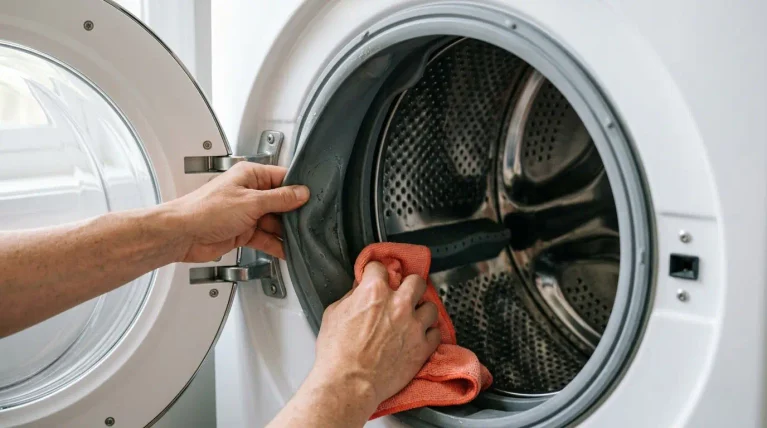
The rubber seal around the door was another easy place to overlook.
That area stays wet during normal use, and residue can collect in the folds and edges.
I didn’t need a flashlight and a detective’s coat.
I just needed to stop looking only at the obvious surfaces.
Then I started wondering about the water
Then there was the possibility that the smell had less to do with dirt and more to do with where the water was going.
A small amount of water left in the bottom can be normal on some dishwashers. Noticeable dirty water that remains after a cycle is different, particularly if the machine is draining slowly or the smell keeps returning.
In some US installations, the dishwasher drain hose is connected through a high loop or an air gap to help prevent wastewater from flowing back toward the machine. The exact setup depends on the installation and local plumbing requirements.
Not every dishwasher with an unpleasant smell has a plumbing problem. Sometimes there is simply old food residue sitting somewhere it shouldn’t be.
If noticeable water remains after a cycle, the machine drains slowly, or the smell keeps returning—especially if it smells more like sewage than food—I wouldn’t keep treating it as a cleaning problem indefinitely.
And in a US kitchen, I would also pay attention to the sink connection if the dishwasher odor seems to be coming from that area.
What I actually did to clean it
I didn’t start pouring every household cleaning ingredient I could find into the machine.
Dishwasher-cleaning advice varies by manufacturer and model, and some of the internet’s favorite tricks aren’t universal recommendations. Vinegar is a good example: some manufacturers allow it as an occasional cleaning method, while others recommend a purpose-made cleaner or an approved maintenance cycle. I didn’t want to assume that a trick that worked for one machine was automatically right for mine.
So I started with the boring option: the manual.
I emptied the dishwasher and removed the lower rack so I could actually see what was going on. I checked the filter, where applicable, and cleaned it according to the manufacturer’s instructions. I cleared the trapped residue carefully, then made sure the filter was properly seated again.
I checked the drain area too, looking for any obvious debris that could interfere with drainage.
I also checked the spray arms and their openings, then wiped the accessible interior surfaces and door seal, paying attention to edges and folds where residue can collect.
If your dishwasher has a dedicated cleaning or maintenance program, this is also the moment to use it if your manufacturer recommends one.
The exact schedule is where I would resist copying somebody else’s routine blindly.
Filter-cleaning schedules vary between machines. Some manufacturers recommend weekly checks, while others use a longer interval or simply advise cleaning when the filter becomes dirty or clogged. The manual for your dishwasher is a better guide than a universal timetable.
A few small habits made a bigger difference
Once I knew what I was looking for, I didn’t suddenly create a complicated dishwasher-maintenance schedule. I just stopped treating the appliance as a sealed box and started paying attention to the filter according to its cleaning instructions instead of waiting for something to smell strange.
I also stopped letting dirty dishes sit in there for ages when I knew the machine wasn’t going to run soon.
I became more aware of overloading. When racks are packed too tightly, water circulation can suffer, which can affect cleaning performance. If the smell appears at the same time that dishes start coming out less clean, it’s worth investigating the loading and maintenance before reaching for more detergent.
And after a cycle, I don’t feel obliged to slam the door shut immediately.
Some manufacturers recommend leaving the door slightly open after a cycle to help the interior dry, particularly when moisture tends to linger.
None of them is particularly exciting. They are just easier to keep up with than a grand cleaning project.
When the smell isn’t just a dirty dishwasher
There is a point where I would stop cleaning and start troubleshooting.
If you’ve cleaned the appropriate parts and the odor keeps returning, I’d start looking for another cause. If the machine is leaving water behind, draining slowly, leaking or showing an error code, I’d move beyond basic cleaning.
A blocked filter is one possible cause of poor drainage, but the drain hose and the rest of the drainage system can cause problems too.
And I wouldn’t start dismantling hoses or electrical components under the sink because a blog post told me to.
That’s where I’d stop experimenting and get the machine checked properly.
The same goes for a persistent sewage-type smell. The dishwasher may be the source, but the smell can also be coming through the connected plumbing, in which case cleaning the inside of the appliance won’t solve it.
The slightly ridiculous lesson I took from it
The whole thing was less dramatic than the smell initially made it seem.
There was no mysterious creature living behind the dishwasher and no plate of forgotten food hiding there for months.
Mostly, there was a machine doing exactly what it was designed to do while I had forgotten that everything it washed off the dishes had to end up somewhere.
I had been looking at the clean dishes and assuming the appliance itself must be clean too.
The strange wet-dog smell turned out to be useful in a way. It made me look properly at the parts of the machine I’d been overlooking—the filter, drain area and seal. These were places I had opened dozens of times without really seeing.
I still find it mildly funny that the appliance responsible for cleaning the dishes can eventually become the thing that needs cleaning.
After that, the smell stopped being quite so mysterious. It was a small household problem hiding in a place I hadn’t thought to check.