The lawn usually tells on summer before the homeowner does. By September, the grass along the sidewalk may look thinner than it did in June. The patch beneath the favorite backyard chair has gone a little brown. Near the driveway, where people have walked the same few steps all summer, the turf is sparse enough to see soil underneath. And then there are the weeds. Not enough to make the yard look abandoned. Just enough to make you notice them every time you pull into the driveway.
Megan had seen this before. Her lawn looked perfectly respectable in spring. By midsummer, though, the same areas always began to struggle. She watered. She bought fertilizer. One year she spread grass seed over the thinnest patches and watched the birds appear to enjoy most of it before she did. The following spring, some of the new grass was there. By August, much of it wasn’t. So when September arrived again, she found herself standing in the garage looking at an unopened bag of seed she’d bought the previous fall.
Maybe the lawn needed more seed. Or more fertilizer. Or more water. The problem was that she’d already tried all three. What she hadn’t done was ask a slightly different question:
What, exactly, is wrong with the lawn?
That distinction matters. University of Minnesota Extension recommends figuring out why a lawn is struggling before launching into renovation because drought, shade, poor soil fertility, pests, disease, mowing practices and thatch can all produce similar-looking symptoms. A fall lawn reset, then, isn’t really a seasonal ritual. It starts with figuring out what the lawn is actually dealing with.
First, make sure this advice is for your lawn
There is one important catch before anyone rents an aerator. This article is about cool-season turfgrass—the grasses commonly grown across much of the Northeast, Midwest, Mid-Atlantic and other cooler parts of the country. Kentucky bluegrass, tall fescue, fine fescues and perennial ryegrass are among the familiar names. These grasses naturally slow down during summer heat and become more vigorous again as temperatures moderate in fall. Their root growth is particularly active in cooler conditions; Penn State notes that root growth in cool-season turf is strongest during the cooler parts of the growing season.
That is one reason fall can be such a useful window for repairing thin turf. It is not, however, a nationwide September prescription. Bermudagrass, St. Augustinegrass, zoysiagrass and centipedegrass are warm-season grasses, and their seasonal rhythm is different. UGA Extension, for example, recommends core aerating warm-season turf during its active growing period rather than while it is dormant.
So if you live in the South and your lawn is Bermuda or St. Augustine, don’t see the word “September” and reach for the aerator. Your lawn may be asking you to do almost the opposite: let it slow down and prepare for winter.
September isn’t the magic part
Garden advice loves a date. September 1. September 15. The first Saturday after Labor Day. Real lawns are less cooperative. The useful signal is what is happening to the grass and soil around you. Fall renovation works well because cool-season turf is moving back into active growth while the worst of summer heat is passing. Minnesota Extension lists mid-August through mid-September as its preferred window for renovation in its climate, while Penn State says later than mid-October is generally too late for seeding in much of Pennsylvania. Those are regional recommendations, not a national countdown clock.
Soil temperature is another useful clue. Cooler soil can favor cool-season root growth, but local weather, grass species, soil and the amount of time remaining before winter all matter.
That is why the better question isn’t, Is it September yet? It is: Is my lawn entering a period when cool-season grass can grow strongly enough to recover and establish new seedlings?
Before renting a machine, look at the lawn
Megan’s first mistake had been assuming that every thin patch needed the same treatment. It didn’t. A lawn that is thin because of shade isn’t fixed by aeration. A lawn damaged by drought doesn’t necessarily need dethatching. And a lawn that has excessive thatch has a different problem from one whose soil has been compressed by years of foot traffic. Start with the simplest inspection you can do.
Push a screwdriver into the soil
Pick a few representative spots, particularly areas that receive heavy foot traffic. When the soil has suitable moisture, try pushing a screwdriver into it. This isn’t a laboratory test, and it won’t give you a neat number to write down. It is simply a way to compare areas. If the screwdriver enters one part of the lawn easily but struggles badly in another, that difference is worth investigating. Look at places where the grass has repeatedly been walked on, where vehicles or equipment have passed, or where the soil seems hard and reluctant to absorb water. Compaction reduces the pore space available for air and water and can restrict root development. Aeration exists primarily to address that problem—not because every lawn deserves an annual round of machine therapy. Penn State describes core aeration as a way of alleviating soil compaction by creating larger pores that help move moisture and nutrients through the soil.
Then check for thatch
Cut a small square through the turf and look at the side of the piece. You are looking for the layer between the green grass above and the actual soil below. Thatch is made largely of partially decomposed stems, roots and other plant material. A thin layer is normal. A thick, tightly woven layer can interfere with movement of air, water and nutrients. And this is where lawn advice often gets itself into trouble: a lawn can look terrible without having a thatch problem. Penn State recommends mechanical dethatching when thatch has become excessive and specifically cautions against removing it during heat, drought or late fall. Minnesota Extension similarly identifies excessive thatch as one possible reason a lawn becomes soft and spongy and responds poorly to ordinary watering and fertilizing. So don’t dethatch simply because the calendar says fall.
If compaction is the problem, core aeration makes sense
Imagine the soil under the lawn as a crowded room. Roots need some space. Water needs pathways through the soil, and air needs to move into those spaces too. Compaction makes the room smaller. A core aerator removes small plugs of soil rather than simply punching holes into the surface. The resulting openings create larger pores that can improve the movement of air and water through the soil. That difference is important. Spike or solid-tine tools may make holes, but they aren’t the same thing as hollow-tine core aeration. Penn State specifically distinguishes core aerators, which remove soil plugs, from equipment using solid spikes.
The soil also shouldn’t be bone-dry or saturated when you aerate. In its fall lawn-care guidance, Penn State notes that soil moisture needs to be in the middle ground: dry soil can make penetration difficult, while very wet soil can worsen compaction. If the lawn is genuinely compacted, several passes may be appropriate. Penn State’s renovation guidance uses multiple passes with a core aerator when cultivation is part of a renovation, while its seasonal lawn guidance describes six to eight passes when overseeding follows aeration.
That doesn’t mean every homeowner should run an aerator over the same lawn eight times. The condition of the soil should decide how aggressive the work needs to be. And if you are dealing with a small compacted patch beside a gate, for example, there may be no reason to aerate the entire yard.
Dethatching is a different job
The word sounds similar to aeration because both can appear in lawn-renovation instructions, but they are not interchangeable. Aeration addresses compacted soil, while dethatching removes excessive organic material accumulated above the soil surface. If your thatch layer is healthy and modest, removing it simply because you are doing fall lawn care can create unnecessary stress. Penn State explicitly says annual dethatching isn’t necessary; it should be done when buildup becomes excessive.
There is another reason to be cautious: a heavily thatched lawn can contain living roots and shoots within that layer. Aggressively stripping it away can leave the turf much thinner than expected. Penn State’s thatch guidance warns that removing too much can severely thin a stand and says weak, heat- or drought-stressed turf should not be dethatched. That is why Megan might discover that she doesn’t need the dethatcher at all. She may have a thin lawn or compacted soil, but those aren’t the same thing as excessive thatch.
Then comes the part the lawn actually wanted: seed
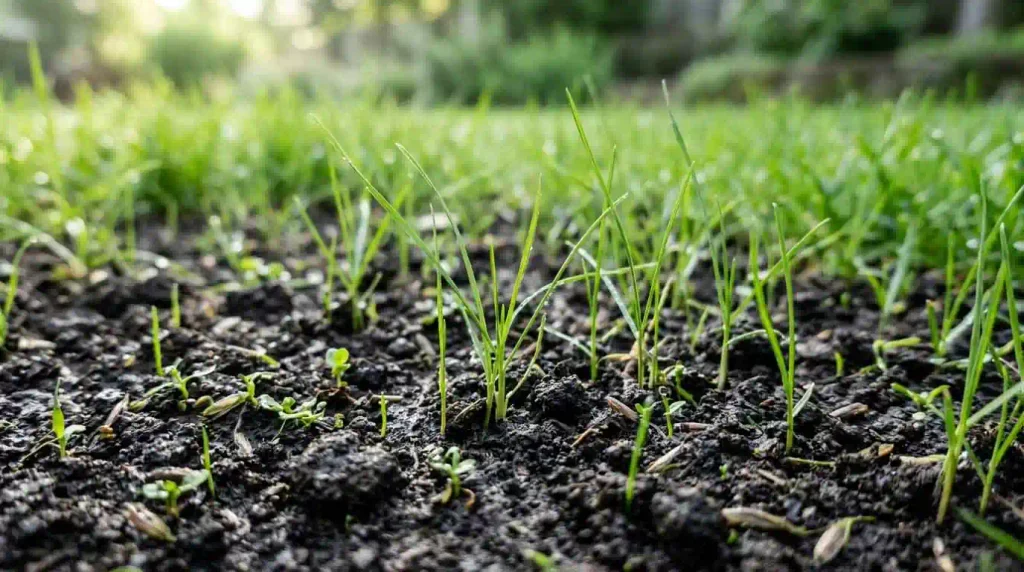
Once the underlying problem has been addressed, overseeding can make sense. The goal isn’t simply to scatter grass seed over the yard and hope. Seed needs contact with soil. That sounds almost embarrassingly obvious until you watch a homeowner broadcast seed onto an established lawn with a dense canopy of grass, leaves and thatch covering the surface. Much of that seed never gets where it needs to be. Penn State recommends overseeding thin turf or small bare areas in early fall and emphasizes the importance of seed contacting soil with enough room to germinate and develop.
Core aeration can help create those openings, and dethatching can help when excessive thatch is genuinely blocking the seedbed. But neither is automatically required before every overseeding job. For a lawn that is merely thin, the most useful intervention may be preparing the surface, choosing an appropriate grass seed for the region and getting the seed into contact with soil.
The seed itself matters more than the bag’s picture
This is another place where a little diagnosis can save money. A cool-season lawn isn’t one single species. Kentucky bluegrass behaves differently from tall fescue. Fine fescues have different preferences from perennial ryegrass. Shade, traffic, drought and soil conditions also influence which grasses are suitable. Minnesota Extension, for example, recommends different seed mixtures depending on whether a lawn is sunny, partly shaded, low-input or expected to tolerate traffic and drought. So a generic “best grass seed” recommendation isn’t very useful.
Read the seed label. Consider the grass already growing in the yard. Think about sun and shade. If you aren’t sure what is there, your local county Extension office can often help identify turf and recommend varieties suited to the area. And don’t buy more seed simply because the lawn looks bad. Buy the kind of seed that has a reasonable chance of succeeding there.
Watering new seed is less glamorous, but crucial
This is the part nobody notices when everything works. New seed needs consistent moisture while it germinates and establishes. That doesn’t mean turning the lawn into a swamp. It means preventing the surface where the seed is sitting from repeatedly drying out. Penn State recommends keeping seeded areas moist until germination and establishment, while Minnesota’s renovation guidance likewise emphasizes maintaining adequate moisture during establishment.
Exactly how often that means watering depends on weather, soil, seed and site conditions. A breezy sunny yard may dry much faster than a shaded one after a cool rain. The useful test is simple: don’t let the newly seeded surface repeatedly dry out during germination. Once the seedlings establish, watering can gradually be adjusted to encourage a deeper, more established root system.
And what about fertilizer?
This is where it is tempting to throw another product at the lawn. Don’t. If the lawn needs nutrients, a soil test is a much better starting point than guessing. Penn State recommends soil testing as part of renovation planning, and its fall guidance notes that testing can help determine pH and nutrient needs.
Starter fertilizer can be appropriate when establishing new turf, but the product and application should follow the fertilizer label and, where appropriate, soil-test recommendations. More fertilizer isn’t a substitute for correcting compacted soil or choosing grass that suits the site, especially where there isn’t enough light for turf.
Megan had spent a year adding things. She was beginning to understand that the lawn didn’t necessarily need more. It needed the right thing.
The lawn fixes that can backfire
The easiest way to make fall lawn care unnecessarily complicated is to treat every September lawn as if it has the same problem.
Dethatching simply because it is fall.
Fall is an appropriate season for dethatching cool-season turf when excessive thatch is actually present. It isn’t a reason to remove a healthy layer every year.
Aerating without a compaction problem.
Core aeration is useful when soil compaction is limiting the lawn. If the soil is already loose and the turf is healthy, there may be little benefit to dragging a heavy machine across it.
Confusing spike aeration with core aeration.
A tool that pokes holes isn’t performing the same operation as one that removes soil plugs.
Working on drought-stressed turf.
Aggressive mechanical work adds stress. Dethatching, in particular, should not be performed on turf already weakened by heat or drought.
Letting new seed dry out.
A beautifully prepared seedbed won’t help much if newly germinating grass repeatedly dries out.
Following warm-season advice on a cool-season lawn—or the reverse.
Bermuda, zoysia, St. Augustine and centipedegrass have different growth cycles. UGA Extension, for example, recommends aerating warm-season lawns during active growth rather than during dormancy.
Treating the calendar as the boss.
September can be an excellent month for cool-season lawn renovation. It is not a universal deadline. Local temperatures, grass type, soil condition and the amount of growing time remaining all matter.
The reset is smaller than you think
By the time Megan finished looking at her lawn, she had crossed several things off the list. The thatch wasn’t excessive. The compacted strip beside the walkway was a different story. The rest of the lawn was simply thin in places after a long summer.
So she didn’t dethatch the entire yard. She aerated the areas where compaction was actually a problem, prepared the thin sections for overseeding, chose seed suited to her existing cool-season turf and paid more attention to keeping the new seed moist. It wasn’t particularly dramatic. There was no single weekend in which the lawn transformed.
But she had stopped buying treatments based on how bad the grass looked from the driveway. She was looking underneath it now.
That is really the useful part of a fall lawn reset. Before you rent the aerator, identify the grass. Before you dethatch, check how thick the thatch layer is. Before you seed, find out why the grass disappeared. And before you circle a date on the calendar, look at the conditions outside.
For cool-season lawns, fall can be a particularly useful time to address summer damage and establish new turf. But the goal isn’t to perform every possible lawn treatment before winter. It is to figure out what the lawn is actually missing—and give it that.