By March, the pot had become something she walked past rather than looked at.
Last fall, it had sat beside the front door looking promising: dark soil, a handful of tulip bulbs tucked underneath, maybe a few violas on top for some immediate color. For a while in spring, it was exactly what she wanted. Then the tulips opened all at once. And just as quickly, they were finished.
The flowers collapsed. The leaves remained, slowly turning from green to the particular yellow that makes a gardener wonder whether she should move the whole thing behind the garage. The pot itself was perfectly good. There was nothing wrong with it, except that for most of the season it had very little to do. This is the slightly irritating part of growing spring bulbs in containers: the show can be wonderful and still be brief. If your porch, patio or balcony doesn’t have room for six different pots, there isn’t much incentive to devote valuable real estate to one dramatic week in April.
She considered buying another container. Then she looked around. There were already pots along the steps. A chair that was supposed to be decorative but had become a place for garden gloves. A hose coiled beside the garage. Another planter probably wasn’t going to solve the space problem.
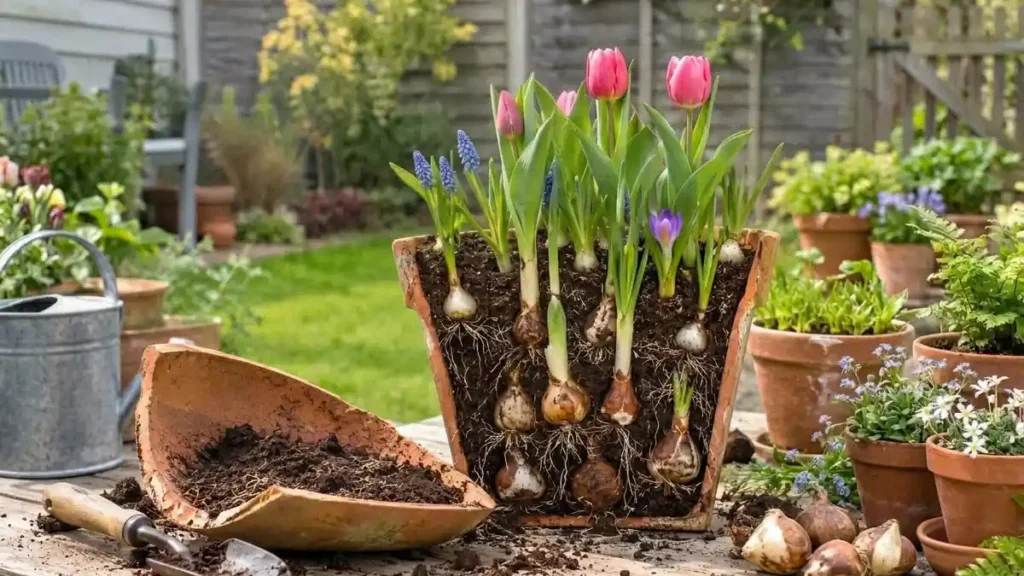
What she needed, she eventually realized, wasn’t more surface area. She needed to use the space underneath it. That is the thinking behind a bulb lasagna container: several kinds of spring-flowering bulbs planted at different depths in the same pot, with larger bulbs generally occupying the lower layers and smaller ones closer to the surface. University of Illinois Extension specifically recommends the lasagna approach for containers, using several layers of bulbs and potting soil to create a longer succession of spring color.
The name sounds more complicated than the idea. The pot is simply being treated as a stack of planting levels rather than one big hole.
The pot was never the problem
She had been making the same mistake each year, although it was an easy one to make. She was thinking horizontally. One container. One planting. One flowering period. But bulbs don’t all need to occupy the same depth. Their planting depths vary by type and size, and some naturally bloom earlier than others. A deep container gives her room to work with those differences.
There is another useful bit of timing hidden in all this. Spring-flowering bulbs are generally planted in fall because the cool season is part of their normal growth cycle. During that period, bulbs can establish roots before spring growth begins, while many also need a period of cold temperatures before they can flower. The exact chilling requirement varies by bulb and cultivar. So the gardener isn’t really asking every bulb to do the same job. She is arranging several plants with different schedules inside one container.
That distinction matters. A “90-day” display is a useful goal, not a promise stamped on the calendar. Weather, cultivar, planting date, winter temperatures and the particular bulbs you choose can all move the flowering window around. Still, the idea is practical. Instead of one pot that peaks and fades, you can aim for a pot that keeps handing the season from one layer to the next.
Start with the container, not the bulbs
The easiest mistake is to get excited about the flowers and forget about the pot. A lasagna container needs enough depth for several planting levels, and the drainage needs to actually work. Spring-flowering bulbs dislike sitting in saturated soil, and Extension guidance consistently emphasizes well-drained growing media and containers with drainage holes. Choose a substantial container rather than a shallow decorative bowl. A deep, wide pot gives the bulbs more room for their roots and for the soil layers. It also generally offers more protection from winter temperatures than a very small container. Illinois Extension notes that larger pots offer greater winter protection than smaller ones.
The material matters, too. A container that can tolerate repeated freezing and thawing is a safer choice for gardeners who intend to leave it outdoors through winter. If you live where winter temperatures regularly become severe, don’t assume that a beautiful ceramic planter belongs outside simply because it survived last winter. Before adding soil, check every drainage hole. A saucer underneath can catch excess water during the growing season, but it shouldn’t become a little frozen pond in winter. Make sure water can escape freely.
For the growing medium, use a quality potting mix rather than digging soil straight out of the yard. Potting mixes are designed to give roots the air and drainage they need in a confined space.
Build the layers around bloom timing
This is where the lasagna starts to make sense. At the bottom, place your largest or later-flowering bulbs. Depending on the varieties available in your area, that might mean large tulips, later daffodils or alliums. Cover them with potting mix according to the planting requirements for those particular bulbs. Then comes a middle layer of bulbs with a different flowering period. Hyacinths, some tulips and certain daffodils can work here. Another layer of soil follows. Near the top, smaller, earlier bulbs such as crocuses or grape hyacinths can provide the first flowers.
There isn’t one universal recipe for the layers. The useful part is following each bulb’s planting instructions while making use of the space between them. Illinois Extension’s container guidance recommends placing the largest bulbs on the bottom, covering them with about two inches of potting soil, then continuing with progressively smaller layers. Don’t use one fixed depth for every bulb. That shortcut looks tidy on paper and is exactly the sort of advice that causes trouble in real gardens. Planting depth depends on the bulb itself, and Extension guidance uses the bulb’s size as part of the depth rule. The package instructions for the variety you bought should take priority.
Within each layer, stagger the bulbs rather than stacking them directly on top of one another. You don’t need to leave enormous gaps. In containers, bulbs can be planted relatively closely for a fuller display, but they should not be pressed against each other. The visual result beneath the soil is a little like a three-story apartment building with very quiet tenants.
For now, nothing is happening. That is normal.
The winter part is easy to underestimate
After the final layer of potting mix goes in, water the container thoroughly so the soil settles around the bulbs and the roots have moisture available as they begin developing. Then comes the oddest part of the project: you wait. The bulbs are not simply sitting there until spring. Spring-flowering bulbs can begin developing roots during the cool season, and cold temperatures are part of the sequence that allows many of them to move from dormancy toward flowering.
Winter care, however, is where American gardeners need to stop thinking of the country as one giant garden zone. A bulb planted in the ground has the insulating mass of surrounding soil. A pot sitting on a porch is exposed to cold from more directions, and its soil volume is much smaller. In colder northern climates, a container may need protection during periods of severe cold. Depending on the pot, the bulbs and the local winter, that could mean moving the container into an unheated garage or another protected space, or insulating it in place. Illinois Extension notes that bulb containers can be overwintered in a garage or protected location and specifically cautions about very cold temperatures. Gardeners in areas with dependable snow cover may get some natural insulation from snow. In colder climates, additional protection can also help buffer extreme temperature swings and reduce the risk of premature spring emergence. University of Minnesota Extension recommends protective mulch for bulbs once the soil begins to freeze in climates where winter exposure is severe.
The important point is not to copy a Minnesota winter strategy onto a porch in Georgia. In warmer parts of the South and West, the challenge can be different. Some spring bulbs need a substantial cold period to flower well, and gardeners in warm climates may need cultivars suited to their region or bulbs that have received appropriate chilling. Extension guidance on bulb forcing demonstrates just how much chilling requirements vary among species. Refrigerating bulbs is therefore not a universal instruction for American gardeners. It can be useful when natural winter conditions aren’t sufficient, particularly when bulbs are being forced, but the requirements vary by bulb.
For an outdoor spring container, follow the recommendations for your specific bulbs and local climate.
A real-world planting session
The gardener eventually chooses a sturdy container that is deeper than the little pots she had been buying. She checks the drainage holes with her finger before doing anything else. The first layer of potting mix goes in. Then the largest bulbs, arranged so their growing tips point upward. She covers them with the amount of mix their planting instructions call for. The next bulbs go in, slightly offset from the first group. More soil. Then the small early bulbs.
By the time she finishes, the surface looks almost disappointingly ordinary. That’s one of the funny things about bulb lasagna. In November, it doesn’t look like the future flower display. It looks like a pot of dirt. She waters it thoroughly, lets excess water drain, and labels the container. The label turns out to be worth the thirty seconds it takes to write it.
By February, she may remember that there are crocuses in there. She may not remember which tulip was planted below them, or whether the daffodils were the mid-season variety or the later one. A weatherproof label with the bulb varieties and planting date saves a surprising amount of detective work later. Then she puts the pot where its winter treatment will be easiest to manage.
The practical bulb-lasagna method
Choose a deep, sturdy container.
Give yourself enough vertical room for multiple bulb layers and their required soil coverage. A substantial container is preferable to a shallow bowl, especially if it will spend winter outdoors.
Check drainage before planting.
The pot should have unobstructed drainage holes. Don’t rely on a thick layer of gravel at the bottom to “fix” a container with poor drainage; the better solution is a container designed to drain properly and a suitable potting medium.
Choose bulbs with different flowering windows.
Look beyond flower color. Check expected bloom period, mature size and planting depth. The point is succession, not simply putting every bulb you like into one pot.
Put the deepest bulbs down first.
The bulbs that need the deepest planting can form the bottom layer. Examples might include later tulips, daffodils or alliums, depending on the varieties you choose.
Add potting mix between layers.
Use the depth recommended for each bulb rather than assuming every layer needs exactly the same amount of soil. Illinois Extension’s example uses roughly two inches of potting soil between bulb layers, but the individual bulb’s planting requirements still matter.
Stagger the bulbs.
Don’t arrange every bulb directly above the one underneath it. Offset the planting positions so the container makes better use of its available space.
Finish with the smallest or earliest bulbs.
Crocus and grape hyacinth are common choices for the upper layer. Snowdrops may also work where they are suited to the local climate.
Water after planting.
Give the container a thorough watering and allow excess water to drain. After that, avoid keeping the dormant pot constantly wet. Check the soil before watering again, especially during cold weather.
Label it.
Write down the varieties, planting date and, if useful, the intended layer. Future-you will appreciate this.
Plan the winter location before winter arrives.
That may be a sheltered porch in a mild climate, a protected corner, or an unheated garage during the worst cold in a northern climate. The right choice depends on your bulbs, container and local weather.
A few mistakes that can spoil the experiment
A shallow container is one of them. There simply isn’t enough room to create meaningful layers while also giving bulbs their required planting depth. Poor drainage is another. A pot that stays waterlogged through a cold winter is asking bulbs to tolerate conditions they may not survive. Garden soil is also a poor substitute for a good container mix. It can become dense and restrict drainage in a confined pot. Then there is the temptation to improvise planting depths. Don’t. If your tulip package says one depth and your crocus package says another, those instructions are more useful than a generic lasagna diagram.
Overwatering is easy during winter because there is so little happening above the soil. The container looks dormant, so it is tempting to check it, see dry-looking soil at the surface and add more water. Check the soil before watering, especially during cold weather.
And don’t promise yourself ninety days. You may get a wonderful succession that stretches from the first crocus into the later tulips and daffodils. You may get less. A warm March can hurry everything along. A cold spring can slow the sequence dramatically. The varieties themselves matter enormously. The goal is a longer season from one container, not a stopwatch.
The space was there all along
By spring, the original problem looks slightly different. The first little flowers appear near the top of the pot. Then another layer begins to open. A few weeks later, taller flowers take over. There will still be foliage after some blooms fade. There will still be a moment when the container looks between seasons. Gardening rarely follows the clean handoff promised by a catalog photograph. But the pot is no longer finished after one brief display. And she didn’t have to find another place for it.
That may be the most useful thing about a bulb lasagna. It’s more than a trick for squeezing flowers into a pot. It’s a way of noticing that a container has depth, and that the space below the surface can be doing something while you’re looking at what’s above it.
One pot. Several planting levels. A spring that doesn’t all arrive on the same Tuesday.