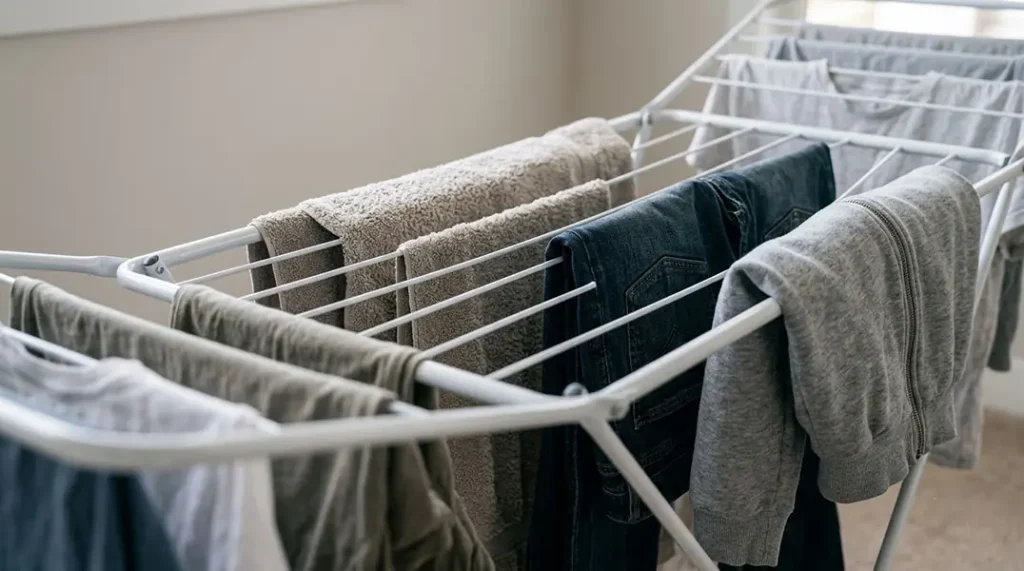
The first time I noticed it, I assumed I had imagined it. The laundry had come straight out of the washer, and while it was hanging on the drying rack it smelled perfectly clean. Later, when I started taking the clothes down, a couple of pieces had acquired that faint damp smell that makes you hesitate before putting them away. A T-shirt was fine. A pair of jeans was not. One towel seemed completely dry on the outside but still had a slightly stale smell.
That was what caught my attention. If the clothes had come out of the washer smelling bad, I would have started there. Instead, the odor seemed to be appearing somewhere between the wash cycle and the wardrobe. So I started paying closer attention to what was happening while the laundry dried.
The drying stage may be where the smell begins
When clothes dry indoors, the moisture has to go somewhere. Wet fabric releases moisture into the room as that water evaporates, and how quickly the moisture leaves the fabric depends on the air around it as well as the fabric itself.
If the air is already humid, evaporation can be slower. Clothes packed tightly onto a rack also have less air moving between them, while a poorly ventilated room can allow that moisture to linger.
The U.S. Environmental Protection Agency recommends keeping indoor relative humidity below 60 percent, ideally between 30 and 50 percent, as part of controlling excess moisture and reducing conditions that can support mold growth. That does not mean a musty-smelling shirt is evidence of mold. It is simply a useful reminder that moisture in the room matters.
I found that more useful than the vague instruction to “ventilate.” In an ordinary home, that might mean using an exhaust fan, the home’s normal ventilation system, or opening a window when outdoor conditions make that sensible. Opening a window isn’t automatically helpful on a hot, muggy day. The aim is to remove moisture, rather than simply replace indoor air with equally damp outdoor air.
A dehumidifier can also help if you regularly dry laundry in a room that stays humid. The EPA lists dehumidification as one way to control indoor moisture when necessary.
What mattered in my case was shortening the amount of time the clothes spent in that in-between state: washed, hanging up, apparently drying, but still holding moisture.
The clothes that gave me the clue
The clothes that made the problem most obvious were the ones that took longest to dry. Towels, jeans, sweatshirts and other thick garments can hold moisture much longer than a lightweight shirt.
Seams, waistbands and other thicker or folded areas can dry more slowly than the surface you happen to touch.
That explained something I had been seeing without really thinking about it: the laundry did not all smell the same.
A thin T-shirt could be dry and fresh while a pair of jeans on the same rack still smelled faintly damp. The jeans weren’t necessarily the whole problem, but they gave me a much better place to look.
There isn’t a useful universal drying time for every fabric, room or climate. A lightweight garment in a warm, dry, well-ventilated room can dry much faster than a towel in a cool, humid space.
Then I looked at the rack itself
My drying rack was doing its job in the narrowest sense: it was holding clothes off the floor. That didn’t necessarily mean it was helping them dry efficiently.
When garments sit close together, broad sections of fabric can touch or overlap. Air movement is reduced, and thicker items can effectively create their own little pockets of dampness.
Spacing became one of the simplest changes to make. I stopped treating every bar of the rack as storage and started giving the larger pieces room to hang open. I spread shirts out rather than bunching them together, and gave thicker items more room for air to move around them.
A fan can help too, provided it is used sensibly. You do not need a powerful blast aimed at the laundry all day; moving air around the drying area can help evaporation. I cared more about whether the clothes were actually drying faster than whether the room simply felt breezier.
A small, enclosed room can make drying harder when there is nowhere for the moisture to go. Putting the rack directly in front of an open window isn’t automatically the answer either; outdoor humidity and the home’s heating or cooling can change the equation.
I also had to consider the washing machine
I also had to ask whether the smell was already there.
For anyone wondering why clothes smell musty after drying, this is where I would start: if the laundry already smells unpleasant when it comes out of the washer, investigate the washing stage first. If it smells fresh when wet and develops that damp odor while hanging indoors, look more closely at the drying environment.
It is not an absolute rule. Smells can be subtle, and several problems can overlap. But it gives you somewhere sensible to start.
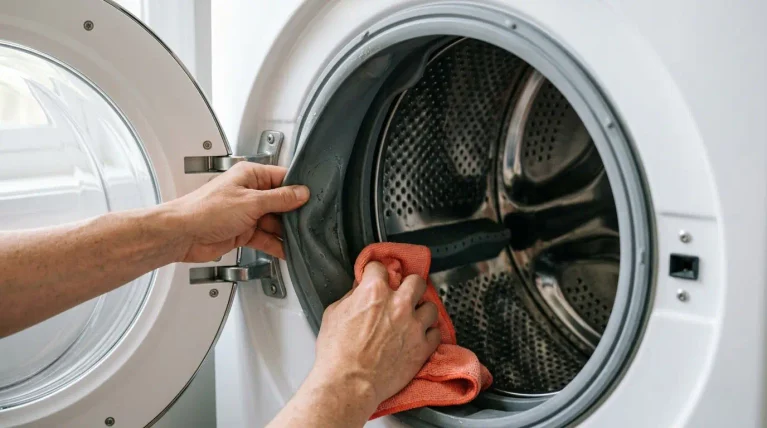
A washing machine can develop odors of its own, particularly when moisture and residue remain inside. Manufacturer guidance commonly recommends removing wet laundry promptly, cleaning the washer according to its care instructions, and allowing the interior to dry between loads.
Detergent was worth looking at too. Adding more wasn’t going to solve a smell that might already be coming from the washer or drying process. Excess product can contribute to residue, and the correct detergent and amount depend on the machine and the load. For high-efficiency washers in particular, using the detergent specified for the machine matters.
Fabric softener is a slightly different question. Its purpose is to condition and soften fabric, so it isn’t a substitute for detergent. Some fabric softeners also leave conditioning agents on the fibers. Fabric softener isn’t automatically the cause of musty laundry, either. It has legitimate uses and can reduce drying time in some circumstances. If you suspect product buildup, I’d start by checking the amounts you’re using against the detergent and softener instructions rather than adding another product to cover the smell.
And there is one very ordinary mistake: forgetting the load.Wet clothes sitting in a closed washer for hours are in a very different situation from clothes that are promptly removed and spread out to dry. If a load already smells questionable when you open the washer, drying it more slowly is unlikely to improve matters. Whirlpool advises that a load left too long may need to be washed again before drying if it has developed an odor.
What actually made the difference
I didn’t need to reinvent my laundry routine. Most of the changes were pretty ordinary.
I paid more attention to the point at which the clothes came out of the washer, rather than letting a finished cycle sit until I happened to remember it. I gave the drying rack more room, spread bulky garments open where possible, and paid more attention to how moisture was leaving the room when it was already humid.
The humidity clue was particularly useful. If you regularly see condensation on windows or notice that a drying room stays damp, that is a reason to look at the room as well as the laundry. The EPA identifies condensation as a sign that indoor humidity may be too high and recommends reducing the moisture source and drying wet surfaces promptly.
I stopped judging dryness by the easiest part of the garment to touch. A shirt can feel dry across its broad surface while a thick waistband or seam remains slightly damp. Before folding something away, especially a heavier item, it is worth checking those slower-drying areas.
Indoor drying isn’t inherently a problem. Plenty of households do it without their laundry developing a musty smell. The difference is that indoor drying asks the room, the rack and the laundry to do a little more work together.
When musty laundry keeps coming back
If the smell keeps returning, I would go back to the beginning of the process rather than repeatedly rewashing the same clothes.
Start with a simple comparison: smell a few items when they come out of the washer, then see what happens as they dry. If the odor is mainly in thicker garments, that’s different from the whole load developing the same smell. I’d also check whether the washer itself smells stale when it’s empty.
If the washer has an odor, follow the cleaning and maintenance instructions for your particular model. A clean-washer cycle may be available, and the door seal, detergent dispenser and other areas can require attention depending on the design. Manufacturer instructions vary, so I’d follow the owner’s manual rather than a generic cleaning routine.
If the washer smells fine but the laundry repeatedly becomes musty while drying, I’d look at the rack, the thicker items and the room itself. Are the clothes packed too closely? Are heavier pieces taking much longer to dry? Is the room staying humid or lacking enough air movement?
Those questions are more useful than simply looking for a detergent that will get rid of the smell.
For persistent moisture problems in the home—particularly if there is visible condensation, dampness or a recurring musty smell beyond the laundry itself—the issue may be bigger than a drying rack. The EPA recommends addressing ongoing moisture problems and keeping indoor relative humidity below 60 percent, ideally between 30 and 50 percent.
The laundry lesson I kept
What changed my thinking was realizing that “dry” and “fresh” are not quite the same thing.
I had been treating the drying stage as the passive part of laundry: wash the clothes, hang them up and wait. When clothes are dried indoors, though, the room becomes part of that process. How quickly the clothes dry depends partly on the humidity, air movement and the way they’re arranged on the rack.
So now, when clothes smell musty after drying, I don’t immediately reach for more detergent. I work backward.
If the odor was already there when the clothes left the washer, I look at the washing stage. If they smelled fresh when wet but changed while hanging, I look at drying time and the room. When only the thickest pieces smell, I pay attention to the places where moisture can linger.
That small change in thinking has made the problem much easier to troubleshoot.
The useful part is knowing which stage to investigate before doing another load.