The shovel is still leaning against the garage when the leaves on the new tree begin to look a little tired.
Back in May, the tree looked like an easy win. It was green, leafy and upright when it came home from the garden center. The hole was dug, the root ball went in, and the hose ran long enough to leave a dark circle of wet soil around it.
For a while, everything looked fine. Then July arrived. The soil around the tree dried faster. The leaves began curling at the edges. Watering became a regular chore, and the homeowner started checking the tree almost every evening, wondering whether it needed more water, fertilizer or something else entirely.
This is one reason spring feels like such an obvious time to plant a tree. Everything is growing. Nurseries are full. The weather is pleasant. A new tree looks ready to become part of the yard immediately. The trouble is that a newly planted tree has a job going on underground that isn’t nearly as visible. It has to rebuild and extend its root system after being moved, and sometimes the hardest part of that job comes just as summer is getting started. That is where fall planting earns its reputation.
The leaves aren’t always telling the whole story
When a newly planted tree looks stressed, the leaves are usually the first thing we notice. We water it. We inspect the foliage. We look for insects. We wonder whether the nursery sold us a bad plant. Those are reasonable reactions. Leaves are the part of the tree we can see. Roots are another matter.
A transplanted tree needs to push roots outward into the surrounding soil before it can function like an established tree. University of Illinois Extension notes that transplant shock can last two or three years, sometimes longer, and that expanding the root system beyond the original planting area is a central part of recovery. That changes the way you look at fall planting. The question isn’t simply whether the tree has enough leaves to look good when you put it in the ground. The more useful question is whether the conditions after planting give those roots a reasonable chance to get established. Autumn often does.
Why fall can be easier on a new tree
Think about what a tree is dealing with in July. The air is hot. The sun is strong. Water is leaving the leaves through transpiration, while the newly disturbed root system is still relatively small. A tree that has been in the ground for years can draw water from a much larger root system. A newly planted tree cannot.
In fall, several things begin changing at once. Air temperatures cool. Transpiration decreases. Soil can remain comparatively warm, and fall rains in many parts of the country can help maintain soil moisture. At the same time, shoot growth slows as plants move toward dormancy while roots can continue growing as long as soil conditions remain suitable. That combination is the useful part. The tree may not have to support the same level of above-ground growth during hot weather, while the soil may still provide conditions for root development.
University of Missouri Extension describes this as a head start before the heat and drought of the following summer. Purdue Extension similarly notes that cooler fall conditions reduce heat and water stress while supporting root development. It is worth being precise here, though. Fall is not magic. Roots do not keep growing indefinitely after the ground freezes, and planting late in the season does not somehow eliminate winter stress. The advantage disappears when conditions become unfavorable for establishment. University of New Hampshire Extension, for example, recommends giving fall-planted woody plants several weeks of mild weather for root growth before freezing conditions arrive. It also notes that some plants are better candidates for fall planting than others.
So the useful idea isn’t “fall is always better.” For many trees and shrubs, fall can provide a gentler transition into the landscape and give the roots time to establish before the following summer.
There isn’t one fall planting date for the whole country
This is where a national gardening calendar can get misleading. September does not mean the same thing in Minnesota as it does in Georgia. October in Pennsylvania is not the same planting window as October in Texas. In northern areas, the window can close quickly once freezing weather approaches. University of New Hampshire Extension notes that early October can be a reasonable deadline in its region, while Illinois Extension describes fall as an excellent planting period but cautions that trees planted too late may not have enough time to establish before winter.
In the South, fall and early winter can offer a much longer planting opportunity, although local soil conditions and species still matter. Texas is its own conversation. Texas A&M AgriLife takes the same local approach, because Texas isn’t one uniform climate. That is why “How late can I plant a tree?” doesn’t have one useful national answer.
Look at your local forecast, soil conditions and expected freeze pattern. A tree planted while the soil is workable and conditions remain mild has a different outlook from one planted immediately before a hard freeze. And don’t forget the plant itself. Deciduous trees and shrubs are often better fall candidates than broadleaf evergreens or certain slow-establishing species. UNH Extension specifically recommends caution with plants such as magnolia, tuliptree, oak and ginkgo in its region, while Illinois Extension notes that some broadleaf evergreens and slow-to-establish trees are better planted in spring.
Local Extension advice is much more useful here than a universal “best trees for fall” list.
Start with the place, not the tree
Once the decision is made to plant, it is tempting to head straight for the nursery. Slow down for ten minutes. Look at the spot first. How much sun does it receive? Does the soil stay wet after rain? How large will the tree or shrub eventually become? Will mature branches interfere with the house, driveway, sidewalk or other plants? Extension guidance repeatedly comes back to the same principle: right plant, right place. The mature size of the plant matters just as much as how attractive it looks in a five-gallon container.
And before the shovel goes into the ground, check for buried utilities. In the United States, 811 provides the nationwide “Call Before You Dig” service for locating underground utilities. Requirements and waiting periods vary by state, so check your state’s 811 process before digging.
It is a small step, but a very worthwhile one.
Then look at the roots
At the nursery, don’t judge a tree entirely by the top. For container-grown plants, slide the plant out of its pot when possible and inspect the root system. Circling or girdling roots deserve attention before planting. Penn State Extension recommends correcting problematic circling roots rather than simply dropping a tightly root-bound plant into the ground and hoping the roots figure themselves out later.
Balled-and-burlapped trees need a different inspection. The root ball should be firm, and the material around it should be handled according to the planting guidance for that stock. Bare-root plants are different again and should be planted so their roots can spread naturally rather than being bent into an undersized hole.
The label on the tree doesn’t tell you everything. Sometimes the root ball does.
The hole should be wide, not deep
This is the part that trips up an astonishing number of otherwise careful gardeners. You dig a generous hole. You put the tree in. It sits too low. So you add another layer of soil underneath. It seems harmless. It isn’t. One of the most common planting mistakes cited by several Extension programs is planting trees too deeply.
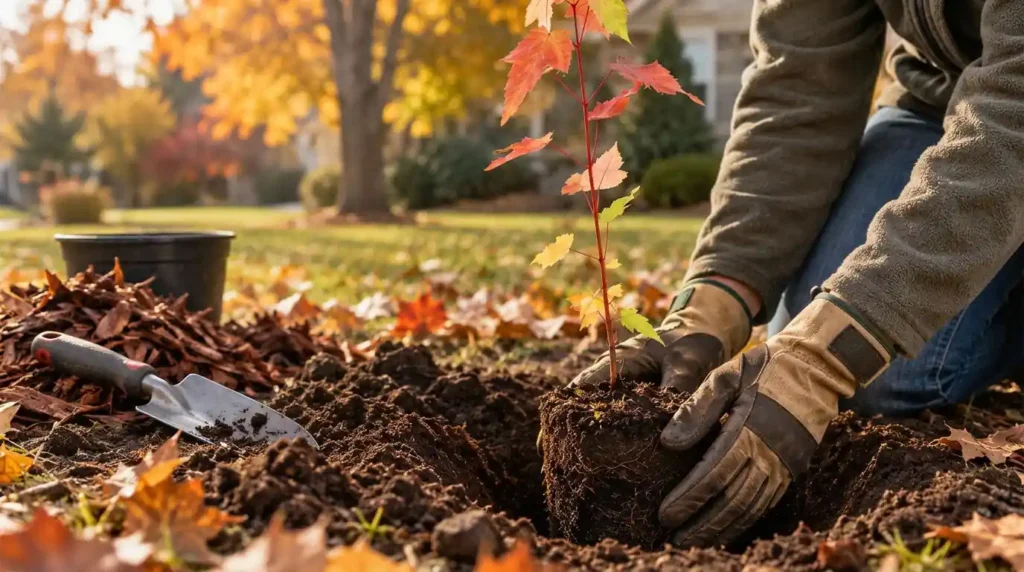
The planting hole should generally be no deeper than the root system or root ball, while the width should provide room for roots to move outward. Penn State recommends a hole at least twice the width of the root ball, while other Extension guidance commonly recommends two to three times the width depending on soil conditions. Before you decide the depth, find the root flare. The root flare is the point where the trunk begins widening as the major roots spread outward. On a properly planted tree, that flare should remain visible at the proper soil grade, not buried beneath it. If nursery soil has been piled over the flare, some of it may need to be removed before planting.
This is one place where an extra minute with your hands can save years of trouble. A tree should not disappear into the ground simply because the root ball came that way.
Don’t automatically improve the soil
This is another instinct that makes perfect sense. You have a hole full of ordinary yard soil. The bagged compost at the garden center looks much better. Why not mix the good stuff in? Because planting holes are not isolated flowerpots. If the surrounding soil is substantially different from the soil inside the hole, roots may encounter an abrupt change in physical conditions as they try to move outward. For ordinary landscape planting, several Extension programs recommend using the soil removed from the hole rather than automatically replacing it with a rich amended mixture. Illinois Extension specifically advises native soil for typical tree planting, while Penn State cautions against relying on rule-of-thumb amendments in difficult or construction-damaged soils.
That doesn’t mean amendments are never appropriate. A genuinely poor, compacted or contaminated planting site may need a different solution. Soil testing can also reveal problems that require correction. It simply means compost is not a universal answer to every planting hole.
Water the roots, not your conscience
After planting, the tree should be watered thoroughly. Then comes the less glamorous part: continuing to check it. Fall rain can help, but rain is not a guarantee that the root ball is moist. Container-grown plants can be particularly vulnerable because their original growing medium may dry differently from the surrounding native soil. University of Minnesota Extension recommends regular watering during establishment, with frequency adjusted for rainfall and conditions. Penn State likewise emphasizes that newly planted trees need consistent moisture until their roots become established.
There is no honest national watering schedule that works for every yard. Sandy soil, clay soil, rainfall, wind, plant size and local temperatures all change the calculation. A better habit is to check the soil. Water slowly enough that moisture reaches the root zone rather than simply running off the surface. Newly planted trees need moisture throughout the root zone, but constantly saturated soil is a problem too because roots need oxygen as well as water. In other words, don’t turn the new tree into a weekly guessing game. Check what is happening underground.
Mulch should look like a donut
Mulch is useful after planting, particularly because it helps moderate soil moisture and temperature and reduces competition from turf and weeds. The mistake is piling it against the trunk. You have probably seen it: a neat mound of mulch rising several inches around a tree until the trunk looks as though it has been planted in a volcano. It is not harmless decoration. Extension guidance generally recommends roughly 2 to 3 inches of mulch, kept away from the trunk and root flare. Deep mulch can reduce oxygen, interfere with water movement and keep bark continually moist.
Spread it outward instead. A broad, shallow ring is useful. A damp pile pressed against the trunk is not.
A few things fall planting does not fix
A good planting season cannot rescue a bad planting job.
“I planted it too deep.”
This is probably the first thing to check. If the root flare disappeared underground, correct the planting depth if the situation can be safely addressed. Deep planting reduces oxygen around the roots and can keep the trunk base persistently wet.
“I bought the biggest tree.”
Bigger isn’t automatically better. A large tree has more above-ground material to support after transplanting, while root disturbance may have reduced the root system available to do that work. Illinois Extension notes that larger nursery plants can experience greater stress than smaller containerized plants.
“I filled the hole with compost.”
Don’t assume richer soil means happier roots. Use native soil for ordinary landscape planting unless testing or site conditions indicate that a different approach is necessary.
“I watered a little every day.”
Frequent light sprinkling can leave deeper parts of the root zone dry. Water slowly and thoroughly enough to moisten the root zone, then let soil conditions and rainfall guide the next watering.
“I thought fall meant I could plant anything.”
It doesn’t. Evergreens can be more vulnerable to winter water loss before their roots are established, and some species are better suited to spring planting in particular regions. UNH Extension, for example, recommends more caution with certain evergreens and slow-rooting species.
“I piled mulch around the trunk.”
Pull it back. The trunk should be visible. The mulch belongs on the soil, not against the bark.
So, is fall actually better than spring?
Sometimes. That’s the honest answer. Spring remains an excellent planting season, particularly for plants that are less suited to fall establishment in a particular region. Spring may also be preferable for bare-root stock or species that local Extension guidance recommends moving before new growth begins. University of Minnesota, for example, recommends early spring planting for bare-root trees and shrubs. Fall simply has a different set of advantages.
The air is cooler. Water loss from foliage is lower. Soil can remain warm enough for root growth. Seasonal rainfall can help. And the plant may have time to establish roots before it faces the following summer’s heat. That last part is the reason the timing matters so much. A tree planted in early fall under favorable conditions may enter winter with new roots already extending into the surrounding soil. A tree planted immediately before the ground freezes has a very different opportunity.
So don’t watch the calendar alone. Watch the season.
The simpler way to think about fall planting
Imagine going back to that shovel beside the garage. The first time around, the job seemed straightforward: dig, plant, water. Now the same job looks a little different. You check the mature size of the plant before buying it. You check the site. You call 811. You inspect the roots. You find the root flare instead of assuming the nursery soil marks the correct depth. You make the hole wide enough for roots to move outward. You resist the urge to turn ordinary soil into a compost-filled bathtub. Then you water thoroughly, keep an eye on moisture, and spread a modest layer of mulch without burying the trunk.
None of this is particularly complicated. It is simply more attentive than dropping a root ball into a hole and walking away. And that is really what makes fall planting useful.
Autumn does not guarantee that every tree or shrub will thrive. It does not remove the need for watering, good site selection or correct planting depth. It does not mean every species should be planted in October, everywhere in the country. What it can do is give many woody plants a quieter beginning. The leaves may be slowing down. The air may be cooler. The soil may still hold enough warmth for roots to keep working. And before next summer arrives with its heat, drought and long stretch of demanding weather, that root system may already have had a little more time to settle in.
The tree in the yard may not look dramatically different by November. Underground, though, the story can be changing.