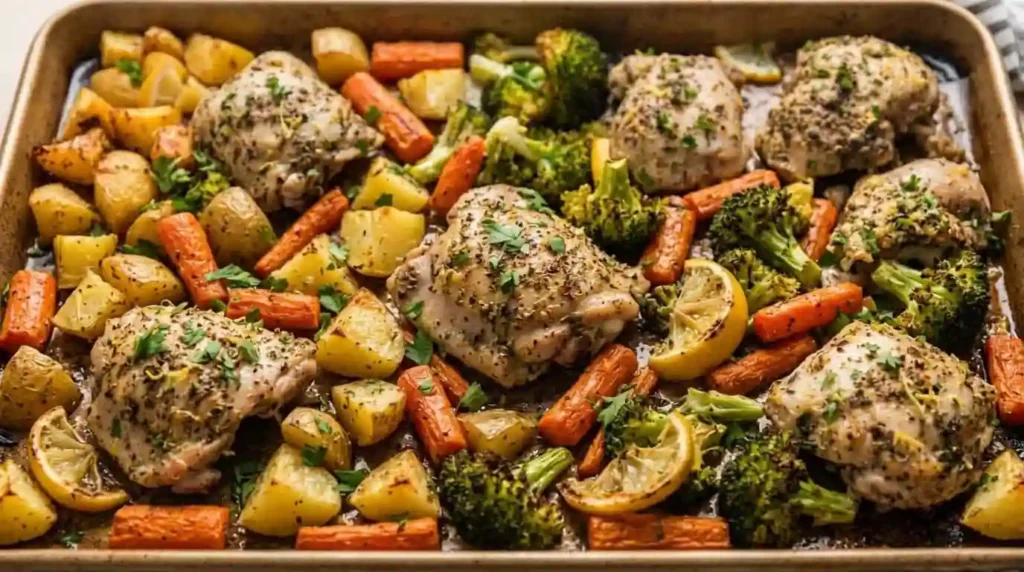
The plan sounds almost too easy to fail. Put the chicken on a sheet pan. Add some potatoes and vegetables. Season everything, slide the pan into the oven, and get on with the rest of dinner.
Except twenty minutes later, the broccoli is soft and dark around the edges while the potatoes are still stubbornly firm. The chicken isn’t ready either. There is another round of oven time coming, and the vegetables that were supposed to make this dinner feel efficient are already looking tired. This is the kind of dinner problem that can make a useful kitchen shortcut feel strangely unreliable.
Picture a weeknight when you’re trying to get dinner moving after a long day. There isn’t necessarily anything wrong with the recipe or the oven. The ingredients simply went onto the pan together because they were all supposed to be dinner together. That small assumption is where things start to go wrong.
Why Does My Sheet-Pan Dinner Never Finish Together?
The first instinct is usually to change something about the cooking. Cut the vegetables smaller. Turn the oven up. Move the pan to a different rack. Give everything another ten minutes. Take the chicken out when it looks done and let the vegetables keep going.
Sometimes one of those adjustments helps. Sometimes it creates a different problem. A smaller piece of potato does cook faster than a large one, for example. But cutting everything smaller isn’t necessarily the answer if the chicken and broccoli are already cooking on the same pan. The broccoli may still be finished long before the potatoes.
The easier way to look at it is this: the oven is shared, but the cooking schedule doesn’t have to be.
A sheet pan makes it possible to cook several foods together. It does not make those foods identical.
Potatoes are dense. A thick carrot takes time to soften in the center. A piece of chicken has its own thickness and needs to reach a safe internal temperature. Broccoli florets have more exposed surface area than a thick piece of potato, so they may soften and brown sooner. Zucchini also behaves very differently from a dense vegetable like a potato.
Putting all of them in the oven at the same moment asks each ingredient to behave as though it has the same timetable.
It doesn’t.
The Timing Problem Wasn’t Really a Recipe Problem
Some of the familiar failures make more sense when you look at the ingredients this way.
A large chunk of potato needs more time than a thin slice. A thick chicken breast needs a different amount of time than a smaller piece. A handful of asparagus can go from crisp-tender to limp while a tray of root vegetables is still working toward tenderness.
Starting everything together doesn’t solve those differences. It just hides them until dinner is nearly ready.
The better approach is to think about density, size, thickness, moisture, surface area and desired doneness before the pan goes into the oven.
That doesn’t mean calculating cooking times to the minute. It means looking at the food and asking which pieces need a head start.
The same principle is used in many successful sheet-pan recipes: ingredients can be arranged and added in stages rather than treated as one batch. Food Network’s sheet-pan guidance similarly recommends pairing ingredients with similar cooking times or starting slower-cooking items earlier.
What Happens When Everything Goes on at Once?
There is another problem hiding underneath the timing issue: moisture.
Vegetables naturally release water as they heat. If too much food is packed onto a pan, that moisture has less room to escape. The vegetables can begin to steam in the crowded spaces instead of roasting and browning properly.
That is one reason a sheet-pan dinner can produce vegetables that are cooked but not particularly crisp or browned.
Crowding also makes the timing problem harder. A packed pan leaves less room around each piece, which can make roasting less even.
You can see the difference just by looking at the tray before it goes into the oven. If the vegetables are piled into a thick layer or touching in every direction, the pan is probably too crowded.
Roasting vegetables generally benefits from spreading them into a single layer with room around the pieces. If the amount of food won’t fit comfortably, using two pans is often more useful than forcing everything onto one. U.S. university extension guidance makes the same recommendation, noting that overcrowded vegetables can steam rather than roast.
That can feel like cheating when the whole appeal of a sheet-pan dinner is having one pan.
It isn’t.
Two uncrowded pans can be easier than one overloaded pan that produces a pile of steamed vegetables and unevenly cooked meat.
The Staggered Sheet-Pan Rule
The rule is straightforward:
Ingredients that need more time go on first. Ingredients that need less time join later.
Then there is the part that is easy to overlook:
Leave enough room for the food to roast.
Think of the sheet pan as both a cooking schedule and a physical layout.
Start with the dense vegetables or other ingredients that need the most time in the oven. Potatoes, sweet potatoes, carrots and similar root vegetables are common examples.
Later, add foods with a more moderate cooking time, such as cauliflower, Brussels sprouts, larger pieces of broccoli or onions.
Later still, add quicker vegetables such as asparagus, bell peppers, zucchini, green beans or cherry tomatoes, depending on the cut and the texture you want.
Those categories aren’t hard rules.
A thick carrot and a thin carrot do not cook alike. A halved Brussels sprout is different from a whole one. Small broccoli florets will behave differently from large chunks. Even the starting temperature of an ingredient can affect how quickly it cooks.
So the useful question isn’t, “How long does broccoli take?”
It is, “How long should this piece of broccoli, cut this way, take at the temperature I’m using?”
So When Should the Meat Go On?
Meat needs its own place in the calculation.
Chicken, for example, is not simply another vegetable that can be timed by appearance. Thickness matters. So does the cut, whether it is bone-in or boneless, its starting temperature and the oven temperature.
A recipe may give you a suggested sequence, but the meat’s safe internal temperature is the important endpoint.
For poultry, the USDA recommends a minimum internal temperature of 165°F, measured with a food thermometer. Color alone isn’t a reliable safety test.
That means the staggered rule is not an excuse to pull chicken out early because the vegetables look perfect.
Instead, use the vegetables and the meat as separate timing problems that happen to share a pan.
For example, potatoes or carrots might begin roasting first. Chicken can be added when its expected cooking time fits the rest of the meal, based on its cut, size and preparation. Broccoli or another quick vegetable can join later.
The exact sequence has to come from the particular ingredients and recipe. There isn’t one universal sheet-pan timetable that works for every combination.
What If the Pan Is Already Too Full?
This is where many sheet-pan dinners quietly go wrong.
A standard rimmed baking sheet only has so much usable space. It may look large on the counter, but a meal for several people can fill it quickly.
A pound of potatoes. A few chicken breasts. A couple of peppers. Broccoli. Maybe onions.
Suddenly the vegetables aren’t spread out anymore. They’re touching, stacked or tucked underneath other ingredients.
If everything is crowded together, use a larger appropriate pan if available, divide the food between two pans, or reduce the amount on each pan. A wire rack can also help with some preparations by allowing air to circulate around the food, although it is not necessary for every sheet-pan dinner.
The goal isn’t to create a perfect geometric arrangement.
Food needs breathing room.
And don’t assume parchment paper will solve a crowding problem. It may make cleanup easier, but it can’t create additional space or compensate for a pan that’s overloaded.
A Better Way to Plan the Pan
Before cooking, divide the ingredients into three rough groups.
First: the foods that are dense, large or otherwise slow to become tender.
Potatoes, sweet potatoes and carrots often belong here.
Second: ingredients that need a moderate amount of roasting.
Cauliflower, Brussels sprouts, onions and larger broccoli pieces may fall into this group, depending on how they’re cut.
Third: quick-cooking or delicate vegetables.
Asparagus, bell peppers, zucchini, green beans and cherry tomatoes can often go in later.
Then look at the meat separately.
Ask how thick it is, what cut it is, whether it has bones, and what safe internal temperature it needs to reach. The recipe’s suggested oven temperature and sequence should guide the timing rather than trying to force the meat into the vegetable schedule.
There may be a little trial and error from one dinner to the next. That’s normal. Ovens vary, and ingredients aren’t all cut to exactly the same size.
The point is to stop treating simultaneous cooking as the goal.
Finishing together is the goal.
Why This Makes Sheet-Pan Dinners Easier
Once you get used to staggering the ingredients, the process is simpler than it sounds.
You don’t need a stopwatch for every vegetable.
You just need to notice the differences that matter.
A potato chunk is going to need more help than a thin strip of pepper. A thick piece of chicken isn’t going to follow the same timetable as a handful of green beans. A crowded pan can leave vegetables softer and less browned than a well-spaced one.
That gives you a simple mental model:
Same pan does not mean same start time.
It also explains why some sheet-pan recipes seem effortless while others require constant checking. The better ones account for those differences, either through compatible cooking times, different cuts or staged additions.
The method isn’t really about making dinner more complicated. It’s about making those decisions before the pan goes into the oven.
Coming Back to the Dinner That Went Wrong
Imagine that same weeknight dinner being made again.
The potatoes go onto the pan first because they need the head start. The chicken joins when its cooking schedule makes sense. The quicker vegetables wait until later.
There is space between the pieces instead of a solid layer covering the pan.
Nobody has to rescue the broccoli from an early finish while waiting for the potatoes. Nobody is standing at the oven wondering whether the chicken is safe to serve yet. The meal still requires attention, and the timing still depends on the particular ingredients.
But the cook isn’t fighting the pan anymore.
A sheet-pan dinner works best when the ingredients share the oven, not necessarily the clock. Give the slower foods a head start, bring in the quicker ones later, and leave the pan enough room to roast.
The sheet pan can still do what you wanted it to do in the first place: get dinner cooked with relatively little fuss.
It just doesn’t have to do everything at once.