The first sign of fall isn’t always a red maple or a pumpkin on the porch. Sometimes it is the plant.
One evening in September, you notice that the nights have started getting noticeably cooler. The pothos that spent the summer on the patio is still putting out new leaves. The ficus looks better than it has in months. Even the potted citrus has enjoyed its long stretch of bright outdoor light.
So you start moving everything closer to the back door. You’ll bring them in soon, you think. Maybe this weekend. Then the forecast drops another few degrees. The plants come inside.
For a few days, nothing seems wrong. Then a yellow leaf appears on the ficus. Another one lands on the floor. The citrus starts looking slightly miserable. You water because the soil seems dry enough, only to discover a few days later that it is still wet.
And then, one morning, there they are. Tiny black flies circling the pot. You stare at them for a moment, hoping they are fruit flies. They probably aren’t.
This is the part of bringing plants indoors for winter that tends to catch people off guard. You thought you were moving a few pots into the house. In reality, you were moving living things from one environment into another, and almost every condition around them changed at once.
That matters. Outside, a houseplant enjoying summer has considerably more light than it will receive through most household windows. The air moves around it. Rain or frequent watering dries at a different rate. Temperatures fluctuate. Beneficial insects and predators are present. Soil organisms are part of a much larger outdoor ecosystem.
Inside, the same pot can behave very differently. Light is weaker. Air movement is lower. Household temperatures are steadier. Later in the season, heating can make the air warmer and drier. Most importantly for watering, the potting mix may stay wet for considerably longer because the plant is using less water as days shorten and growth slows.
That last change is easy to miss. You remember how often you watered in July. The plant doesn’t necessarily need that schedule in October.
University of Minnesota Extension notes that many houseplants should come indoors as temperatures move into the 40s and 50s, while the exact tolerance varies by species. Some succulents and cold-tolerant seasonal plants can handle cooler conditions, while many tropical houseplants cannot.
So there isn’t one magical date on the calendar when every plant in the country should cross the threshold. The weather matters more than September 15 or October 1. And so does the plant.
When to bring plants inside for winter
If you have tropical foliage, tender houseplants, or container citrus that spent the summer outside, start watching nighttime temperatures rather than waiting for the first frost. For many common houseplants, temperatures dropping into the 40s and 50s are a signal to start paying attention. Some plants can tolerate brief cool spells better than others, while genuinely tropical plants can be damaged by temperatures that would barely bother a cold-hardy perennial.
Your region changes the timing, too. A gardener in Minnesota may be dealing with chilly nights considerably earlier than someone along the Gulf Coast. A gardener in the Mid-Atlantic may have several weeks of comfortable transition weather. Parts of the South and Southwest may keep tender containers outside much longer.
The useful question is not simply, What month is it? It is: What does this plant tolerate, and what are my nighttime temperatures doing? For many northern U.S. gardeners, that can mean starting to think about the move as early as September, while warmer regions may have more time.
There is another reason not to wait until the last minute. Pests.
The bugs you don’t notice outside can become very noticeable inside
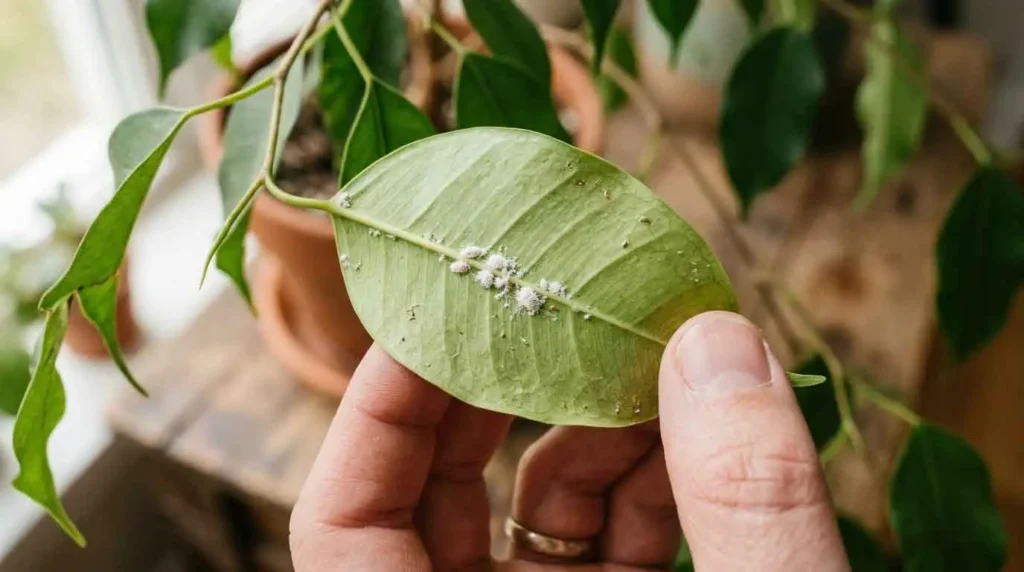
A plant can look perfectly healthy on the patio and still be carrying a few unwanted passengers. Look closely at the undersides of leaves, where leaves meet stems, along new growth, around pot rims, and underneath containers. Check the saucer, too. University of Minnesota Extension recommends examining the entire plant and container and notes that a hand lens can reveal pests that are difficult to see with the naked eye. It also recommends checking pot rims, bottoms and saucers.
Look for:
- fine webbing or tiny moving specks, which can point toward spider mites
- clusters of small insects on new growth, such as aphids
- white, cottony material associated with mealybugs
- raised bumps or shell-like insects that may be scale
- tiny flies moving around the soil, which may be fungus gnats
The important part is that you don’t need to assume every insect is a disaster. You need to know what you have before the plant joins the rest of your collection. Outside, rain, predators and other environmental conditions can help keep pest populations in check. Indoors, many of those checks are reduced.
A small problem can become much harder to manage when several plants are sitting together in the warm, relatively protected environment of a living room.
Fungus gnats are especially good at making themselves known in fall
Those tiny black flies around the pot are often fungus gnats, not fruit flies. They are small, weak-flying insects whose larvae develop in moist growing media. The adults are mainly a nuisance, while the larvae feed primarily on fungi, algae and decaying organic material, although they can also feed on plant roots. And fall creates a particularly convenient setup for them.
Plant growth often slows. Day length decreases. The soil doesn’t dry as quickly. Meanwhile, the gardener may continue watering according to the summer routine. Colorado State University Extension identifies moist growing media as a major factor in fungus-gnat problems and notes that these pests are often more noticeable in late fall and winter, partly because plants that spent summer outdoors can bring populations indoors with them.
So if the soil is staying wet longer than it used to, don’t respond automatically with another watering. Check it first.
Give the plants a cleaning before they come through the door
Once you’ve decided which plants are coming inside, give them a proper inspection and wash. A garden hose is useful for larger plants. A sink or shower works for smaller ones. A reasonably firm spray of water can physically remove dust and some soft-bodied insects. University of Minnesota Extension also recommends washing leaves and cleaning the outside of pots before bringing plants indoors.
Work over the whole plant. Look underneath the leaves, not just across the top where everything looks clean. Wipe or rinse the pot itself. Pay attention to the rim and bottom. Empty and clean the saucer.
If a plant is heavily infested or carrying a pest problem that is proving difficult to control, bringing it into a room full of other plants may not be worth the risk. Extension guidance notes that in severe cases, discarding a heavily infested plant can be the most economical way to protect the rest of a collection.
And don’t automatically spray everything “just in case.” Identify the pest first. If you do use an insecticide, insecticidal soap or horticultural oil, the product must be labeled for the particular plant, pest and intended use. Not every garden pesticide is appropriate for use indoors, and even products sold for houseplants can have specific application requirements.
Don’t put the returning plants beside everyone else
This is the step people are most likely to skip. The plant comes inside. It looks fine. You put it next to the monstera. Two weeks later, the monstera has a problem too. A quarantine period doesn’t need to feel like running a botanical laboratory in your spare bedroom. The basic idea is simply to give returning plants their own space for a while, away from your established indoor collection.
Penn State Extension recommends isolating plants brought inside for the winter for about three weeks, while University of Minnesota guidance recommends isolation for roughly one to two weeks for new additions so potential pest problems have time to become visible. That difference is useful. It tells you there isn’t a sacred magic number. Think in terms of roughly two to three weeks when practical, especially if you’re bringing several outdoor plants back into a large collection.
During that period, inspect them regularly. Check when you water. Look underneath leaves. Watch sticky traps if you’ve placed them near the pots. Look for new webbing, honeydew, scale or flying insects.
The purpose of quarantine is not to prove that the plant is perfectly clean. It’s to give you time to discover a problem before it becomes everybody’s problem.
Expect some leaves to fall
This is where many perfectly good plants get an unfair diagnosis. You bring in a beautiful ficus. A week later, it drops leaves. You panic. Then you move it to another window. Water it. Move it again. Add fertilizer. Maybe repot it. Now the plant has experienced even more changes.
Some leaf yellowing and leaf drop can happen when plants transition from outdoor conditions to indoor ones. University of Minnesota Extension specifically notes that this is common and can be related to the change in environment and shorter light duration. Tropical plants such as hibiscus, ficus and citrus can respond this way during the transition. That doesn’t mean you should ignore severe decline. It means a few unhappy leaves immediately after the move don’t necessarily mean you’ve killed the plant.
Give it some consistency.
Let the light change gradually
Imagine spending an entire summer outside and then being asked to live beside a window. Even the sunniest household window doesn’t deliver the same outdoor light environment. If possible, make the transition less abrupt. University of Minnesota Extension recommends gradually reintroducing plants to indoor conditions rather than moving them suddenly from outdoor conditions to a very different indoor environment.
The exact approach depends on the plant. A pothos, ficus, citrus tree and shade-loving plant aren’t going to have identical light requirements. Start with the light the plant actually needs rather than automatically choosing the darkest convenient corner of the house. If the plant later stretches toward the window, supplemental lighting may be useful.
And once you’ve chosen a good spot, try not to keep moving the plant around every few days because one leaf looks unhappy. Sometimes the best intervention is leaving it alone.
Change your watering habits, too
This is one of the easiest ways to accidentally create the fungus-gnat problem you’re trying to prevent. Outside, a large container may dry quickly because of sunlight, heat and airflow. Inside, that same pot may stay moist. Colorado State University Extension recommends allowing the growing medium to dry between waterings, particularly the upper portion of the soil, because moisture encourages fungus-gnat development.
That doesn’t mean every houseplant should be allowed to become bone-dry. It means you should stop watering by memory. Stick your finger into the soil. Lift the pot if you know how it normally feels when it needs watering. Learn how quickly that particular container is drying in its new location.
The summer schedule has ended. Your plant’s water use has changed with it.
What went wrong?
The frustrating part of this whole process is that most failures are ordinary mistakes.
“I put it in the sunniest window.”
More light isn’t automatically the answer to every transition problem. A plant still needs time to adjust, and the right location depends on the species.
“I kept watering like I did outside.”
This is one of the easiest ways to keep indoor soil unnecessarily wet and invite fungus gnats.
“I checked the leaves, so I knew it was clean.”
Pests don’t restrict themselves to the most obvious parts of a plant. Check leaf undersides, stems, pot rims, saucers and the bottom of containers.
“Those tiny flies are probably fruit flies.”
If they’re hovering around your pots and repeatedly emerging from the soil, fungus gnats are worth considering.
“I brought everything inside on the same afternoon.”
Understandable. Also exactly how you end up with six pots indoors before you’ve inspected even one of them properly.
“I sprayed something just in case.”
Resist that impulse. Identification comes first, and the label determines whether a product is appropriate for the plant, pest and indoor setting.
The easier way to think about the whole process
By the time fall arrives, the temptation is to treat bringing plants indoors as one large chore: carry the pots inside, put them near the windows and hope everything makes it to spring. A little more patience at the beginning makes winter much easier. Start watching nighttime temperatures. Decide which plants actually need protection. Inspect them before they enter the house, then wash the foliage and clean the containers. Separate returning plants from your established collection and watch them for a couple of weeks. Then adjust light and watering to their new environment.
That’s it. There will still be a yellow leaf. A ficus may complain. You may discover one fungus gnat three weeks after you were certain the plants were clean. Gardening rarely gives us that kind of certainty.
The useful part is knowing what you’re looking at. A plant dropping a few leaves after coming inside isn’t necessarily a crisis. Soil staying wet for much longer than it did outdoors is useful information. A few tiny flies around a pot are worth investigating before they become twenty tiny flies around every pot.
The goal isn’t to make the transition perfect. It’s to make it gradual enough that the plant has a chance to catch up with you. And next fall, when you find yourself standing beside the back door with six pots waiting to come inside, you’ll know what to look for before you carry them through it.
Sources & Further Reading
- University of Minnesota Extension, “Bringing houseplants in for winter” — seasonal timing, pest inspection, quarantine, leaf drop and pesticide-label guidance.
- University of Minnesota Extension, “Managing insects on indoor plants” — inspection, hand lenses, washing, isolation and pest identification.
- Penn State Extension, “Pest and Disease Problems of Indoor Plants” — recommends isolating plants brought indoors for about three weeks and monitoring foliage, stems and soil.
- Colorado State University Extension, “Fungus Gnats as Houseplant and Indoor Pests” — fungus-gnat biology, moisture conditions and management.
- University of Minnesota Extension, “Time to bring houseplants back inside” — washing plants and containers and gradually reintroducing plants to indoor conditions.