
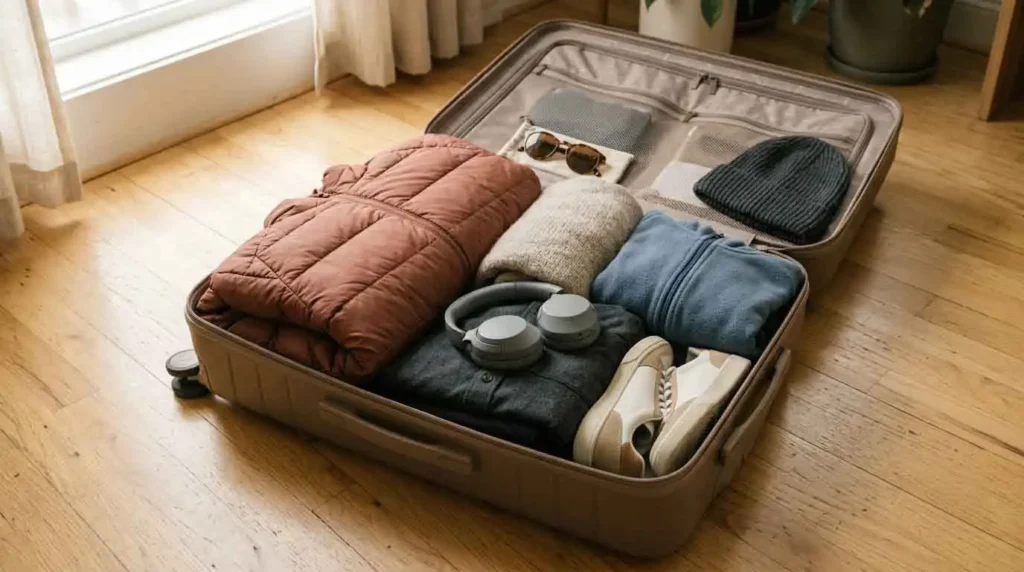
It usually happens with the winter clothes. A suitcase that swallowed five summer outfits without a complaint suddenly looks impossibly small once the sweaters, fleece, long-sleeve shirts and heavier layers come out of the closet. You press down on the lid. You sit on the suitcase. You try the zipper again. It moves about two inches.
Picture Megan packing for a five-day trip in December. She has already removed one sweater and worn her bulkiest shoes on the plane. Still, the suitcase looks as though it has been packed by someone preparing to live in a cabin for three months rather than visit family for a long weekend. So she does what many travelers do: she starts looking for a more efficient way to pack. That is how compression packing cubes enter the picture.
The promise is appealing: put your clothes inside, close the second zipper, squeeze out the air, and suddenly there is room for more. There is some truth to that. Compression can substantially reduce the space occupied by lofted clothing. The trouble starts when that extra space is mistaken for extra carrying capacity.
Megan’s suitcase wasn’t suddenly lighter. The air inside her clothes was.
The part packing-cube advertisements tend to skip
Winter clothes are unusually good candidates for compression because many bulky garments contain a surprising amount of trapped air. Fleece, down and other lofted textiles can take up a great deal of space without being especially heavy. Compression packing cubes work mechanically by squeezing that trapped air out of the clothing and holding the fabric in a smaller volume. The research behind this article estimates that some dual-zipper compression systems can reduce clothing volume by as much as 40 percent.
It sounds almost magical until you think about what has actually changed. The fabric is still there, the sweater is still there, and the pounds have not gone anywhere.
This is the distinction that gets lost in a lot of packing advice: compression changes volume, not mass. So if your suitcase is too full because your clothes are fluffy, compression can help. If your suitcase is too heavy because you packed six pairs of boots, three thick sweaters and a pile of holiday gifts, compression cannot rescue you.
In fact, it can make the problem easier to miss.
That’s where Megan got into trouble
Once Megan saw empty space appearing inside the suitcase, she did what felt completely logical: she filled it. Another sweater went in, then a pair of jeans, followed by the coat she had originally planned to wear on the plane. The suitcase still closed, which felt like success.
The research highlights a potential failure mode with compression cubes: they turn soft clothing into dense, rigid blocks. Once travelers use the newly created space to pack more belongings, the suitcase can become heavier while its overall dimensions remain unchanged.
That matters because airlines can have separate limits for how large a bag is and how much it weighs.
During the late-fall and winter travel season, when bulky clothing is competing for limited suitcase space, that distinction becomes particularly important. That’s also when interest in compression cubes rises as travelers start trying to fit cold-weather clothing into carry-on luggage.
Overweight baggage can be expensive. On major U.S. carriers, excess-weight fees can reach $100 to $200 for common overweight ranges, although fees and weight limits vary by airline and route. Check your airline’s current baggage policy before heading to the airport.
Suddenly, “I found more room” doesn’t sound quite as satisfying.
Compression works best on clothes that behave like air-filled objects
Compression cubes aren’t a gimmick in every situation. The trick is knowing which fabrics actually benefit from being squeezed.
Down, fleece and synthetic base layers are particularly suitable because they contain more loft that can be reduced. Merino wool, linen and structured tailoring are much less attractive candidates, especially when appearance matters.
That makes sense once you stop thinking of a compression cube as a magical suitcase expander and start thinking of it as a tool for rearranging soft material.
A fleece pullover can tolerate being squeezed into a smaller bundle, but a structured blazer is another story. A fine wool garment that needs to arrive looking polished is not exactly asking for several days of aggressive compression. The research specifically warns that structured clothing can come out with persistent creasing.
Megan’s mistake, then, wasn’t buying the cube. It was asking the cube to solve a problem it couldn’t solve.
The better experiment is smaller than you think
Instead of compressing everything, she separates the suitcase into two groups. The first is soft, bulky clothing—fleece, down layers, synthetic base pieces and similarly lofted items. The second is everything else: shoes, toiletries, books, denim, structured clothing and other dense objects. Only the first group goes into the compression cubes.
That leaves her with a suitcase that is easier to organize without turning every available inch into an invitation to add more weight. The same approach can make sense for travelers using soft luggage or frameless travel backpacks, where internal compression can also provide some structure. The approach is particularly useful for carry-on travelers packing four to seven days of winter clothing, especially when avoiding a checked bag is the goal.
The trick is to treat the space you create as flexibility, not as a new quota for belongings. That small change keeps extra space from becoming extra luggage.
A simple way to decide whether you actually need compression cubes
Before buying anything, look at what is filling your suitcase. If the main problem is fluffy clothing, compression may be useful; if the suitcase is already heavy with dense clothing and other belongings, it probably isn’t. Down jackets, fleece layers and synthetic base layers are logical candidates for a compression cube, while tailored clothes for a business trip are a different story. On a warm-weather trip, the benefit may be much smaller because lightweight summer fabrics contain less trapped air, leaving less volume to squeeze out.
There is another situation in which a compression system may not be the smartest choice: a hard-sided 50/50 clamshell suitcase. The research notes that heavily compressed cubes can become dense, inflexible blocks that don’t necessarily sit neatly around the internal frame and recesses of that style of luggage. In other words, the cube may create more theoretical space while making the real-world geometry of the suitcase harder to work with.
Don’t confuse a fuller suitcase with a better-packed suitcase
A suitcase can be neatly organized and fully zipped and still be a bad suitcase to take to the airport. Packing has at least three competing limits: volume, weight and shape. Compression helps mainly with the first. Once a cube is compressed, its contents become more compact and often more rigid, and if you keep pushing items into the remaining space, you can end up with a bag that looks beautifully efficient while quietly becoming too heavy for the airline limit. The supplied research specifically identifies this as one of the central consumer misunderstandings surrounding compression cubes.
After compression, the better question isn’t “How much more can I fit?” It’s “Do I need anything else?” That question may save you more in baggage fees than another zipper ever will.
There is no prize for compressing everything
You don’t have to put every shirt into a compression cube simply because the cube has a second zipper, or fill an empty corner of your suitcase because you discovered one. And you certainly don’t need to buy compression cubes just because another traveler swears by them. For a carry-on-only traveler heading somewhere cold for several days, compression can solve a genuine spatial problem. For a business traveler carrying tailored clothing, a summer traveler with lightweight fabrics, or someone already traveling comfortably with room to spare, the purchase may accomplish very little.
Sometimes the best packing upgrade is simply taking fewer things. It is not as satisfying as buying a new gadget, but your suitcase has never been impressed by gadgets.
What Megan finally changed
Megan keeps the compression cubes. She just stops treating them like a suitcase expansion pack.
Her fleece and soft winter layers go in them, while her structured clothes stay out. She leaves enough flexibility in the suitcase to arrange everything without forcing rigid cubes against every corner. Most importantly, once the clothing fits, she doesn’t use the recovered space as permission to keep shopping the closet. The suitcase closes without the usual fight with the zipper, and Megan knows the extra room came from removing air, not weight.
Compression packing cubes are useful when your problem is bulky clothing. They are not a way around an airline’s weight limit, and they cannot turn five pounds of belongings into three. The smartest use of one is surprisingly modest: make soft clothes smaller, then stop packing.